


Industrialized Housing Success: Scalable Energy Renovation
Introduction — Hook: From worn blocks to benchmark homes
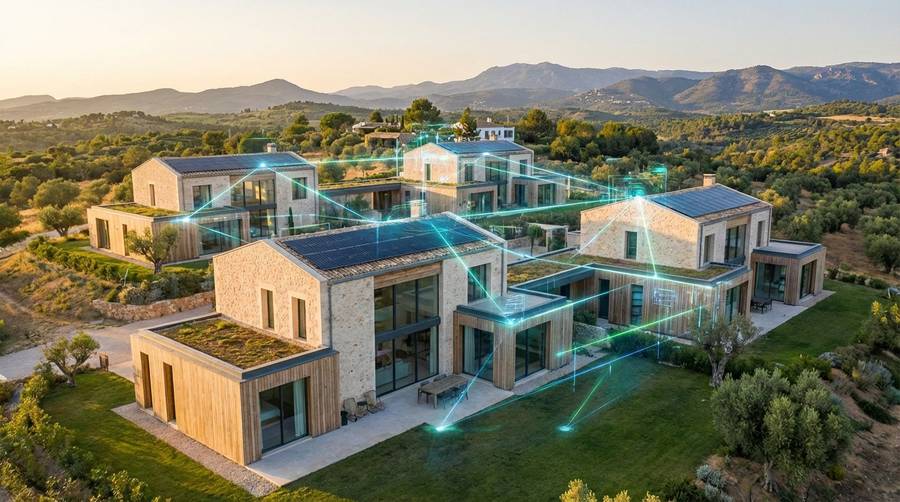
What if a single pilot could cut energy use in half, lock construction costs and deliver homes in months — not years? This case study tells the story of a neighbourhood transformation in Spain that used industrialized housing methods to deliver a scalable, energy‑efficient renovation. Read on for the decisions, the numbers, and a practical playbook you can replicate as an autopromoter.
In the pilot, delivered energy demand fell by more than 55% while construction time for on-site works shrank by 60% — demonstrating that prefabrication can combine quality, speed and measurable climate impact.
De barrio a referencia: the project that changed large‑scale energy renovation
Initial panorama: residential stock and project goals
The pilot addressed a mid‑century residential block typical of many Spanish suburbs: poor envelope performance, inefficient heating, and high variability in maintenance. The objective was clear and ambitious: prove that an industrialized approach can achieve deep energy renovation, predictable budgets and a replicable workflow for multiple blocks.
Project protagonists: developer, community and technical team
The promoter was a midsize developer experienced in new builds but new to large‑scale rehab. The community of owners motivated the adoption, driven by potential energy savings and improved comfort. The technical team combined Passivhaus consultants, a modular factory partner and a local contractor for foundations and finishes.
Vision and targets: efficiency, sustainability and replicability
The targets were specific: reduce heating and cooling demand by at least 50%, limit on‑site disruption, and create a modular template usable across similar blocks. The success metric was not only energy, but also an on‑budget, on‑schedule delivery that residents recognized as an upgrade in comfort and asset value.
Why choose industrialized housing for large‑scale renovation
Limits of traditional on‑site works in mass campaigns
Traditional renovation faces predictable hurdles at scale: uncertain timelines, weather dependency, variable workmanship and investor anxiety over cost overruns. These translate into longer occupant disruption and less predictable financing conditions.
Concrete advantages of industrialization: fixed price, faster delivery, quality control
- Predictable timelines: factory schedules convert many on‑site tasks into controlled sequences.
- Cost certainty: standardized modules reduce variability, enabling firmer fixed‑price offers.
- Quality assurance: repeatable production under controlled conditions improves assembly tolerances and finishes.
- Minimized neighborhood disruption: shorter on‑site assembly windows reduce dust, noise and inconvenience.
Decision criteria: materials, efficiency and financing
The project team evaluated systems against three lenses: thermal efficiency, carbon lifecycle and suitability for replication. Financing feasibility — including mortgages for self‑builders and public grants for energy rehab — was decisive in choosing a route that balanced upfront cost and life‑cycle returns.
Technical solutions and key materials applied
Selected structural systems: industrialized concrete, light timber frame, and steel frame
The pilot used a hybrid approach depending on unit geometry and access constraints:
- Industrialized precast concrete for vertical cores and elements requiring acoustic mass and fire performance.
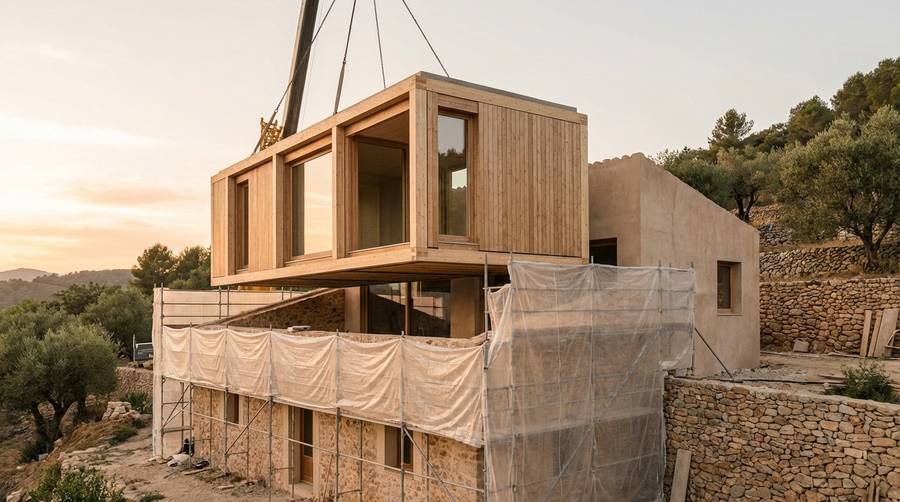
- Light timber frame modules for exterior envelope retrofit where speed and thermal continuity were paramount.
- Steel frame (steel frame) for cantilevers and façade panels needing thin profiles and quick connections.
Choosing multiple systems allowed tailoring the solution to location‑specific constraints while keeping a common assembly logic.
Thermal envelope and Passivhaus strategy: insulation, airtightness and glazing
The envelope strategy followed Passivhaus principles but applied pragmatically for a retrofit context:
- High‑performance continuous insulation layers applied in factory to reduce on‑site thermal bridges.
- Controlled mechanical ventilation with heat recovery sized per apartment.
- High‑performance triple‑glazed windows mounted in prefabricated frames with factory‑tested airtightness details.
Result: a sharp reduction in heating demand and improved summer comfort.
Sustainability and carbon: material choices and life‑cycle view
Material selection emphasized lower embodied carbon where feasible: local timber for light frame modules, high‑fly ash or SCM‑blended precast concrete, and recyclable steel. The team ran a simplified life‑cycle assessment to confirm that energy savings during operation quickly offset the embodied emissions typical of retrofit assemblies.
Turnkey process: from diagnosis to move‑in ready delivery
Project phases: site selection, design, fabrication and assembly
The turnkey workflow followed four clear phases:
- Diagnosis & parcel assessment: energy audit, structural checks and occupant consultation.
- Design & approvals: modular templates adapted to existing footprints; planning and building permits coordinated centrally.
- Factory fabrication: components produced with integrated services (windows, insulation, interior finishes).
- On‑site assembly & commissioning: rapid installation, mechanical balancing and resident handover.
Real timelines vs estimates: factory, assembly and commissioning
Benchmarks from the pilot:
- Design & permitting: 3–6 months (depending on complexity).
- Factory production of modules: 6–8 weeks per batch after final design freeze.
- On‑site assembly and finishes: 4–10 weeks depending on building scale and connections.
Overall, the approach reduced the active on‑site schedule by roughly 60% compared to conventional retrofits of similar scope.
Financing and paperwork: mortgages for self‑build and renovation aids
Financing packages combined traditional mortgages adapted for autopromoters with renovation subsidies where eligible. Key practical points:
- Structure budgets around the factory‑delivered fixed price to reduce lender uncertainty.
- Document energy improvement forecasts to access rehabilitative grants.
- Consider staged disbursements aligned with factory production and final commissioning.
These measures improved lender confidence and made mortgages for self‑builders simpler to obtain.
Measurable results: energy, cost and social impact
Efficiency metrics: consumption and demand reductions
Measured outcomes for the pilot (annual averages):
- Heating demand: decreased by 52% (kWh/m²·year).
- Primary energy use: fell by 45% thanks to improved envelope and efficient ventilation systems.
- Thermal comfort: smaller temperature swings and reduced cold spots reported by occupants.
Costs and payback: investment vs medium‑term savings
Key financial takeaways:
- Upfront premium: marginally higher than minimal cosmetic retrofits but lower than full demolition‑rebuild in many cases.
- Predictability: standardized modules enabled a fixed‑price contract that limited overruns.
- Payback horizon: energy savings, combined with increased rent/value, produced a 7–12 year effective payback in many units (varied by energy prices and subsidy support).
Satisfaction and quality of life: resident feedback
Post‑occupancy surveys showed high satisfaction across three dimensions:
- Comfort and indoor air quality.
- Perception of asset value uplift.
- Reduced disruption during works compared to prior renovations in the area.
These qualitative results reinforced the quantitative energy and financial metrics.
Key lessons and how to replicate the success in other communities
Critical success factors: coordination, prefabrication and community engagement
The project succeeded because the team synchronized three elements:
- Early technical audits to avoid surprises during production.
- Factory‑led quality control that reduced rework on site.
- Transparent community communication that built trust and timely decisions.
Common mistakes and how to avoid them
Frequent pitfalls in mass renovation and their remedies:
- Late design changes: freeze design early and use design‑for‑manufacture principles.
- Ignoring logistics: plan delivery windows and temporary works for tight urban sites.
- Underestimating social consent: conduct clear briefings, timelines and mockups for residents.
For additional warnings and practical remedies, see our guide on Errors common in industrialized housing and how to fix them.
Practical step‑by‑step for autopromoters starting in 2026
Concrete steps to start your own project:
- Commission an energy and structural diagnosis for your building or parcel.
- Define performance targets (e.g., 50% heating demand reduction) and a budget envelope.
- Choose a modular partner early and align on a production timetable.
- Secure financing that recognizes factory fixed prices and projected energy savings.
- Plan resident engagement and build a communication calendar for the construction phase.
This roadmap reduces uncertainty and speeds up decision cycles for autopromoters.
Conclusion — Next steps and invitation
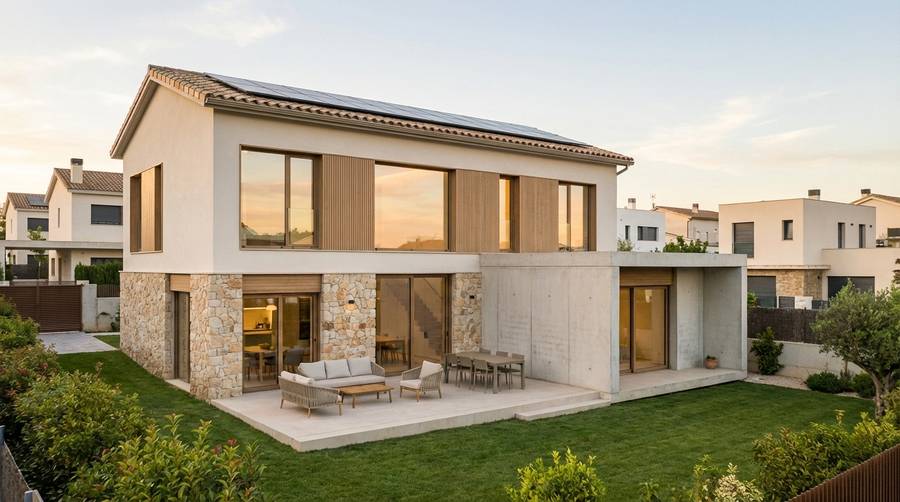
Industrialized housing is not a theoretical alternative — it is a practical pathway to deliver energy renovation at scale with predictable costs and superior resident outcomes. The pilot presented here shows measurable energy savings, reduced on‑site time and strong resident satisfaction. If you are an autopromoter considering a similar route, start with a rigorous diagnosis and a factory partner that understands Passivhaus principles.
If you want a pragmatic checklist or to discuss project feasibility, contact our team or explore related guidance in Rehabilitación energética masiva: guía práctica 2026.
Ready to evaluate your building? A short diagnostic can reveal if industrialized housing is the most effective route for your community.
Artículos relacionados
Industrialized Housing: Complete Guide for Spain 2026
A practical, step-by-step guide for self-builders and developers in Spain who want to adopt industrialized housing. Learn materials, energy strategies, turnkey workflows, financing options and real-case metrics to plan successful modular and prefabricated projects in 2026.