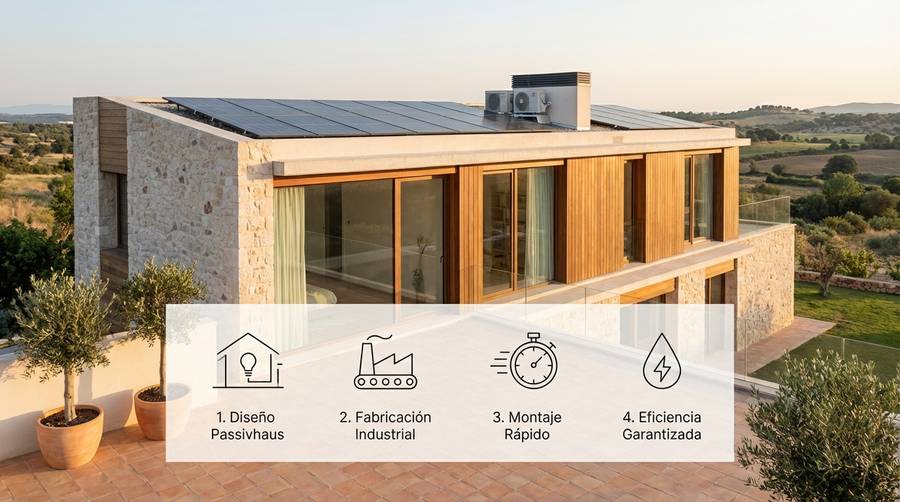
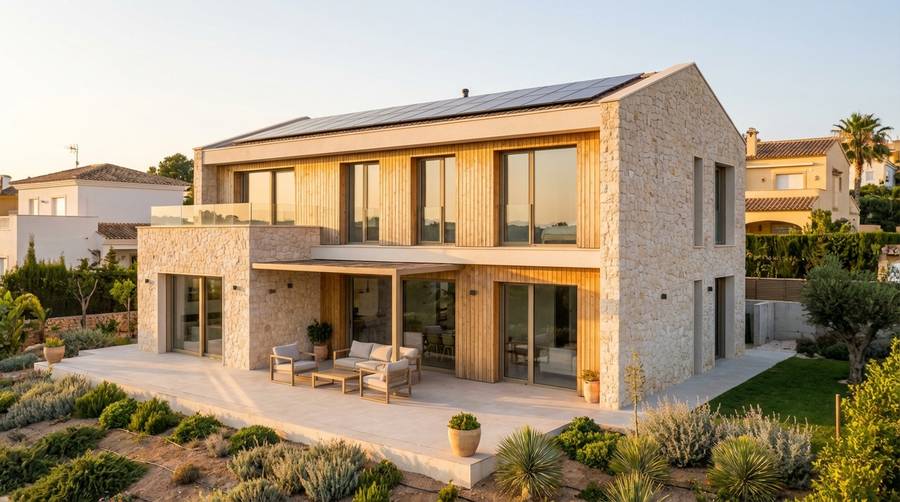
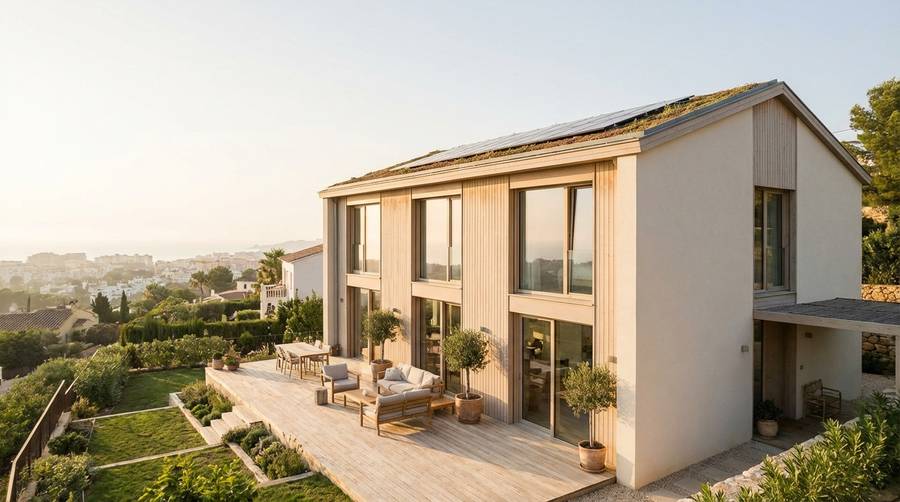
Passivhaus Industrialized Home: A Turnkey Success
How the project began: from idea to the decision to build industrialized
Hook: They wanted a comfortable, low‑energy home for their growing family — delivered on time, with a fixed price and zero surprises. What followed was a turnkey industrialized Passivhaus that transformed their expectations of what a new home can be.
Client context: needs, plot and family goals
The clients were a family of four with a South‑facing plot near Valencia. Their priorities were simple and clear: high thermal comfort year‑round, predictable costs, a healthy indoor environment for children, and reduced energy bills. They had limited time to manage a complex site and preferred a process that minimized on‑site disruption.
Key constraints: tight timeline to coincide with school year, local planning limits on footprint, and a modest budget compared with bespoke masonry projects.
Why they chose an industrialized home with Passivhaus certification
After comparing options, the family chose an industrialized solution certified to Passivhaus principles. The reasons were practical: industrialized construction offered precise factory quality, a fixed contract price, and assembly times that kept the site closed quickly. Passivhaus ensured measurable energy and comfort targets.
Decision drivers: airtightness, predictable delivery, and long‑term operating savings.
Initial expectations: timelines, budget and sustainability commitment
At contract signing the family set three targets: delivery within 9 months from order, a fixed maximum cost, and primary energy consumption below 30 kWh/m²·yr. These targets shaped choices in design, materials and financing.
Design and planning: the key to an industrialized Passivhaus
Collaborative design process with architect and promoter (bioclimatic solutions)
The project used a tight collaborative loop between the architect, the industrialized housing promoter, and the family. Weekly design sprints focused on solar orientation, window placement and shading. The result was a compact, thermally optimized plan that prioritized south glazing and cross‑ventilation for summer comfort.
- Bioclimatic choices: south‑facing living areas; deep eaves; thermal buffer zones (entrance, laundry).
- Early mockups: 3D models and on‑site sun studies reduced late changes.
Selection of materials and construction system (industrialized concrete, timber frame, steel frame)
The project combined an industrialized concrete plinth for durability and moisture control, a light timber frame (entramado ligero) for external walls, and selective steel framing for long spans. This hybrid approach balanced longevity, prefabrication speed and thermal performance.
Why this mix worked: concrete at ground floor mitigated humidity; timber guaranteed favorable thermal bridging behavior; steel enabled open living spaces.
Permits, technical project and adaptation to Spanish regulations (impact on schedule)
Early engagement with the local town hall shortened permit times. The team produced a complete technical project aligned to Spanish Código Técnico de la Edificación and Passivhaus documentation, which prevented rework during construction. Allocating two months to finalize permits was vital to hit the nine‑month delivery window.
The turnkey process: steps, milestones and integrated management
Parcel search and feasibility study to contract signature
The promoter ran feasibility checks: orientation, access, soil bearing and utilities. A short, written viability report highlighted additional foundation needs, so the parties agreed a fixed allowance rather than an open‑ended price. This protected the family from surprises during groundworks.
Fabrication phases, factory quality control and on‑site assembly
Factory production followed a strict quality protocol: component labelling, pre‑assembly tests, and a final airtightness check on modules before dispatch. The manufacturing window took 10 weeks; the on‑site assembly was completed in 14 days. Factory QA eliminated most common site issues.
- Factory checks included: dimensional tolerances, insulation continuity, window installation and mechanical systems pre‑testing.
- On‑site: foundations, crane lift, module joining, façade finishes, and commissioning.
Coordination of trades, Passivhaus certification and final delivery
Integrated project management ensured trades arrived only when needed. HVAC and MVHR systems were commissioned before handover. A blower door test confirmed the airtightness target. The final Passivhaus certification process required measured energy and airtightness reports, which the project team delivered with minimal corrections.
Final airtightness result: 0.45 ACH@50Pa — well within Passivhaus targets and a strong indicator of long‑term comfort and low heating demand.
Real metrics from the case: timelines, costs and energy performance
Actual schedule: manufacturing + assembly vs traditional build
Total time from order to handover: 9 months (2 months permits + 2.5 months design + 10 weeks factory + 3 weeks on‑site finishing and commissioning). Compared to a similar masonry project in the region, which averaged 18–24 months, this represented a 50–60% reduction in calendar time.
Cost breakdown with fixed price and predictable savings
The contract used a fixed turnkey price, broken down in the technical annex. Notable line items:
- Design and permits: 9% of total.
- Factory construction and materials: 58%.
- On‑site works and foundations: 18%.
- MEP and commissioning: 10%.
- Contingency and certification: 5% included.
Compared to variable‑price traditional builds, the family avoided a common 10–20% overrun. When adding operating savings, simple payback on the premium paid for Passivhaus elements (air‑tightness, MVHR, better glazing) was projected at 9–12 years given local energy prices.
Passivhaus outcomes: measured consumption, thermal comfort and carbon reduction
First‑year monitored results:
- Space heating demand: 12 kWh/m²·yr (below the initial 30 kWh target).
- Total primary energy: 28 kWh/m²·yr.
- Annual gas/electric bills reduced by ~75% versus a 1990s masonry reference home of similar size.
Measured indoor temperatures showed stable comfort ranges: 20–23°C in winter living spaces and <26°C in summer with minimal active cooling. The estimated CO2 reduction compared to a conventional new build was approximately 60% over operational life, excluding embodied carbon.
Technical and experiential comparison: industrialized vs traditional construction
Thermal performance and airtightness: measurable differences
Industrialized construction enables consistent insulation continuity and controlled junctions, which are the basis of Passivhaus results. The blower door and thermal imaging verified fewer thermal bridges and a more predictable envelope than traditional masonry with on‑site insulation.
Advantages in schedule, cost control and risk minimization
Key advantages observed:
- Speed: factory lead times reduce weather risk and delays.
- Cost certainty: fixed price contracts and controlled material procurement.
- Quality control: assembly line checks reduce rework.
Client perception: satisfaction, maintenance and perceived quality
The family reported high satisfaction: less stress during the build, cleaner site, and immediate comfort upon moving in. Maintenance expectations were modest—durable façade finishes and a mechanical ventilation unit with annual checks. The perceived quality matched that of high‑end conventional homes, dispelling myths about prefabricated housing being second‑rate.
Lessons learned and recommendations for self‑builders
How to choose the right construction system and technical team
Recommendations:
- Prioritize teams with proven Passivhaus delivery, not just modular experience.
- Insist on factory QA documentation and pre‑shipping tests.
- Opt for hybrid systems only after understanding foundations and local soil conditions.
Planning financing: self‑build mortgages and payment phases
Financing a turnkey industrialized Passivhaus can follow standard self‑build mortgage pathways in Spain. Key tips:
- Negotiate staged payments tied to factory milestones to protect liquidity.
- Provide lenders with airtightness and energy performance forecasts — banks respond well to demonstrable lower operating costs.
- Consider a buffer of 5–8% beyond the fixed price for site contingencies (e.g., unforeseen groundworks).
Practical advice to ensure a smooth Passivhaus outcome
Actionable tips:
- Schedule blower door tests at multiple stages: pre‑assembly (factory) and post‑assembly (site).
- Lock down window specifications early — they have outsized impact on both cost and thermal performance.
- Plan occupant use: proper MVHR operation training reduces complaints and optimizes energy results.
Closing inspiration: impact on the family and the future of industrialized housing
Transformation in the family's life: comfort, savings and peace of mind
The family described the experience as liberating: predictable timeline meant life plans stayed on track; low bills and stable comfort improved quality of life; and the turnkey approach allowed them to focus on moving in rather than managing subcontractors.
Contribution to sustainability and Spain's housing stock
Projects like this illustrate how industrialized Passivhaus solutions can scale sustainable housing in Spain: faster delivery, reproducible quality and verifiable operational savings. For municipalities seeking resilient, low‑energy housing, industrialized methods offer a pragmatic path forward.
For a practical deep‑dive into system choices and costs, see our guide Passivhaus industrializada: guía práctica 2026 and the case study Casa prefabricada Passivhaus: caso real en España.
Next steps for those dreaming of their own industrialized home
If you are considering a turnkey industrialized Passivhaus, start with three immediate actions:
- Commission a feasibility study for your plot.
- Define absolute must‑haves vs nice‑to‑haves in a short written brief.
- Request factory QA and airtightness targets from any supplier before signing.
Final thought: industrialized, turnkey Passivhaus homes can deliver professional quality, controlled cost and measurable sustainability. For self‑builders ready to prioritize long‑term comfort and certainty, this approach is no longer experimental — it is proven.
"Delivered in nine months, 12 kWh/m²·yr measured heating demand, and a stress‑free handover — that is what industrialized Passivhaus can deliver when design, factory and client align."
Call to action: If you want tailored guidance for your plot or a realistic cost and timeline estimate, contact our team to start a no‑obligation feasibility study and take the next step toward a turnkey industrialized home.