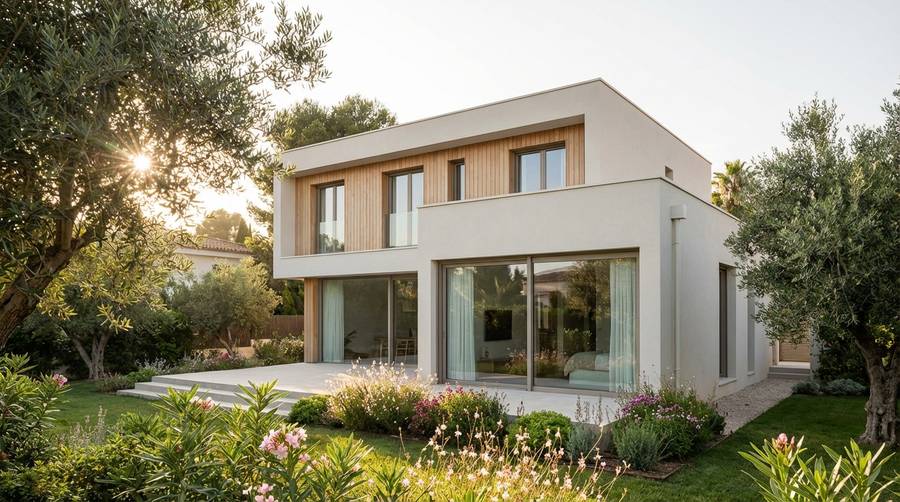
2-Storey Prefabricated House in Spain: Complete Guide
Why choose a 2-storey prefabricated house for your family in Spain
Imagine moving into a fully finished home months earlier than a traditional build—without unexpected cost overruns. That reality is increasingly common for families choosing a prefabricated house in Spain. This guide explains why a two-storey layout is often the best balance of footprint, privacy and value.
Modular and industrialized housing can reduce on-site time by 50–70% and deliver a fixed-price contract—transforming the risks for self-builders.
What industrialized housing means and why it matters for families
Industrialized housing refers to factory-made modules or elements assembled on-site. For families it means tighter quality control, predictable schedules and less disruption on the plot. Factory processes standardize tests for airtightness, finishes and structural connections that are harder to guarantee in-situ.
Key benefits versus traditional construction: time, price and control
Compare the three most decisive advantages:
- Time: Parallel factory production reduces overall project duration.
- Price certainty: Fixed contracts with fewer hidden extras.
- Control: Decisions early in the process, with detailed specifications and predictable procurement.
When a 2-storey layout is the ideal option
A two-storey prefabricated house usually suits families who want:
- Smaller plot usage while keeping generous indoor area.
- Clear separation between living and sleeping areas.
- Better passive solar options on constrained sites.
Practical and sustainable advantages compared to traditional homes
Faster timelines and fixed-price delivery: real data and examples
Typical timelines for a two-storey prefabricated house in Spain (indicative):
- Design and permits: 3–6 months.
- Factory production: 6–10 weeks.
- Transport and on-site assembly: 2–4 weeks.
- Final finishes and commissioning: 2–6 weeks.
In contrast, a traditional build often requires 12–24 months with more variables. Case studies consistently show a reduction in on-site risk and delays.
Energy efficiency and carbon reduction: Passivhaus criteria and certifications
Designing to high-efficiency standards is easier when systems and assemblies are produced under controlled conditions. Consider these levers:
- Factory-fitted high-performance windows and continuous insulation.
- Airtightness tests performed before shipment.
- Integration of MVHR (mechanical ventilation with heat recovery) and heat pump systems during production.
Targeting Passivhaus or similar certifications can cut heating demand by 75–90%, and modular envelopes often reach the required performance with fewer on-site interventions.
Quality and durability: factory control and performance guarantees
Factories enforce quality checks at multiple stages: materials, assembly, sealing and finishes. These checks translate into measurable reductions in defects. Ask for documented test results for airtightness (n50), thermal transmittance (U-values) and moisture control.
Recommended materials and systems for a 2-storey prefabricated home
Industrialized concrete: uses, structural advantages and assembly speed
Precast concrete elements provide excellent compressive strength, fire resistance and long-term stability. They are ideal for load-bearing walls, stair cores and foundations in two-storey solutions. Benefits include:
- Rapid assembly of structural elements.
- High durability and low maintenance.
- Good thermal mass when combined with insulated envelopes.
Light timber frame: insulation, comfort and sustainability
Timber frame systems offer excellent thermal performance and low embodied carbon when sourced responsibly. They adapt well to modular manufacturing and enable quick, dry assembly. For families prioritizing comfort and natural materials, timber offers warm interiors and efficient construction.
Steel frame: strength, design flexibility and compatibilities
Steel frame systems provide long spans, open-plan flexibility and precise tolerances for multi-storey prefabrication. They pair well with engineered timber floors or composite panels to balance stiffness and thermal performance.
How to design your 2-storey prefabricated house step by step (Guide 2026)
Define needs and spatial program: rooms, living zones and accessibility
Start with a clear brief. Use a simple checklist:
- Number of bedrooms and bathrooms.
- Desired open-plan or compartmentalized living space.
- Future-proofing: accessibility, adaptable rooms and provisions for electrification.
Rank your priorities: daylight, privacy, storage and outdoor connection. These choices will steer the layout and facade orientation.
Choose a construction system, finishes and efficiency criteria from the outset
Selecting the construction system early reduces redesign and cost changes. Decide on:
- Envelope U-values, airtightness targets and ventilation strategy.
- Preferred external finishes (stone, wood cladding, render) consistent with Mediterranean aesthetics.
- Interior finishes and services integration for a turnkey delivery.
Plans, permits and coordination among developer, manufacturer and technical team
Coordinate three streams in parallel: architectural design, structural and MEP (mechanical, electrical and plumbing) detailing, and permitting. A clear RACI (who is Responsible, Accountable, Consulted, Informed) among the homeowner, manufacturer and project architect reduces delays.
The turnkey process explained: from plot to handover
Search and analysis of the plot: planning, services and topography
Before purchase, evaluate:
- Local planning rules and maximum buildable area.
- Utility connections (water, sewer, electricity, telecom) and estimated connection costs.
- Topography and access for delivery trucks and cranes.
Conduct a quick site feasibility to estimate foundation type and any retaining structures. Early geotechnical data prevents surprises.
Factory production, transport and on-site assembly: schedule and milestones
Typical milestones for a turnkey project:
- Order and production start.
- Quality inspections in factory and pre-shipment testing.
- Transport logistics and on-site delivery.
- Assembly, connections and commissioning.
Demand a clear Gantt chart showing critical path items and contingency time for weather or permitting.
Handover, tests and client delivery: warranties and documentation
On delivery, expect:
- Operation manuals, warranty certificates and as-built plans.
- Commissioning records for HVAC, renewable systems and airtightness test results.
- Punch-list completion timeline and aftercare protocol.
Costs, financing and mortgages for self-builders
Indicative cost breakdown (plot, modular construction, site works and extras)
Costs vary by region and specification. A simplified example for a medium-spec 150–180 m² two-storey family home:
- Plot: region-dependent.
- Modular construction (factory, transport, assembly): 45–60% of total build cost.
- Foundations and site works: 10–20%.
- Finishes, landscaping and extras: 20–30%.
Request transparent line items from manufacturers to compare quotes fairly.
Financing options: self-builder mortgages and modular-specific alternatives
In Spain, options include:
- Self-build mortgages that release funds by milestone.
- Traditional mortgage on completed value (useful if the manufacturer offers full turnkey delivery and a final valuation).
- Manufacturer financing or staged payment agreements.
Ask banks for sample amortization schedules and build-stage release conditions. A clear turnkey contract simplifies bank underwriting.
Real example: case study with time, cost and client satisfaction
One two-storey project completed in 2024 showed these results:
- Total project duration: 7 months from production start to handover.
- On-site assembly: 3 weeks.
- Customer satisfaction: high scores for finish quality and delivery time.
These metrics are representative when the design is fixed early and permits are managed proactively.
Turning the idea into a home: final tips and next steps
Decision checklist: key questions before signing
- Is the energy performance target realistic and documented?
- Are all finishes and fittings specified in the contract?
- What are the exact warranty scopes and durations?
- Is transport and crane access confirmed for the site?
Choosing the manufacturer and project team with objective criteria
Evaluate vendors by:
- Factory visits and sample inspections.
- Third-party test certificates and references from completed projects.
- Clear contractual milestones and defined penalties for delays.
Compare at least three suppliers and check actual delivered homes. You can read a detailed real project here: Casa prefabricada 2 plantas: caso real y resultados.
Resources and references: regulations, subsidies and inspiring case studies
- Local municipal planning offices for plot rules.
- Regional energy efficiency subsidies and national aid for renovation/new build.
- Manufacturer case studies and independent building performance tests.
Final note: Building a two-storey prefabricated house in Spain offers families a fast, high-quality and energy-efficient path to homeownership when planned with clear targets and the right team. Start with a concise brief, firm energy and budget goals, and insist on documented tests. This reduces uncertainty and delivers a home you can enjoy sooner.
If you want a tailored checklist or a cost benchmark for your plot, get in touch and we can produce a quick feasibility plan for your project.