Prefabricated House vs Traditional Home: Pros & Cons
Why choose industrialized housing today: landscape and key benefits
Hook: If you're planning to self-build in Spain in 2026, choosing the construction method will determine costs, schedule and the home's long-term performance. This guide compares prefabricated (industrialized) housing and traditional construction with clear metrics and actionable advice.
What we mean by industrialized housing in Spain's urban context
Industrialized housing refers to homes manufactured in controlled factory settings and assembled on site. In Spain this includes systems such as steel frame, light timber framing and industrialized concrete panels. The approach focuses on repeatable quality, speed and minimized on-site work.
General benefits: fixed price, predictable schedules and repeatable quality
The primary advantages are:
- Predictability: fixed-price quotes and shorter, defined schedules.
- Quality control: factory QA reduces variability and rework.
- Lower site disruption: reduced noise and waste in neighborhoods.
What to expect on delivery times and planning impact
Expect the design-to-delivery timeline to compress by up to 30–50% compared to traditional methods for similar specifications. That affects land acquisition deadlines, financing draw schedules and permit timing—plan these in parallel, not sequentially.
Case metric: a standard 120 m² three-bedroom industrialized house in Spain can reach 'fully finished' handover in 4–6 months on site after factory production, versus 12–16 months for traditional builds of similar scope.
Assembly speed: prefabricated house versus traditional construction
Phase comparison: factory manufacturing vs on-site build
Prefabricated route: design and approvals → factory production of modules/panels → site foundation and services → rapid on-site assembly → finishing. Parallelization is key: while foundations are prepared, factory builds continue.
Traditional route: sequential site excavation → structural works → enclosure → wet trades → finishes. Many tasks depend on weather and subcontractor availability.
Closed timelines: real metrics and reduced uncertainty
Measured examples:
- Factory production: 6–12 weeks for components (depending on complexity).
- On-site assembly: 1–8 weeks for modules or panels.
- Total on-site time: 4–12 weeks additional for utilities and finishes in well-managed projects.
Contrast: traditional on-site time for similar scope often exceeds 40 weeks. Industrialized workflows cut the critical path and shift risk to contractual guarantees.
Impact on neighbors and urban logistics (noise, traffic, loading bays)
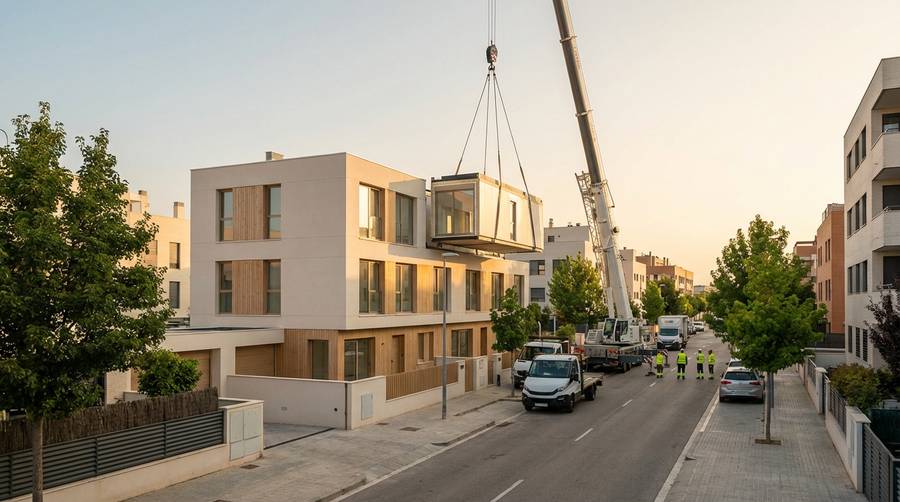
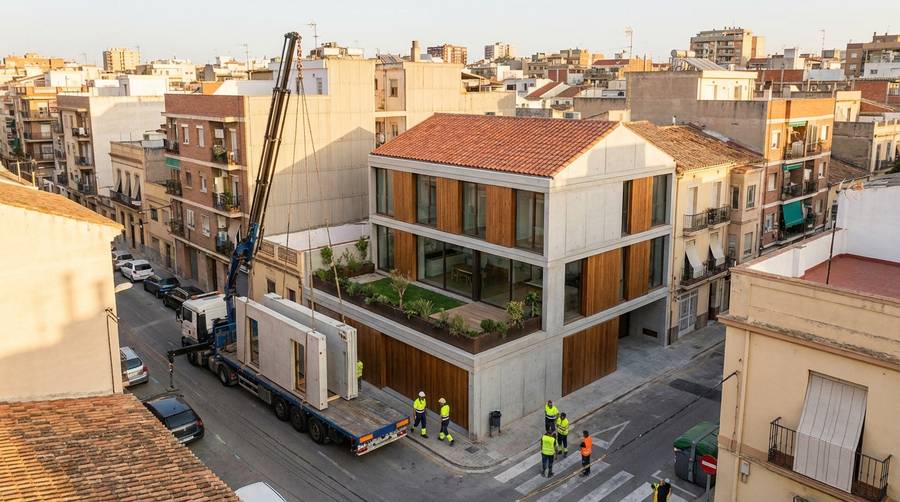
Industrialized projects reduce weeks of heavy activity. However, they concentrate logistics into shorter windows: delivery of large modules or trucks requires permits and temporary occupation of public space. Early coordination with the town hall avoids fines and complaints.
Costs and financing: fixed price, predictability and options for self-builders
Cost structure: industrialized vs traditional projects
Typical cost drivers:
- Industrialized: higher upfront design and factory costs but lower labor variability, fewer weather delays and less waste. Price per m² is often comparable to quality traditional builds but with tighter tolerances.
- Traditional: modular cost distribution over time, but higher exposure to price inflation for materials and labor, and higher likelihood of change orders.
Mortgages for self-building and modular-specific financing
Options available in Spain for autopromotores include:
- Self-build mortgage (hipoteca para autopromoción): staged disbursement aligned with construction milestones. Industrialized projects can shorten milestone schedule, which may require renegotiation of draw dates with the lender.
- Construction-to-permanent loans: some lenders provide a combined product that converts to a standard mortgage at handover.
- Manufacturer financing: certain industrialized providers offer commercial financing or partner with banks to smooth payments.
Tip: present a llave en mano contract and factory production schedule to the bank—this typically lowers perceived risk and eases approval.
Economic risks and how to mitigate them with turnkey contracts
Common deviations: scope changes, additional site works, unexpected utilities. Mitigation measures:
- Insist on a turnkey (llave en mano) contract with fixed-price clauses and clear exclusions.
- Require factory QA reports and a production timeline attached to the loan schedule.
- Allocate a contingency of 5–8% for unavoidable variances; request supplier bonds if available.
Materials and quality: industrialized concrete, timber framing and steel frame
Technical comparison: durability, thermal performance and maintenance
Material overview:
- Industrialized concrete panels: excellent thermal mass, durability and acoustic performance. Best for urban plots requiring solidity and low maintenance.
- Light timber frame: fast, lightweight and high thermal performance when coupled with modern insulation. Requires careful detailing for moisture control.
- Steel frame (steel frame): precise tolerances, rapid erection and good structural performance; thermal bridging must be managed.
Maintenance: concrete typically needs less routine work over decades; timber demands scheduled inspections and proper detailing. Steel requires corrosion protection in coastal areas.
How systems affect assembly time and cost
Steel and timber systems often enable the fastest on-site erection. Concrete panels can be slightly slower to hoist but reduce internal finishing time due to integrated services. Choose based on site access, program and desired thermal/ acoustic targets.
Factory certifications and quality controls vs on-site inspections
Look for providers with ISO-compliant processes and third-party testing. Factory QA includes material traceability, controlled curing and assembly jigs—this lowers risk of workmanship variability that frequently plagues on-site builds.
Sustainability and energy efficiency: Passivhaus and carbon reduction
Environmental advantages of industrialization: less waste, lower carbon
Factory production reduces material waste by optimized cutting and reuse. Shorter on-site activity also lowers transport runs and emissions. When combined with low-carbon materials, industrialized homes can cut embodied carbon significantly versus traditional on-site builds.
Integrating Passivhaus criteria in design and production
Industrialized methods are well-suited to meet Passivhaus principles due to precise thermal junctions and repeatable airtightness detailing. Incorporating triple glazing, continuous insulation and mechanical ventilation with heat recovery (MVHR) at the design stage yields predictable performance.
Measurable examples: energy savings and thermal behavior in real projects
Measured outcomes from recent Spanish projects:
- Energy demand reductions of 60–90% compared with standard new builds when Passivhaus protocols are applied.
- Operational savings often pay back incremental costs within 8–12 years under typical Spanish energy prices.
Urban logistics and permits: plan delivery without surprises
Coordination with municipalities, transporting modules and urban restrictions
Transport of large modules requires:
- Timetabled permits for oversized loads.
- Advance notice to municipal traffic departments and police.
- Assessment of street width, overhead cables and turning radii.
Engage a logistics partner early and secure the necessary vados (loading/unloading permits) and short-term occupation permissions.
Strategies to minimize impact in residential areas and public space occupation
Best practices:
- Schedule deliveries during low-traffic windows.
- Use off-street staging where possible to keep public lanes clear.
- Communicate with neighbors and provide a contact for day-of delivery concerns.
Practical checklist for permits, vados and municipal coordination
- Confirm site access constraints and provide them to the manufacturer.
- Apply for oversize vehicle permits 4–6 weeks in advance.
- Request temporary occupation permits (vados) and coordinate waste containers and cranes.
- Prepare emergency contact with local services for the delivery day.
Deciding between prefabricated and traditional: a practical guide for self-builders
Decision criteria: timeline, budget, sustainability and customization
Ask yourself:
- Is a fast delivery a priority?
- Do you need a fixed budget and reduced scope risk?
- Is high energy performance (e.g., Passivhaus) a goal?
- How bespoke must the design be?
Rule of thumb: choose industrialized approaches when predictability, speed and energy performance outrank ultra-custom architectural expression. For highly irregular forms or heritage constraints, traditional methods may be preferable.
Case studies with metrics: timelines, cost per m² and client satisfaction
Study A — Mediterranean 140 m² detached home (steel frame, turnkey):
- Factory production: 8 weeks.
- On-site assembly and finishes: 10 weeks.
- Total project time: 6 months from site start to handover.
- Cost: €1,750/m² (turnkey, mid-range finishes).
- Client satisfaction: 92% (post-handover survey at 12 months).
Study B — 120 m² timber-frame Passivhaus (industrialized panels):
- Factory: 10 weeks.
- On-site: 6 weeks.
- Total time: 5 months.
- Cost: €1,980/m² (high-performance envelope, MVHR).
- Measured heating demand: 15 kWh/m²·year.
These real-world cases show predictable schedules and measurable energy outcomes, useful when discussing finance and mortgages with banks.
Next steps: preparing a request for quotation and questions to ask a turnkey provider
When requesting a quote, include:
- Complete plot details and photographs.
- Desired final specification (insulation, windows, PV, finishes).
- Target delivery dates and any access restrictions.
Questions to ask providers:
- Can you provide a detailed turnkey price with exclusions?
- What are factory test reports for airtightness and thermal transmittance?
- How do you manage on-site logistics and municipal permits?
- Can you align payment milestones with my mortgage draw schedule?
For operational risks and assembly speed, you may find useful practical guidance in our project analysis such as Vivienda industrializada: caso de éxito en ciudad and the lessons in Errores comunes en vivienda industrializada y cómo evitarlos.
Closing inspiration: how to secure a successful project without surprises
Balanced summary of advantages and disadvantages for decision-making
Advantages of prefabricated/industrialized housing:
- Shorter overall schedules and reduced site disruption.
- Greater cost predictability under fixed-price contracts.
- High quality control and better alignment with energy targets like Passivhaus.
Disadvantages / limits:
- Upfront coordination and design requirements are more demanding.
- Logistics for module transport need detailed planning.
- Some very bespoke architectural expressions can be more costly to industrialize.
Final recommendations for self-builders in Spain 2026
To maximize success:
- Start municipality and finance conversations early—permits and bank approval set the rhythm.
- Choose a turnkey provider with documented factory QA and third-party test certificates.
- Prioritize precise design decisions early to avoid costly changes once production starts.
- Plan logistics and community communication for the delivery window to reduce friction.
Resources: templates, regulations and professional contacts
Gather these documents before engaging providers:
- Plot technical dossier (topography, services map and access).
- Turnkey contract template with milestone schedule.
- List of required municipal permits and estimated lead times.
Call to action: If you are an autopromotor weighing options, review your plot constraints and financing timeline, then request turnkey proposals from two different industrialized providers to compare schedules, fixed-price offers and factory QA data. Contact a trusted advisor if you want help preparing a focused RFQ or reviewing mortgage alignment for a modular project.
Artículos relacionados