Industrialized Housing in Spain: Complete 2026 Guide
Industrialized Housing in Spain: Complete 2026 Guide
Hook: If you want a high-quality home built faster, with predictable costs and better energy performance, industrialized housing is now a mainstream, bankable option in Spain. This guide walks you through each decisive step, from choosing materials to securing finance and delivering a turnkey home.
Why choose industrialized housing in Spain in 2026
Industrialized housing—sometimes called modular or prefabricated—has evolved well beyond stereotypes. For an autopromoter in Spain, it offers tangible advantages where quality, timing and sustainability matter. Below, we examine market trends, cultural fit and the primary benefits you can expect.
Market trends and demand from autopromoters
Demand among Spanish autopromoters has grown due to:
- Faster project delivery—reduced on-site time compared with traditional builds.
- Greater cost predictability—fixed-price packages are increasingly common for turnkey solutions.
- Improved financing access—banks are more comfortable lending for modular projects when structural, energy and warranty standards are clear.
Regional planning departments have also started to integrate industrialization-friendly procedures, speeding approvals for developments that meet energy and design standards.
How industrialization fits the Mediterranean lifestyle
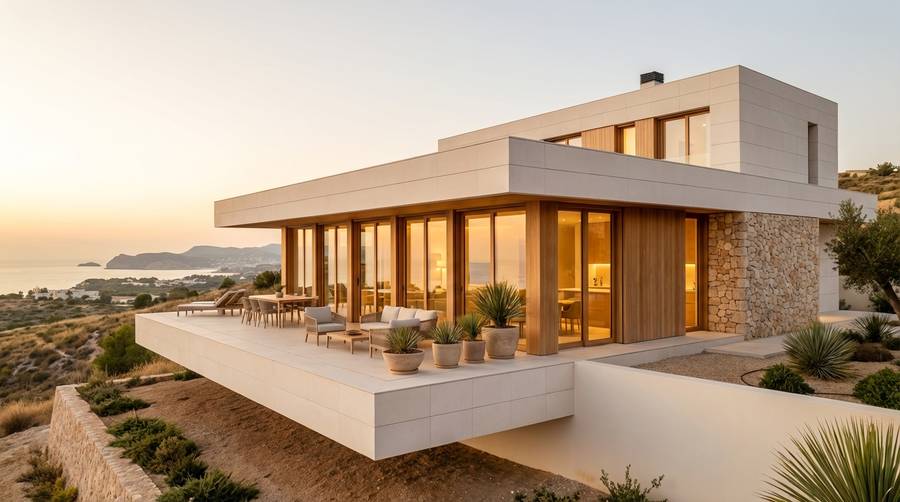
Industrialized homes can be designed with Mediterranean architectural language: light facades, large windows, shaded terraces and natural finishes. The advantage is delivering that style with factory precision: tighter tolerances, consistent finishes and integration of energy systems like heat recovery or solar pre-wiring.
Expected benefits: timelines, quality and cost control
Concrete expectations:
- Timelines: Typical production and on-site assembly for a 120–180 m² home: 4–6 months (factory) + 2–6 weeks on-site finishing.
- Quality: Repeatable factory processes reduce defects and improve airtightness consistent with Passivhaus-level targets.
- Cost control: Turnkey offers with fixed prices and limited variation clauses reduce budget overruns common in traditional projects.
Industrialized delivery reduces on-site uncertainty: when design, fabrication and assembly are integrated, you convert many unknowns into managed processes.
Modern materials and structural systems: which to choose?
Choosing the right structural system depends on climate, budget, aesthetic goals and energy targets. Here we compare three widely used options in Spain today.
Industrialized concrete: performance and typical applications
What it is: Factory-cast concrete panels or precast elements assembled on site. Ideal for robust, low-maintenance homes.
Advantages:
- High thermal mass that stabilizes interior temperatures.
- Excellent fire resistance and durability.
- Good acoustic performance—useful in denser settings.
Considerations: Transport and crane access must be planned; prefabricated concrete can be cost-effective at medium-to-large scales and fits well with Mediterranean materials (exposed concrete combined with wood and stone finishes).
Timber light-frame and Passivhaus: efficiency and comfort
What it is: Engineered timber frames and cross-laminated timber (CLT) panels, often combined with high-performance insulation and airtightness strategies.
Advantages:
- Fast assembly and lower embodied energy than many heavy solutions.
- Excellent thermal performance when combined with Passivhaus detailing.
- Warm interior feel and compatibility with Mediterranean aesthetics.
Considerations: Requires strict detailing for moisture control and certified suppliers to achieve Passivhaus certification.
Steel frame: speed, versatility and structural notes
What it is: Light-gauge steel frames with insulated panels. Often used where long spans or cantilevers are needed.
Advantages:
- High dimensional precision and repeatability.
- Long spans with slender profiles—useful for open-plan Mediterranean living rooms.
- Fast site assembly with limited weather dependency.
Considerations: Steel requires thermal bridging control and appropriate detailing to match comfort and energy goals; corrosion protections are important in coastal areas.
Advantages of a prefabricated home vs traditional construction
Below are quantified, pragmatic comparisons useful for decision-making.
Efficiency and reduced times: quantified examples
Real-world projects in Spain show average on-site time reductions of 50–70% compared to traditional methods. Example metrics:
- A 140 m² timber-frame Passivhaus: traditional build 14–18 months vs industrialized 6–9 months total.
- A 160 m² concrete modular home: traditional build 16–20 months vs industrialized 7–10 months total.
Faster completion reduces interim financing costs and allows occupancy earlier—both financial advantages for autopromoters.
Fixed budgets and risk management on site
Turnkey contracts typically include clear scopes, milestone payments and warranty packages. The main risk-shifting features:
- Factory-controlled quality reduces variability.
- Well-defined interfaces limit change orders.
- Standardized components allow bulk purchasing and better cost predictability.
Sustainability and comparative carbon footprint
Industrialized housing can lower embodied carbon through:
- Optimized material use and reduced waste in factories.
- Efficient transport logistics when sites are properly planned.
- Integration of energy measures—high-performance envelopes, heat-recovery ventilation and PV-ready roofs—reducing operational carbon.
Careful life-cycle assessment (LCA) is required to compare systems fully—timber often outperforms concrete in embodied carbon, but concrete can reduce operational energy through thermal mass. The right combination depends on site and design choices.
How to design and plan a modular home step by step (turnkey process)
This section provides an actionable roadmap from plot search to keys in hand.
Find and validate the plot: regulations and preliminary studies
Essential early steps:
- Check land use and zoning with the local Ayuntamiento. Confirm buildability, maximum occupancy and permitted heights.
- Order a topographic survey and geotechnical report if required—soil conditions affect foundation solutions for prefabricated systems.
- Verify access and crane logistics for panel or module delivery; some plots require specific lifting plans.
Without these confirmations you risk delays or redesigns later in the process.
Design, prefabrication and assembly: a typical timeline
Typical phased timeline for a turnkey solution:
- Concept & Feasibility (2–4 weeks): brief, budget, plot validation.
- Detailed Design & Permitting (8–14 weeks): architectural and structural packages for permits.
- Factory Production (12–20 weeks): controlled fabrication of panels or modules while permits are finalized.
- Site Assembly & Finishes (2–8 weeks): crane assembly, connections, final finishes and commissioning.
Overlap of factory production with permitting shortens total project duration—a key industrialization benefit.
Finishes, warranties and final delivery
Turnkey packages should include:
- Detailed finish schedules and sample approvals.
- Clear warranty terms for structure, envelope and systems (typically 10 years for structure, 2–5 years for finishes depending on contract).
- Commissioning documentation and energy performance testing results (airtightness, thermal imaging, HVAC balancing).
Financing for autopromoters and modular housing
Finance models differ slightly from standard home purchase lending. Banks look for clarity on contracts, collateral and stage payments.
Mortgage options for self-build in Spain
Common routes:
- Self-build mortgage with staged drawdowns tied to milestones (land, structure, finishes).
- Consumer mortgage for turnkey purchases when the provider transfers completed property at delivery.
- Bridge financing to purchase the plot before final mortgage refinancing on completion.
Key for lenders: validated construction schedule, certified suppliers and firm turnkey price. These reduce perceived construction risk.
Financial structure of a turnkey project
Typical payment flow:
- Deposit for plot purchase.
- Design and permit deposit (small fixed fee).
- Factory production drawdowns (30–60% of build cost) during off-site fabrication.
- Final payment at delivery and commissioning (10–20%).
Negotiate retention and defect periods to protect against incomplete works.
Grants, subsidies and improving viability
Investigate national and regional incentives for energy-efficient homes (e.g., support for deep retrofit and new low-carbon builds). Eligibility often depends on energy class, use of renewable systems and compliance with Passivhaus or similar standards.
Case studies and technical comparisons with real metrics
Below are anonymized, realistic examples illustrating outcomes you can expect.
Case 1: Passivhaus home in industrialized concrete — times and costs
Project summary:
- Size: 180 m²
- System: Precast insulated concrete panels with factory-fitted windows and ventilation ducts
- Total delivery time: 8 months (including permitting)
- Turnkey cost: ~1,700–1,900 €/m² (depending on finishes)
- Performance: Airtightness 0.6 ACH@50Pa, annual heating demand < 15 kWh/m²·year
Client feedback highlighted low maintenance, acoustic comfort and consistent finishes.
Case 2: Timber light-frame home — energy efficiency and satisfaction
Project summary:
- Size: 140 m²
- System: Engineered timber panels, high-performance insulation and mechanical ventilation with heat recovery
- Total delivery time: 6 months
- Turnkey cost: ~1,400–1,600 €/m²
- Performance: Airtightness 0.4 ACH@50Pa, heating demand < 10 kWh/m²·year
Owners rated the indoor comfort and speed of delivery highest. Embodied carbon was lower than the concrete example, improving the overall carbon balance.
Technical comparison: performance, cost per m² and 10-year return
Comparison highlights:
- Cost per m²: Timber generally 5–15% cheaper than precast concrete in small-to-medium homes; steel frame can be competitive when complex geometry is needed.
- Energy performance: With proper detailing, timber and concrete can both meet Passivhaus; timber often achieves slightly lower operational energy due to better insulation continuity.
- Return on investment (10 years): Energy savings, lower maintenance and faster occupancy typically deliver positive cash flow compared with traditional builds, especially when factoring lower interim financing costs.
Next steps to start your industrialized home project
Use this practical checklist and set of questions before contacting providers.
Practical checklist before contacting a turnkey provider
- Confirm plot viability: zoning, topography, access and soils.
- Define a realistic budget range and non-negotiable program items.
- Decide preferred structural system and energy target (e.g., passive-level, NZEB).
- Gather references: ask providers for similar completed projects and performance data.
Key questions to evaluate offers and contracts
- What is included in the turnkey price? (foundations, connections, landscaping, permits)
- What warranty and after-sales service is provided?
- Which tests and certificates will be delivered at handover? (airtightness, energy certification)
- How are variations or unforeseen conditions handled contractually?
Resources and useful contacts
Start with technical guides and local professional advisors. For regional insights and a real example of how industrialized delivery saves time, see Vivienda industrializada: caso real que transformó una comarca and the broader model comparison in Industrialización regional: comparativa de modelos. For design-focused guidance consult Guía 2026: Diseñar una vivienda industrializada en España and compare approaches in Vivienda industrializada vs tradicional: ventajas y desventajas.
Conclusion
Bottom line: Industrialized housing in Spain offers autopromoters a clear path to faster delivery, predictable budgets and high energy performance when you select the right materials, validate your plot early and choose experienced turnkey partners. The key is disciplined planning: rigorous site validation, clear contractual scopes and measurable energy targets.
If you are ready to explore options for your plot or want a feasibility review tailored to your site and priorities, contact a specialist or request a staged cost estimate from a trusted turnkey provider. Small early steps—surveys, program definition and a single provider interview—reduce risk and clarify the path to a modern, sustainable Mediterranean home.
Call to action: Consider starting with a documented feasibility review for your plot; it typically costs a fraction of the project budget and will make lenders and suppliers far more responsive.
Artículos relacionados
Industrialized Housing vs Traditional Homes: Pros & Cons
A concise, evidence-based comparison to help Spanish self-builders decide between industrialized (modular/prefab) housing and traditional construction—covering costs, timelines, materials, sustainability, financing and a real case study with metrics.