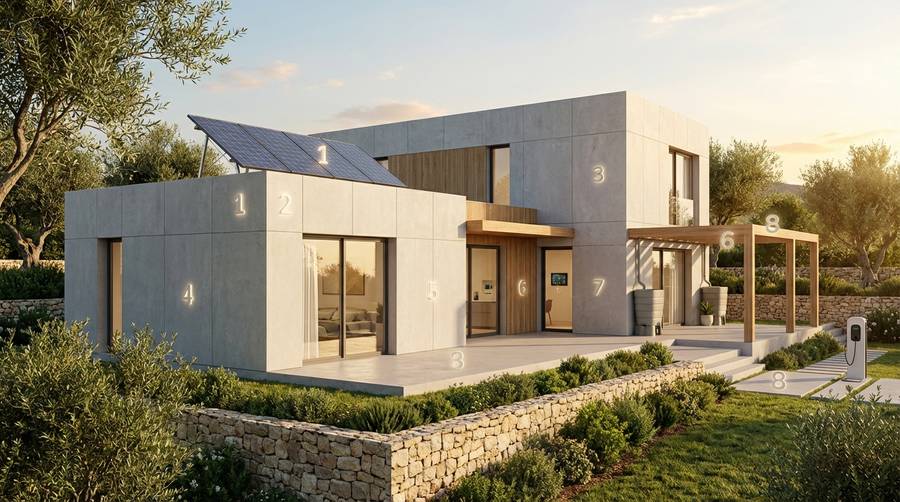
Prefabricated Concrete Homes: 6 Clear Advantages in Spain
Hook: Why prefabricated concrete is changing homebuilding in Spain
If you want a faster, more predictable and energy-efficient home in Spain, prefabricated concrete deserves a hard look. This article breaks down six practical advantages — with real metrics, negotiation tips and a concise checklist for autopromoters pursuing a turnkey (llave en mano) path.
1. Faster delivery: real reductions in construction timelines
Comparing timelines: prefabricated concrete vs traditional builds
Typical reduction: a prefabricated concrete project for a 150–200 m² single-family house often shortens the on-site phase from 9–14 months to 3–5 months. Overall project time (design, permits, production and assembly) commonly falls between 6–10 months versus 12–24 months for conventional builds.
- Why it’s faster: structural elements and closures are made off-site, freeing you from weather delays and extended wet trades on site.
- Measured example: a recent Mediterranean-style 180 m² home manufactured using panelized precast concrete reached weather-tight status in 21 days of on-site assembly; full commissioning followed within 3 months.
How industrial control shortens critical phases (closing the shell, services)
Factory production allows parallelization: while the foundation is prepared on site, walls, façades and service modules are manufactured simultaneously — reducing idle time. Precision-fit panels expedite mechanical, electrical and plumbing (MEP) installation because embedded chases and pre-cut openings avoid rework.
Impact on indirect costs: fewer delays and lower overrun risk
Shorter schedules reduce indirect costs such as site management, temporary facilities, and financing interest. For an autopromoter this can mean 3–8% lower indirect project costs compared with long traditional projects; savings compound if bank loan interest accrues during a shorter building period.
2. More predictable cost: closed budgets and lower uncertainty
Turnkey contracts for autopromoters
Turnkey (llave en mano) models consolidate design, factory production and final delivery under a single contract. For autopromoters this simplifies coordination and transfers schedule risk and many procurement responsibilities to the manufacturer/contractor.
Factors that enable a fixed price: supply chain and factory control
Manufacturers who secure raw material supply and standardize repeated modules can offer fixed-price packages. Key enablers:
- Bulk procurement of concrete, insulation and finishes.
- Controlled labor costs in the factory.
- Standardized details that reduce change orders.
Numeric example: typical cost breakdown and savings
For a representative 180 m² house in Spain, a simplified cost split might look like:
- Factory fabrication & panels: 40–45%
- Site works & foundations: 15–20%
- MEP and finishes: 25–30%
- Project management, permits, contingency: 10–15%
What saves money: shorter site time reduces site overhead, and fewer change orders cut contingency spend. Conservatively, autopromoters can expect a 5–12% lower project volatility compared to traditional builds.
3. Energy performance and sustainability with industrialized concrete
Insulation, airtightness and contribution to Passivhaus targets
Prefabricated concrete panels perform well when combined with modern insulation systems and factory-installed airtight membranes. Benefits include:
- Consistent thermal continuity with fewer on-site joints.
- Factory QA on joints and insulation reduces thermal bridges.
- Better initial airtightness, making Passive House certification or near-Passivhaus performance achievable with correct detailing.
Reducing carbon footprint: materials, processes and life cycle
Concrete has a high embodied carbon per kg, but industrialized methods can reduce overall lifecycle emissions by:
- Minimizing waste via exact batching and reuse of formwork.
- Lower transport-related emissions when panel sizes are optimized for local manufacture.
- Long service life which amortizes initial embodied carbon over decades.
Tip: combine precast concrete with high-recycled-content aggregates, low-clinker cements, and locally sourced insulation to improve carbon balance.
Certifications and metrics to monitor: consumption, envelope and efficiency
When assessing proposals, require these metrics:
- Projected heating/cooling demand (kWh/m²·year)
- Airtightness (n50 air changes at 50 Pa)
- Embodied carbon estimates (kg CO2e/m²)
Target airtightness below 1.5 n50 and heating demand under 25 kWh/m²·year are realistic goals for industrialized concrete homes aiming at high energy performance.
4. Construction quality and durability: benefits of factory control
Dimensional precision and consistent finishes in precast panels
Factory-produced concrete panels offer repeatable tolerances that reduce on-site adjustments. This results in tighter joints, cleaner façades and fewer callbacks for finishing work.
Structural resistance and long-term maintenance
Precast concrete is inherently durable, resistant to moisture and fire, and often requires less routine maintenance than lightweight alternatives. For coastal Mediterranean climates, choose appropriate concrete mixes and protective coatings to limit chloride penetration.
How quality translates to client satisfaction and resale value
A well-built precast concrete home typically enjoys lower maintenance complaints in the first five years and can command a stronger resale position thanks to perceived longevity and thermal comfort.
5. Flexible design tuned to Mediterranean lifestyle
Integrating large openings, terraces and natural materials
Precast systems can be combined with large glazed frames, cantilevered terraces and applied natural finishes (wood, stone) to achieve the Mediterranean aesthetic: light façades, generous outdoor living and cross-ventilation.
Personalization options: layout, façades and finishes
Contrary to the misconception that prefabrication is rigid, modern precast solutions allow customization in:
- Room layout within a modular grid.
- Exterior cladding choices — timber slats, stone panels, or stucco over panels.
- Window sizing and terrace integration for indoor-outdoor flow.
Case studies: real Spanish homes built with prefabricated concrete
Examples across Spain show:
- Weather-tight assembly in under a month.
- Measured energy consumption reductions of 30–50% versus local conventional stock when paired with upgraded insulation and efficient systems.
- High homeowner satisfaction scores for comfort and acoustic performance.
For architectural details on concrete prefabrication strategies, see Hormigón prefabricado: 8 claves para tu vivienda industrializada.
6. Financing and project management for autopromoters
Self-build mortgages and advantages over traditional build loans
In Spain, mortgages for autopromoción can be structured to release funds against milestones rather than speculative budgets. Lenders view turnkey prefabricated projects favorably when the provider has demonstrable production capacity and warranty structures, because risk of delay and cost escalation is lower.
Financial planning: payment milestones and execution guarantees
Negotiate these elements into contracts:
- Clear milestone payments linked to deliverables (foundation complete, panels installed, commissioning).
- Performance bonds or advance-payment guarantees for factory stages.
- Retention or warranty periods for finishes and systems.
Practical tips for contracting turnkey offers and negotiating banks
When evaluating proposals:
- Ask for a fixed-price quote with an itemized scope and exclusions.
- Check manufacturer references and visit a finished home when possible.
- Require an agreed testing protocol for airtightness and thermal performance.
- Present the turnkey schedule to your bank with manufacturer documentation to secure milestone-based financing.
Practical close: how to choose the right prefabricated concrete option
Quick checklist to compare offers and manufacturers
- Factory production capacity and lead times.
- Included scope (foundations, MEP, finishes, landscaping?).
- Guarantees: structural, waterproofing, and performance warranties.
- Measured energy targets and testing obligations.
- Detailed payment schedule and penalty clauses for delays.
Key questions for the turnkey contract and site supervision
- Who assumes permit responsibility and municipal liaison?
- What are tolerances for changes and associated costs?
- Is there an independent verifier for performance testing?
- How will interfaces between factory elements and site works be handled?
Resources and next steps: from land search to delivery
Practical next steps:
- Secure a plot with compatible build parameters (access for panels, foundation type).
- Request a turnkey proposal with timelines and performance metrics.
- Validate manufacturer references and visit completed homes where possible.
- Discuss milestone financing options with your bank early.
Conclusion
Prefabricated concrete delivers measurable gains in time, cost certainty, energy performance and durability — all well-suited to the Mediterranean lifestyle in Spain. For autopromoters, the most important steps are to demand clear performance metrics, visit completed projects and secure milestone-based financing. If you want a pragmatic next move, start by shortlisting two manufacturers and request turnkey quotes that include airtightness and lifecycle carbon estimates.
Interested in comparing specific turnkey offers or reviewing a draft contract? Contact our team to review proposals and create a tailored checklist for your plot.