Industrialized Housing: The Future of Modular Homes in Spain
Why industrialized housing will redefine construction in Spain
Hook: In 2026, industrialized housing is no longer an alternative — it is a strategic response to cost volatility, timeline delays and climate targets.
Spain faces rising construction costs, slow permitting cycles and a national push for lower carbon buildings. Industrialized housing addresses each challenge by moving value to controlled, repeatable factory environments and offering fixed-price, time-certain deliveries. Below we unpack the market numbers, comparative advantages and the remaining barriers to scale.
2026 landscape: key sector figures and adoption pace
Recent industry tallies show modular and factory-built methods account for an estimated 8–12% of new single-family and small multifamily projects in Spain. Adoption is fastest in regions with active housing plans and fast-track permits.
- Average factory build time: 8–12 weeks for modules, plus 6–10 weeks site assembly.
- Delivered projects growth: Year-on-year growth rates of 18–25% in markets with supportive policy.
- Typical cost variance vs traditional: ±3% to −8% depending on complexity and level of finish.
Advantages vs traditional housing: efficiency, fixed price, time certainty
Why developers and self-builders choose industrialized housing:
- Time certainty: Shorter on-site windows reduce weather risk and permit-linked delays.
- Price transparency: Factory processes allow a fixed-price contract with defined change controls.
- Predictable quality: Factory QA reduces defects and rework.
- Energy performance: High-precision envelopes better support Passivhaus-level strategies.
Current barriers and growth levers: regulation, supply and demand
Scaling industrialized housing requires three coordinated moves.
- Regulatory alignment: Faster homogenous permitting for factory modules across municipalities.
- Supply chain maturity: Wider availability of certified materials like industrialized concrete and CLT.
- Market education: Demonstrating long-term asset value and mortgage friendliness for self-builds.
By moving up to 60% of on-site value chain into controlled production, industrialized housing can reduce on-site time by half and lower operational carbon during construction by up to 35%.
How to design an industrialized home step by step in Spain (2026)
This section gives a clear, actionable roadmap for autopromoters building an industrialized home today.
Parcel selection and planning constraints: what to check first
Start with three filters: regulatory fit, access and topography.
- Regulation: Validate local zoning and module height limits. Confirm foundations type allowed.
- Access: Verify truck and crane access for module delivery and assembly.
- Topography: Prefer sites with limited slope to reduce bespoke foundation costs.
Early checks prevent costly redesigns later in the factory cycle.
Modular design and customization: from brief to final layout
Design in two layers: structural modules and interior finish packages.
- Define the program: bedrooms, bathrooms, services and flexibility needs.
- Module grid: Choose a standard module size to maximize factory repeatability.
- Customize within standards: Offer façade and floor finishes as configurable options, rather than bespoke construction changes.
This approach balances personalization with cost control.
Timeline planning and deliverables for a turnkey project
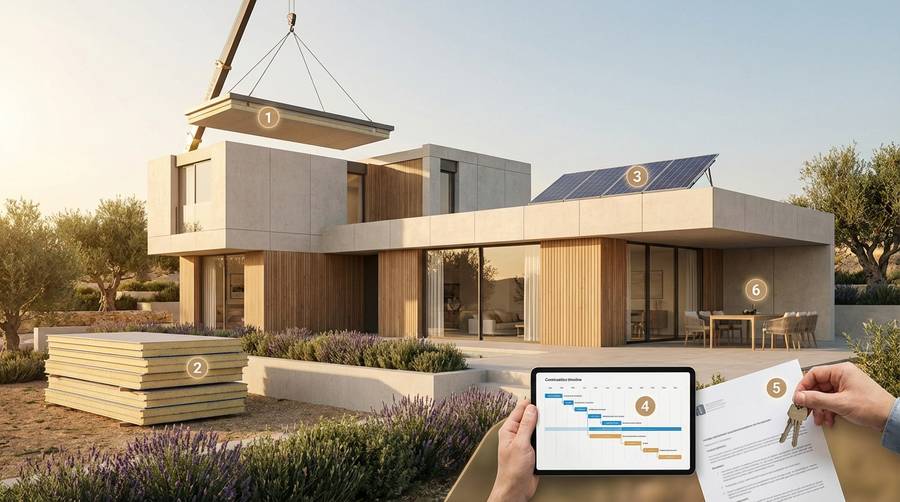
Example milestone plan for a 150 m2 single-family home under a turnkey contract:
- Weeks 1–4: Detailed design and permit submission.
- Weeks 5–10: Factory production of modules.
- Week 11: Foundation and site preparation.
- Weeks 12–13: Module delivery and assembly.
- Weeks 14–16: Utilities connection, finishes and handover.
Clear milestones with penalties or incentives help align expectations.
Materials and structural systems that will define the next decade
Material choice dictates performance, carbon footprint and lifecycle cost. Below are three core approaches and practical considerations.
Industrialized concrete: performance, durability and use cases
Factory-cast concrete panels and hybrid precast frames offer high thermal mass and durability. They fit well for projects demanding robustness and acoustic performance.
- Best uses: basements, party walls, low-rise multifamily.
- Pros: Fire resistance, longevity, low maintenance.
- Cons: Higher embodied carbon unless using low-clinker mixes or supplementary cementitious materials.
Light timber framing and steel frame: technical and carbon comparison
Light timber framing and steel frame systems are the leading choices for single-family modular homes.
- Timber: Lower embodied carbon, fast to assemble, good thermal properties.
- Steel frame: High dimensional stability and long spans, but higher embodied carbon unless recycled steel is used.
Choose timber when carbon targets and on-site speed top priorities. Choose steel for long spans and open-plan needs.
Compatibility with Passivhaus and energy efficiency solutions
Industrialized systems more easily achieve airtightness and insulation continuity. Integrate these elements early:
- Continuous exterior insulation layers.
- Controlled mechanical ventilation with heat recovery (MVHR).
- Thermal bridge-free module junctions.
These steps make Passivhaus-level performance achievable without excessive cost premiums.
Sustainability, energy efficiency and carbon reduction
Delivering low-carbon homes requires both materials choices and operational strategies.
Passive and active strategies: envelope, ventilation and renewables
Combine passive design with integrated active systems.
- Passive: optimized solar orientation, high-performance glazing, deep insulation.
- Active: rooftop PV, heat pumps, MVHR and smart energy management.
Industrialized workflows simplify integrating these systems into production assemblies.
Impact metrics: measuring CO2 reduction and lifecycle consumption
Adopt two metrics for decision-making:
- Embodied carbon per m2: kgCO2e/m2 for materials and transport.
- Operational energy per year: kWh/m2/year for heating, cooling and hot water.
Benchmark targets: aim for embodied carbon reductions of 20–40% versus traditional builds and operational energy below 15 kWh/m2/year for near-Passivhaus homes.
Certifications and public incentives in Spain (2026)
Relevant options include national efficiency grants and local incentives for zero-emission housing. Certification can increase access to grants and improve mortgage terms.
For procedural guidance, consult the Guía completa de vivienda industrializada.
Financing and economic models for self-builders
Financing industrialized homes requires aligning bank processes with predictable factory workflows.
Self-build mortgages: requirements, timelines and worked examples
Banks typically request staged disbursements tied to construction milestones. Industrialized housing simplifies certification at each stage.
- Typical requirement: land purchase completed before release of build funds.
- Staging: design approval → factory production → assembly → handover.
Example: a €300,000 project may be disbursed in four tranches aligned with the milestone plan described earlier.
Realistic cost models: fixed-price contracts, risks and clauses to watch
Key contract features to negotiate:
- Defined scope: modular sizes, finishes and allowances.
- Change control: clear pricing and approval process for variations.
- Delays and force majeure: specific clauses that reflect factory-driven timelines.
Alternative financing: leasing, phased financing and partnerships
Phased financing and partnerships with developers can reduce upfront cash needs. Leasing models are emerging for speculative multi-unit builds, but are less common for owner-occupied homes.
Case studies and technical comparisons: measurable results
Below are concise, anonymized case summaries with key metrics to inform decisions.
Case 1: Modular family home — timeline, final cost and client satisfaction
Project: 140 m2 single-family home, timber modules, turnkey delivery.
- Factory production: 9 weeks.
- On-site assembly: 11 days.
- Total delivery: 16 weeks from permit to handover.
- Cost: €1,450/m2 final, including connections and landscaping.
- Satisfaction: 92% net promoter score on delivery, with praise for communication and predictable cost.
Case 2: Small multifamily modular development — productivity and CO2 savings
Project: 12-unit building using hybrid precast and timber infill.
- Productivity: 60% reduction in on-site labor hours.
- CO2: 28% embodied carbon reduction vs comparable cast-in-place solution.
- Time to completion: 9 months from groundworks to occupancy.
Technical comparison vs competitors: cost/m2, timelines and warranties
Compared with local traditional builders, industrialized offers:
- Costs: comparable or slightly lower total cost per m2 when options are constrained.
- Timelines: typically 40–60% shorter on-site duration.
- Warranties: factory-backed component warranties and clearer performance guarantees.
These outcomes depend on a disciplined design brief and choosing suppliers with transparent traceable metrics.
Looking ahead: key trends and recommendations for self-builders
From 2026 to 2030, three forces will shape industrialized housing adoption.
Expected innovations 2026–2030: digitalization, deeper industrialization and added services
Expect increased use of digital twins, component standardization and integrated energy-as-a-service offerings. These will reduce lifecycle costs and simplify retrofit paths.
How to choose a reliable industrialized partner: criteria and questions
Ask prospective partners these questions:
- Can you demonstrate delivered projects with detailed metrics on time and cost?
- What are your embodied carbon figures per m2?
- Which guarantees and post-handover services do you provide?
Check references and visit completed projects whenever possible.
Practical roadmap to start your project today: immediate steps and resources
- Verify land constraints and access.
- Define a concise program and budget range.
- Engage an industrialized partner for a preliminary feasibility study.
- Secure pre-approval for financing aligned with staged factory milestones.
For detailed permitting guidance, see our Vivienda industrializada: ventajas y guía llave en mano and the Vivienda industrializada: ventajas para autopromotores.
Conclusion
Industrialized housing is a pragmatic path forward for Spanish self-builders. It delivers time certainty, competitive total cost and measurable carbon reductions when paired with the right materials and contracts. The market is maturing; the advantage now lies with those who plan with factory logic, secure aligned finance, and choose partners with proven metrics.
If you are considering a turnkey modular project, start with a focused feasibility brief and demand clear KPIs from suppliers. Contact us to review your site and project brief, or download our checklist to evaluate industrialized partners.
Ready to explore how industrialized housing can work for your plot? Reach out for a tailored feasibility review.
Artículos relacionados