Industrialized Housing: Wood, Concrete or Steel in Spain
Why choose industrialized housing with timber, industrialized concrete or steel frame in 2026
The fastest way to complete a high-quality home in Spain today is no longer simply 'traditional build'—it’s industrialized delivery that controls time, cost and performance. Whether you’re an autopromoter aiming for energy targets or a family wanting certainty on budget and deadlines, understanding how timber, industrial concrete and steel frame perform is essential to decide confidently.
Industrialized construction can cut on-site time by 50–70% and reduce schedule-related overruns—critical when land costs and financing time matter.
Advantages vs traditional construction: time, cost and quality
Time certainty: Off-site fabrication compresses the on-site schedule to mainly assembly, lowering weather-related delays. Typical closed-envelope milestones drop from 6–12 months (traditional) to 4–12 weeks (modular panels or volumetric elements), depending on the system.
Cost predictability: Factory processes, repeatable assemblies and fixed scope lead to more reliable fixed-price offers. That reduces the risk of change-order inflation common in on-site builds.
Quality control: Factories use calibrated tools, digital workflows and QA gates. The result is consistent thermal performance and fewer defects at handover.
When each material makes the most sense
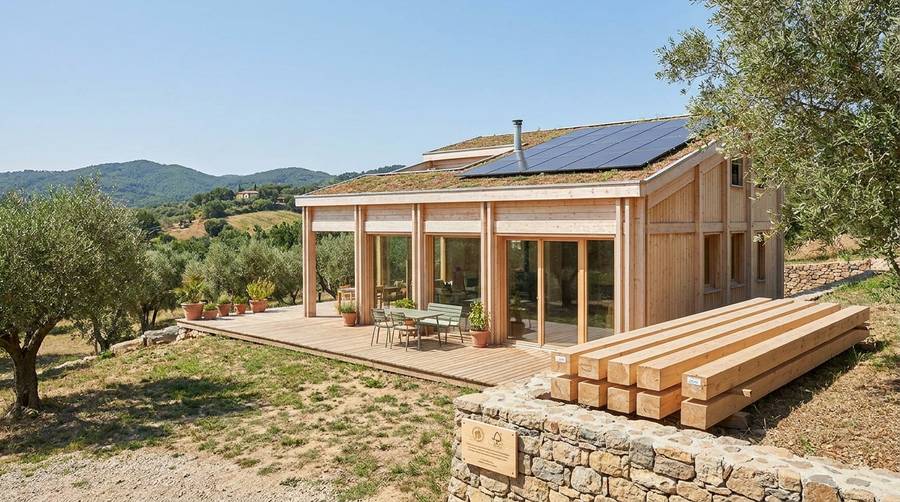
- Timber (light-frame): Best for rapid, lightweight envelope builds with excellent thermal behaviour and lower embodied carbon.
- Industrialized concrete: Suits projects demanding high thermal inertia, acoustic performance and compact volumes—often in urban plots or low-maintenance homes.
- Steel frame: Ideal for larger spans, multi-storey designs and complex geometries where structural slenderness or speed are priorities.
Impact on sustainability and carbon footprint
Sustainability is not automatic: choice of material, transport distances, supplier processes and design decisions determine real carbon results. Timber can store biogenic carbon, but transportation and finishes matter. Industrialized concrete may use lower-carbon mixes and efficient production; steel benefits from recycling but has high embodied energy unless sourced responsibly.
Technical comparison: timber light-frame vs industrialized concrete vs steel frame
Thermal performance and Passivhaus potential
Timber light-frame: Enables thick, continuous insulation and airtightness details—commonly the easiest route to reach Passivhaus metrics in single-family homes. Panels with factory-installed membranes reduce on-site air leakage risks.
Industrialized concrete: Offers thermal mass that smooths indoor temperatures, useful in Mediterranean climates with diurnal swings. To meet Passivhaus, concrete systems require careful thermal break design and high-performance insulation layers.
Steel frame: Requires thermal breaks to avoid conductive bridges. With proper insulation strategies and precision detailing, steel-framed industrialized homes can meet Passivhaus, but the margin for detailing error is smaller than for timber.
Durability, maintenance and behaviour in the Mediterranean climate
- Timber: When protected from moisture and UV, modern treatments and ventilated façades ensure longevity. Regular inspection of seals and flashings is recommended.
- Concrete: Highly durable with low maintenance; excellent for coastal or high-humidity zones if mixes and cover are specified correctly.
- Steel: Durable with proper galvanization and coatings; watch for potential corrosion at penetrations and ensure detailing prevents water trapping.
Construction cost, manufacturing lead time and quality control
Cost: Timber light-frame often shows competitive base costs for single-family homes due to material efficiency and speed. Industrialized concrete can be cost-effective where labour is expensive or when fewer finishes are needed. Steel is typically pricier for materials but can save time on structure for complex designs.
Lead time: Prefab panels or modules take factory time (6–14 weeks typical), plus site preparation. Critical path often shifts to permit and foundation works.
Quality control: All three benefit from factory QA; choose suppliers with documented QA protocols, thermal testing records and sample testing results.
Pros and cons of choosing timber for industrialized homes
Energy efficiency, lightness and speed of assembly
Pros: High insulation potential, low thermal bridging and light weight. Panels arrive ready for quick erection, reducing crane time and on-site labour.
Sustainability and carbon capture: real benefits and limits
Real benefits: Wood stores carbon and, when sourced from certified sustainably-managed forests, reduces net emissions. Life-cycle studies often show lower embodied carbon than concrete or steel alternatives for comparable envelopes.
Limits: End-of-life scenarios, adhesives and transport influence the final carbon balance. Specify low-VOC adhesives and local supply chains to maximise benefits.
Risks, fire protection and Spanish regulatory requirements
Fire performance: Engineered timber systems can meet fire safety through encapsulation, sprinkler systems and fire-rated sheathing. Spanish building codes require demonstration of performance—engage fire engineers early.
Moisture management: Design for ventilated façades, capillary breaks and robust flashing to avoid decay. Regular inspection windows at junctions are best practice.
How the turnkey process works for an industrialized home
Key stages: plot search, design, manufacturing, assembly and delivery
- Plot and feasibility: Verify local zoning, buildability and services. Topography dictates foundation approach.
- Design and permits: Work with an industrialized-housing architect to align the design with factory constraints early; submit for building permit with system-specific details.
- Factory manufacture: Panels, modules or component assemblies are produced under controlled conditions with QA gates.
- Site works and assembly: Foundations, connections and utility trenches are prepared while factory builds the elements. Assembly typically takes days to a few weeks.
- Commissioning and handover: Thermal tests, airtightness checks and systems commissioning complete the turnkey delivery.
Typical timelines and control points to guarantee fixed price and quality
Sample timeline for a 120–160 m² home: permit and design 3–6 months (parallel to plot search); factory 8–12 weeks; site works 4–8 weeks; assembly and commissioning 2–6 weeks. Key control points: permit approval, fixed foundation cost, and a signed manufacturing scope to lock the price.
What to include in a turnkey offer
- Detailed scope of works and exclusions.
- Delivery and assembly schedule tied to milestones.
- Warranties for structure, envelope and systems.
- Responsibility split for permits, connection fees and landworks.
- Testing requirements: airtightness (blower door), thermal performance and final inspections.
Financing and mortgage options for autopromoters of modular homes
Self-build mortgages: differences vs traditional building loans
Key difference: Banks lend against a staged project plan for traditional builds; for industrialized homes you need a clear manufacturer contract with delivery milestones, a certified cost breakdown, and a schedule showing factory and site activities.
Alternative financing routes and how to present a modular project to a bank
- Request a detailed contract from the manufacturer with payment schedule tied to manufacturing and delivery.
- Provide certified energy performance targets (e.g., Passivhaus projections) to show long-term cost savings.
- Consider bridging loans or staged mortgages that release funds per milestone rather than per calendar month.
Budgeting contingencies and protecting a fixed price
Tip: Keep a 5–10% contingency for unforeseen utility or site adaptation costs. Insist on a fixed-price manufacturing scope and clearly defined change-order pricing rules.
Case studies and real metrics to help you decide
Example 1: Light-frame timber house — cost, time and satisfaction
Project: 140 m² single-family home in inland Andalusia. Delivery: turnkey. Metrics achieved:
- Factory lead time: 10 weeks.
- On-site assembly: 10 days for envelope; fully commissioned in 6 weeks after foundation completion.
- Final cost: competitive with traditional build — reported 3–8% lower when accounting for shorter financing period.
- Occupant feedback: high satisfaction with thermal comfort and indoor air quality.
Example 2: Industrialized concrete home — energy performance and schedule
Project: 180 m² coastal home using precast insulated panels. Metrics:
- Thermal inertia delivered stable indoor temps during summer peaks, reducing cooling loads by an estimated 20% vs lightweight envelope.
- Factory production: 12 weeks; on-site assembly: 3 weeks.
- Maintenance: low; owners highlighted acoustic comfort as a key benefit.
How to interpret metrics: what to ask manufacturers
- Request actual airtightness test results (Blower Door) from completed projects.
- Ask for comparative U-values and Psi values at junctions.
- Get real timeline logs showing factory start/end, delivery and assembly dates.
- Seek references and, if possible, visit finished homes during different seasons.
How to choose the right option for your project: a decision checklist
Key criteria: budget, climate, sustainability and lifestyle
- Budget flexibility: if tight, timber light-frame often offers the best balance of cost and speed.
- Climate: coastal or high-humidity sites may favour concrete; inland Mediterranean benefit from thermal mass or ventilated timber façades.
- Sustainability goals: timber leads in embodied carbon when sourced locally; seek low-carbon concrete mixes if choosing concrete.
- Architectural style: steel enables larger openings and slender profiles for modern Mediterranean aesthetics.
Questions to ask your provider
- Can you provide airtightness and thermal test results from completed homes?
- What warranties cover structure, envelope and finishes?
- How is on-site coordination handled between foundation contractor and factory delivery?
- Do you manage permits and connections as part of a turnkey scope?
- Which local references can I visit?
Practical next steps to move forward with confidence
- Define your budget range and non-negotiable requirements (size, energy target, timeline).
- Shortlist 2–3 systems and request fixed-scope proposals with milestone schedules.
- Include a performance-based clause (airtightness or energy certification) in contracts.
- Arrange a financing pre-approval that recognises modular delivery milestones.
Deciding between timber, industrialized concrete and steel frame comes down to your priorities: speed and low embodied carbon (timber), thermal mass and low maintenance (concrete), or structural flexibility and spans (steel). Use the checklist above and insist on real metrics from suppliers to reduce uncertainty.
If you want, we can help you compare three turnkey proposals side-by-side, using a standard spreadsheet that aligns scope, timelines, warranties and energy performance—so you can make a clear, evidence-based choice.
Ready to move from doubt to decision? Contact a specialist, gather fixed-scope offers and book visits to finished homes—these are the fastest ways to validate what works for your plot and lifestyle.