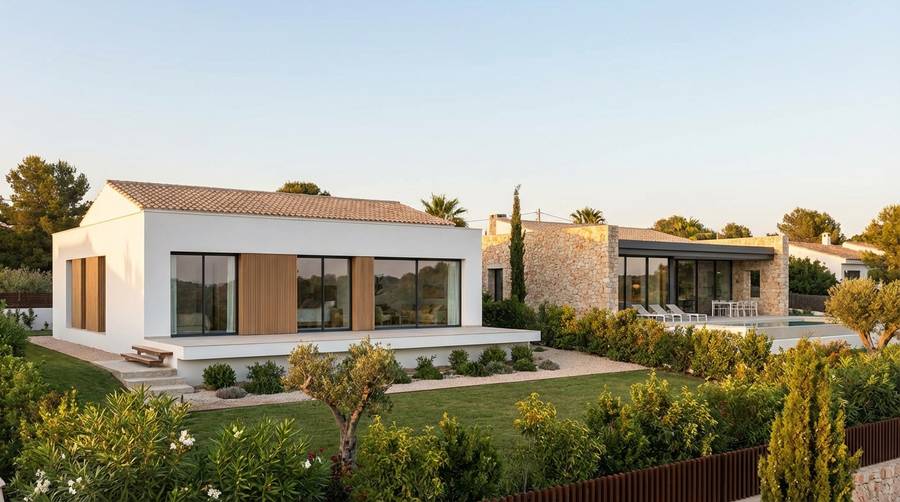
Industrialized Housing in Spain: Affordable vs Traditional
Why choose affordable industrialized housing in Spain in 2026?
Hook: If you want a high-quality home delivered faster and with fewer surprises than a traditional build, industrialized housing deserves a serious look.
Industrialized housing—also called modular or prefabricated housing—has matured. In Spain in 2026 it combines modern materials, predictable budgets and strong energy performance. For many self-builders, that mix reduces risk and accelerates occupancy.
Current sector landscape and key trends
The market has shifted from basic kit homes to high-spec, finished residences. Factory processes now control quality, while designers adapt Mediterranean forms and materials. Key trends include integration with Passivhaus principles, use of concrete panels, timber frames and steel systems, and comprehensive turnkey offers that include plot search and delivery.
What 'affordable' means: real cost vs total cost
Affordable is not just a low construction price per m². For self-builders it means a predictable total cost to move-in: land, connections, permits, taxes, finishes, and financing costs. Industrialized housing often lowers contingency lines and on-site labor costs, making the total delivered cost competitive even if component prices are similar.
- Lower on-site labor and shorter schedules reduce financing interest and temporary housing costs.
- Factory quality reduces rework and warranty claims—fewer hidden costs later.
- Transparent pricing models common in turnkey offers improve budgeting.
Who benefits: the modern self-builder
Typical beneficiaries are families prioritizing time and energy efficiency, professionals building outside urban centers, and buyers seeking better energy performance. If your priorities include budget certainty, faster delivery, and sustainability, industrialized housing aligns well.
Objective comparison: prefabricated house vs traditional house
Project time and delivery: average data and variance
Typical timelines:
- Industrialized housing (turnkey): 6–9 months from contract to handover, depending on site works.
- Traditional construction: 12–24 months on average, with common delays due to weather and subcontractor scheduling.
Factory production compresses the critical path. While site foundations and utilities still require time, parallel workflows reduce overall project duration. Expect timeline variance if the plot needs remediation or complex permits.
Cost: fixed price, contingencies and budget control
Industrialized housing often offers a fixed-price contract for the build scope. That reduces the owner's exposure to inflation on labor and onsite delays. However, fixed-price offers can exclude plot-related works, VAT timing, or optional upgrades—so read scopes carefully.
- Industrialized: better cost visibility, smaller contingency (typically 5–10%).
- Traditional: more variability, contingency commonly 15–25% due to unknowns.
Build quality and finishes: expectations vs reality
Factory-controlled environments improve dimensional accuracy and assembly quality. Modern prefabricated systems routinely match or exceed finishes seen in traditional builds, especially when the project specifies high-quality claddings and custom interiors.
Key point: Quality depends on supplier capability, not the method. Request references, visit completed homes, and review warranty terms.
Many self-builders reduce time-to-move-in by 40–60% and narrow cost overruns, when they choose a reputable turnkey industrialized solution and verify scopes upfront.
Construction materials and systems: strengths and trade-offs
Industrialized concrete: durability, insulation and cost
Precast or industrialized concrete panels deliver robust thermal mass, long service life and low maintenance. They are ideal for coastal or high-humidity locations. Concrete systems can be designed to meet high insulation standards when combined with external insulation layers.
Limitations: Higher embodied carbon per m² than timber, though modern mixes and efficient production can lower impact. Transport and crane needs on site can add cost on constrained plots.
Light timber frame: speed, sustainability and care
Timber frame (light wood) offers fast assembly, excellent thermal performance and low embodied carbon. It pairs well with breathable envelopes and high-performance windows to reach Passivhaus targets.
- Advantages: rapid assembly, renewable material, excellent U-values.
- Considerations: moisture management and detailing at junctions. Regular maintenance of external cladding may be needed over decades.
Steel frame: structural flexibility and design freedom
Steel frame systems enable longer spans, open plans and precise tolerances. They are dimensionally stable and compatible with varied cladding. When combined with factory insulation and airtightness control, steel frames support high energy performance.
Watch points: Thermal bridging and junction detailing require careful design. Corrosion protection and acoustic separation must be specified.
Sustainability and energy efficiency: is modular best?
Passivhaus and passive measures in industrialized homes
Industrialized processes facilitate consistent airtightness and insulation continuity, two pillars of Passivhaus design. Factories can install continuous insulation layers and precision window fittings that are harder to achieve on site.
Combining passive measures—orientation, shading, thermal mass—with mechanical ventilation with heat recovery (MVHR) commonly yields heating demand reductions of 75–90% compared to conventional Spanish houses.
Reducing carbon footprint: metrics that matter
Key metrics to request from suppliers:
- Embodied carbon per m² (kg CO2e/m²).
- Operational energy demand (kWh/m²·yr) under standard conditions.
- Life cycle assessment (LCA) scope and boundaries.
Industrialized production concentrates emissions in the factory, enabling process optimization and material efficiency. When paired with timber or low-carbon concrete, total lifecycle emissions can drop significantly.
Real energy performance vs certifications: practical cases
Certification like Passivhaus is useful, but measured performance is king. Case studies show industrialized homes in Spain achieving 10–25 kWh/m²·yr for heating with correct design and occupant behaviour. Verify monitored data from comparable projects rather than relying only on predicted values.
The 'turnkey' process explained step by step
From plot search to handover: milestones and typical durations
Typical turnkey sequence and approximate durations:
- Plot search and viability study: 2–6 weeks.
- Design development and permits: 3–6 months (varies by municipality).
- Factory production: 6–12 weeks (concurrent with some site works).
- Site works and installation: 4–12 weeks.
- Final finishes, commissioning and handover: 2–4 weeks.
Overall: a well-managed turnkey project often completes in 6–9 months after permits are in place. Permitting remains the biggest calendar variable.
Responsibilities, permits and agent coordination
Turnkey providers typically coordinate architect design, structural engineering, factory production and on-site assembly. Clarify who handles:
- Planning application and local fees.
- Utility connections and cadastral updates.
- Site access, foundation subcontract and civil works.
Tip: Include a project manager or designate a single point of contact to avoid scope gaps between factory and site contractors.
Ensuring transparency in cost and schedule
Request a detailed Gantt-like schedule and a scope matrix that itemizes what is included and excluded. Insist on payment milestones tied to verifiable deliverables—factory completion, site foundations, final certification. Keep a 3–5% retention to ensure defects are addressed after handover.
Financing and mortgages for self-build and modular housing
Financing options in Spain for modular and self-build projects
Common paths:
- Mortgage for land purchase + construction loan or staged mortgage disbursement.
- Green mortgages with preferential rates for high-efficiency homes (where offered).
- Consumer-type loans combined with a mortgage for small scopes, though costlier.
Turnkey offers simplify financing because lenders value predictable costs and shorter build periods. Presenting a fixed-price contract, production schedule and experienced contractor references increases lender confidence.
Typical lender requirements and how to prepare
Lenders usually require:
- Detailed budget and contract with the builder.
- Project schedule and bank guarantees or insurance for completion.
- Valuation of the finished property (some banks base lending on finished value).
Prepare clear documentation: technical specifications, energy performance targets, and contractor warranties.
Strategies to improve terms and avoid surprises
- Negotiate staged drawdowns aligned to measurable milestones to reduce interest exposure.
- Explore green mortgage options tied to energy certifications.
- Retain contingency funds outside the mortgage to avoid expensive top-up loans.
Practical conclusion: how to decide and next steps
Decision checklist: objective criteria
Use this checklist to weigh options:
- Budget certainty required? Prioritize turnkey industrialized solutions.
- Speed to occupancy important? Industrialized typically wins.
- Design flexibility and large spans needed? Assess steel-framed modular or hybrid solutions.
- Sustainability goals (Passivhaus)? Verify supplier track record and measured performance.
- Plot complexity (steep slopes, narrow access)? Site constraints may favour traditional or mixed approaches.
Recommended scenarios by priorities
- Maximum predictability + good energy performance: turnkey industrialized with timber or concrete panels.
- Architectural freedom with tight spans: steel frame modular with on-site finishing.
- Lowest embodied carbon focus: timber-frame industrialized with durable external finishes.
Key resources and next actions for self-builders
Next steps:
- Request three detailed turnkey proposals with full scopes and timelines.
- Visit at least two completed homes by each supplier to verify finishes and performance claims.
- Engage a mortgage advisor early to map financing milestones to the project schedule.
Case snapshot: A recent turnkey modular project near Valencia completed from permit approval to handover in 7 months. Final cost variance was under 4% vs contract. Post-occupancy energy measurements showed heating demand below 15 kWh/m²·yr. Client satisfaction scored 9/10 on delivery and finishes.
Final thoughts and call to action
Choosing between industrialized housing and traditional construction is a question of priorities: time, predictability and sustainability often tip the balance toward industrialized options. But quality, guarantees and the supplier's track record make the difference.
If you are a self-builder in Spain, start by defining the three non-negotiables for your project: budget cap, required move-in date, and energy target. Use those criteria to evaluate turnkey proposals and financing offers.
Ready to explore options? Compare turnkey offers, visit completed homes and consult a mortgage advisor to match financing to your schedule. If you want help assembling a checklist or reviewing proposals, contact a specialist who understands industrialized housing in Spain.
Take the next step with evidence: review proposals, verify real data and choose the approach that reduces risk while delivering the home you want.