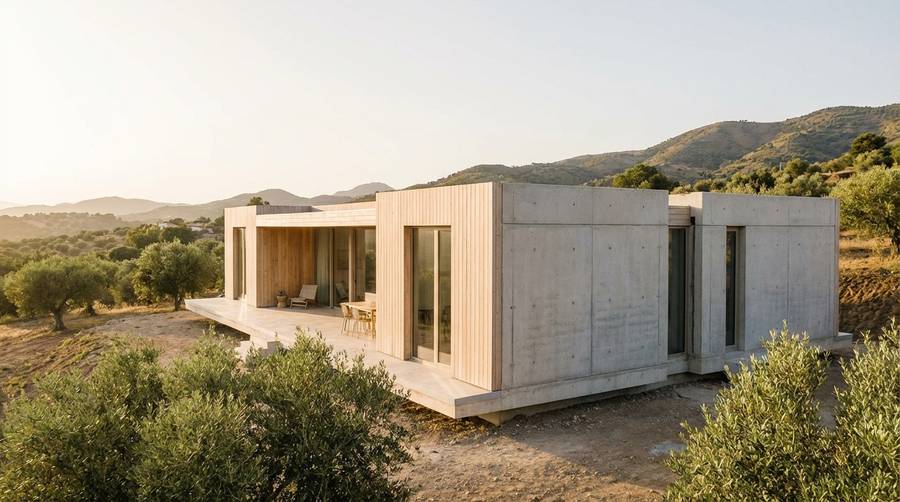
Prefabricated House vs Traditional Build: Clear Guide
Introduction — Why this comparison matters now
Hook: If you’re planning to build in Spain today, the choice between a prefabricated house and a traditional build will determine your timeline, budget certainty and long-term energy costs.
This article gives a direct, actionable comparison based on real metrics and recent case studies. It’s written for families, autopromoters and small promoters who want a clear decision framework—no fluff, just the facts and practical next steps.
Prefabricated (industrialized) homes can reduce on-site time by up to 60% and cut unforeseen costs, while modern materials like timber frame and low‑carbon concrete close the gap on durability and thermal performance.
Why consider industrialized housing in Spain today?
Advantages versus traditional construction — the core benefits
Time certainty: Factory-controlled production and parallel on-site work typically mean a much shorter critical path. Expect the on-site phase to take weeks rather than months.
Cost predictability: Many manufacturers offer a fixed-price contract for a defined scope (shell, envelope, or turnkey), reducing the risk of escalating labor or material costs.
Quality control: Controlled factory conditions improve repeatability, reduce weather-related defects and often deliver higher airtightness and insulation consistency.
Who benefits most: families, autopromoters and small promoters
- Families looking for shorter disruption and faster move-in.
- Autopromoters who need budget certainty and a predictable schedule to coordinate mortgages and sale of existing properties.
- Small promoters who require reliable delivery models to manage multiple plots with tight timelines.
Key questions before starting (plot, regulations, and timelines)
- Is the plot accessible for deliveries and crane operations?
- What local planning constraints affect façades, height and materials?
- What are realistic calendar milestones from permit to delivery?
Comparative analysis: prefabricated house vs traditional build
Delivery times and risk of delays
Prefabricated: Typical timeline from contract to handed-over home is 6–10 months for a single-family turnkey delivery in Spain (design + factory build + site assembly). The on-site assembly window often spans 2–8 weeks. Parallel workflows shrink critical path.
Traditional: Expect 12–24 months for a similar scope. On-site sequencing (foundations, structure, weather-proofing, interior trades) and weather sensitivity increase delay risk.
Total cost: fixed price, contingencies and long-term value
Prefabricated: Offers tighter fixed-price contracts for defined scopes. Commonly lower labour premiums and fewer on-site overruns. However, transportation, crane work and unexpected site preparation (soil remediation, retaining walls) can add costs if not anticipated.
Traditional: More flexible mid-project changes but higher exposure to labour and material price inflation. Contingency budgets of 10–20% are normal.
Quality, customization and durability
Quality: Factory conditions yield consistent insulation, airtightness and finishing standards. Modern prefabricated systems meet or exceed conventional standards.
Customization: Modular/prefab does not mean one-size-fits-all. Contemporary suppliers offer high degrees of customization—layouts, façades and finishes—though extreme design novelties may be easier in traditional builds.
Durability: Modern timber frames with proper detailing and low‑carbon concrete systems have comparable lifespans to masonry when maintained correctly.
Modern materials: timber frame and low‑carbon concrete explained
Light timber frame: insulation, weight and carbon footprint
Advantages: Lightweight, fast assembly, excellent thermal performance when combined with continuous insulation. Lower embodied carbon per m2 compared to traditional concrete or brick.
Considerations: Detailing at junctions, humidity control and protective cladding are essential. When designed with an airtight strategy and mechanical ventilation (MVHR), timber homes often achieve superior thermal comfort.
Low‑carbon industrialized concrete: strength and thermal mass
Advantages: High structural capacity, excellent thermal inertia that smooths internal temperature swings, and compatibility with industrialized processes (precast panels, insulated sandwich elements).
Considerations: Embodied carbon has decreased with new binders and low‑clinker mixes, but designers must still optimize mix design and minimize unnecessary volume to keep the carbon footprint low.
Hybrid approaches and selection criteria
- Use timber for upper floors and low‑carbon concrete for foundations and ground-floor slabs to combine lightness and inertia.
- Choose materials based on climate zone: timber envelopes excel in mild climates; thermal mass helps in high‑diurnal swing areas.
- Assess local supplier capability and warranties when selecting hybrids.
Sustainability and energy efficiency: achieving Passivhaus targets
How industrialized homes simplify Passivhaus compliance
Controlled production means repeatable insulation depths, fewer thermal bridges and better airtightness—core Passivhaus requirements. Factory QA and blower-door testing during assembly reduce on-site surprises.
Energy savings, comfort and emissions reduction
Well-executed industrialized homes can reduce operational energy by 75–90% compared to typical Spanish homes built to older standards. Combined with low‑carbon materials, lifecycle emissions fall significantly.
Certifications, materials and critical measures (windows, envelope, systems)
- High-performance windows (triple glazing in many Passivhaus projects).
- Continuous external insulation and careful detailing at junctions.
- Mechanical ventilation with heat recovery (MVHR) sized to certified standards.
Turnkey process and financing for autopromoters
Stages: from plot search to move-in
- Plot selection: Access, legal constraints and topography check.
- Concept and budgeting: Feasible layout, zoning and preliminary cost estimate.
- Design and permit: Technical package, EPC considerations and permit submission.
- Factory production: Component manufacture while foundations are prepared on site.
- Assembly and commissioning: Crane installation, sealing, services connection and testing.
- Handover: Final checks, certifications and customer walkthrough for defect lists.
Financing options: self-build mortgages and modular loans
Spanish banks increasingly offer self-build (hipoteca de autopromoción) loans structured in tranches linked to project milestones. Modular housing providers may also help structure supplier-backed financing or recommend lenders familiar with turnkey deliveries.
Key points for financing:
- Prepare a realistic cash-flow plan aligned with permit and assembly milestones.
- Seek lenders that accept factory contracts and turnkey guarantees as collateral.
- Factor in insurance and retention clauses covering post-delivery defects.
Guarantees, contractual timelines and permits management
Insist on clearly defined milestones, liquidated damages for unjustified delays and performance guarantees for airtightness and thermal metrics. Confirm who handles permit management and utility connections in the contract.
Case studies with real metrics: times, costs and satisfaction
Case 1: Timber-frame family home — data and outcomes
Project: 150 m2 single-family home, timber-frame, turnkey.
Timeline: Design to handover in 8 months. On-site assembly in 4 weeks.
Cost: Final turnkey cost €1,750/m2 including foundations and standard finishes. Contingency used: 3% (minor siteworks).
Performance: Airtightness 0.3 ACH @50Pa, heating demand <15 kWh/m2·year.
Customer satisfaction: 9/10 — praised schedule certainty and interior comfort.
Case 2: Low‑carbon concrete industrialized home — comparative metrics
Project: 180 m2 home using precast low‑carbon concrete panels for ground floor and timber upper floor.
Timeline: 10 months end-to-end. On-site assembly 6 weeks (including slab and panel installation).
Cost: €1,950/m2 turnkey. Higher upfront than pure timber but lower maintenance expectations and stronger thermal inertia.
Performance: Robust acoustic and thermal comfort; operational energy ~20 kWh/m2·year with PV and MVHR.
Customer feedback: 8.5/10 — valued solidity and reduced thermal swings.
Lessons learned and client testimonials
- Early identification of site constraints avoids late cost additions.
- Choosing the right level of customization helps keep fixed-price benefits.
- Clients consistently rank predictability and energy comfort as the main advantages over traditional builds.
For common pitfalls, see Errores al elegir vivienda industrializada.
How to decide: practical criteria and next steps
Decision checklist (budget, climate, design priorities)
- Budget certainty vs flexibility: need for fixed price?
- Local climate: prioritize thermal mass or lightweight insulation?
- Design complexity: can modular components support your form language?
- Plot constraints: access, foundations and utility connections?
Questions to ask suppliers and how to compare offers
- What exactly is included in the turnkey scope? (Foundations, finishes, landscaping)
- What are the guaranteed performance metrics? (airtightness, U-values, heating demand)
- What warranties and post‑delivery support are provided?
- How are change orders priced and managed?
Recommended next steps to start your project
- Confirm plot constraints and basic budget.
- Request three comparable turnkey proposals with clear milestones.
- Speak with a lender about a self-build mortgage and align tranche timing.
- Ask for references and onsite visits to completed homes of similar construction.
Conclusion — Which path suits you?
Summary: Prefabricated housing in Spain today offers real advantages in time, cost certainty and energy performance — particularly when combined with modern materials like timber frame and low‑carbon concrete. Traditional builds still provide flexibility for bespoke forms and site-driven solutions.
Choose prefabrication if you value schedule certainty, predictable costs and a high-performing thermal envelope. Choose traditional methods if your project demands unique architectural expression beyond standard modular possibilities or if local constraints make modular logistics impractical.
Final thought / CTA: If you’re considering a self-build, start by auditing your plot and assembling three turnkey quotes aligned to a realistic financing plan. Contact a specialist for a tailored feasibility review to compare options side-by-side and reduce the risk of surprises.