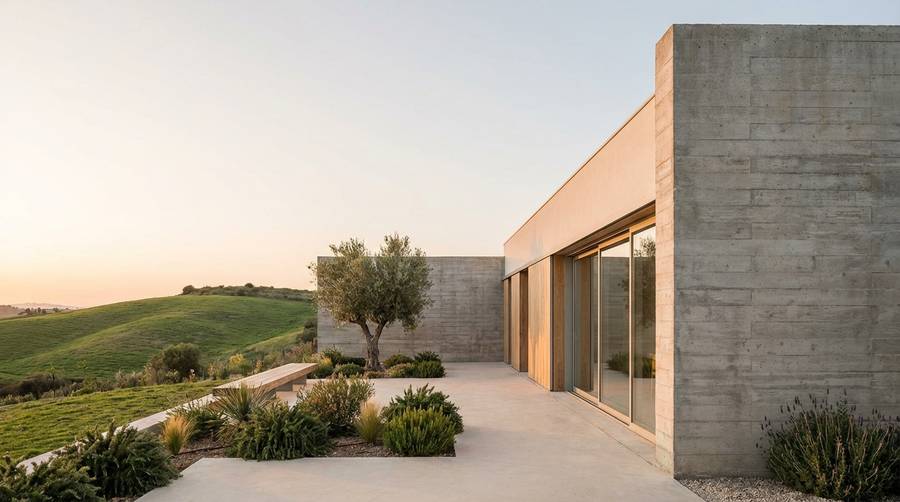
Carbon-Capturing Concrete for Industrialized Housing
Introduction — Hook: why this matters now
Building a modern home in Spain today means balancing speed, cost and climate impact. For self-builders and autopromotores choosing industrialized housing, carbon-capturing concrete offers a rare combination: structural reliability with measurable reductions in embodied CO2. This article gives a practical, no-fluff roadmap to understand the material, compare it to conventional concrete, review real metrics, and integrate it into a turnkey (llave en mano) project.
Choosing low-carbon materials early can cut a project’s embodied emissions by 20–40% while preserving durability and design flexibility—critical for Passivhaus-level projects.
1. Why carbon-capturing concrete matters for industrialized housing
Clear definition and relevance for self-builders in Spain
Carbon-capturing concrete refers to concrete formulations or processes that permanently bind CO2 during production or curing, or that use cement substitutes and recycled materials to lower net emissions. For autopromotores, it is relevant because it directly affects your project’s embodied carbon, compliance with emerging regulations, and market appeal.
How it fits with industrialized materials: concrete, wood and steel
Industrialized housing commonly mixes systems: precast concrete elements, light wood framing (entramado ligero), and steel frame construction. Carbon-capturing concrete is compatible with all three when used for foundations, load-bearing panels, floor slabs or exterior cladding. Its integration requires coordination in factory workflows and detailing (jointing, interfaces, fixings), but it does not force a change in architectural language — Mediterranean designs with warm façades remain fully achievable.
General benefits: sustainability, durability and market acceptance
- Lower embodied carbon: Direct reduction in lifecycle CO2.
- Durability: Equivalent or improved long-term performance vs standard mixes.
- Market value: Increasing buyer preference and growing regulatory acceptance.
2. Five key advantages of carbon-capturing concrete in prefabricated homes
1) Net emissions reduction and support for Passivhaus goals
Reduced embodied carbon complements operational energy savings of a Passivhaus approach. In practice, replacing conventional concrete with a carbon-capturing alternative can reduce embodied CO2 by 15–35% depending on mix and process—helping projects meet stricter sustainability claims or certification points.
2) Structural performance without sacrificing Mediterranean aesthetics
Manufacturers deliver carbon-capturing concrete in precast panels and exposed finishes that suit Mediterranean contemporary architecture—smooth light façades, stone and wood accents. The material supports large window openings and open-plan interiors while offering the mass benefits that stabilize indoor temperatures.
3) Increased resale value and quantifiable lifecycle savings
Early indicators show buyers value verified low-carbon construction. When combined with energy efficiency, projects often report higher perceived value—important for resale. Simplified LCA estimates show payback in environmental terms within decades, while market premiums depend on location and demand.
4) Factory control improves consistency and quality
Industrialized production of carbon-capturing concrete elements allows tighter quality control—consistent curing, defined mix ratios and traceability. That reduces on-site variability and helps meet warranty expectations for turnkey delivery.
5) Compatibility with hybrid systems and circularity goals
The best mixes can incorporate industrial by-products (fly ash, blast-furnace slag) and recycled aggregates, supporting circular economy objectives without compromising strength—important for developers and owners targeting meaningful sustainability metrics.
3. Technical comparison: carbon-capturing concrete vs traditional concrete
Mechanical properties, curing time and factory compatibility
Modern carbon-capturing mixes are engineered to match or exceed the compressive strength and durability of standard concrete. In factory settings, curing regimes can be optimized (accelerated CO2 curing in some processes) to shorten production cycles. However, some specific formulations require controlled curing environments—factor this into factory planning.
Impact on closed-site timelines and quality control
Using precast carbon-capturing elements does not lengthen on-site assembly time; in many cases, improved dimensional control and less corrective work reduce the time to a weather-tight envelope. The key is early coordination between designer, manufacturer and site team to ensure connections and tolerances are clearly defined.
Relative costs, maintenance and life-cycle assessment (LCA)
Costs can be modestly higher up front—typically 3–12% depending on the supplier and scale—but LCA analyses often show lower lifetime environmental costs. Maintenance needs are similar to traditional concrete; chloride ingress and carbonation processes remain the primary durability considerations and must be designed against in coastal Spanish environments.
4. How carbon-capturing concrete affects energy efficiency and certifications
Thermal mass interaction with passive design
Concrete’s thermal mass helps stabilize indoor temperatures, smoothing peak heating and cooling loads when paired with appropriate insulation and solar control. In Mediterranean climates, strategically located concrete elements can lower HVAC demands when combined with high-performance building envelopes typical of modular, factory-built homes.
Contribution to certifications and sustainability reports
Documented use of carbon-capturing concrete strengthens sustainability narratives in technical reports and can support certification credits (e.g., BREEAM, VERDE, and supplier-specific sustainability schemes). For Passivhaus, its main role is reducing embodied emissions rather than operational energy, but embodied reductions are increasingly recognized in holistic certification approaches.
Examples of expected energy and carbon metrics
- Embodied CO2 reduction: commonly 15–35% vs conventional concrete mixes.
- Operational energy: unaffected directly, but thermal mass can reduce peak loads by 5–10% in well-designed envelopes.
- Whole-life benefits: combined embodied+operational strategies may lower total lifecycle carbon by 20–30% over 60 years.
5. Real case studies: metrics, timelines and client satisfaction
Case 1 — Modular home with carbon-capturing panels (metrics)
Project: 140 m² two-storey family home, precast carbon-capturing façade and slab. Factory production: 8 weeks. On-site assembly and envelope closure: 6 days. Final fit-out and services: 10 weeks. Total turnkey delivery: 5 months.
Costs: construction cost per m² comparable to high-quality modular alternatives; material premium ~7% for concrete elements. Embodied CO2: estimated reduction of 22% vs same-design using conventional concrete.
Client feedback: rated satisfaction 9/10 for speed, finish quality and thermal comfort during first year.
Case 2 — Turnkey industrialized house with hybrid structure
Project: 220 m² llave en mano using steel frame + carbon-capturing concrete foundation and stair cores. Timeline: design-to-hands-over 7 months. Quality checklist enforced in factory reduced on-site rework by 60% compared to similar non-prefab projects.
Environmental outcome: lifecycle analysis showed a 28% drop in production-phase emissions after accounting for recycled aggregates and optimized mix design.
Lessons learned: common challenges and fixes
- Supply chain clarity: Secure supplier commitments for mix and delivery windows early.
- Interface detailing: Prioritize workshop drawings for joints between concrete and timber/steel to avoid site delays.
- Certification evidence: Request LCAs and EPDs (Environmental Product Declarations) from manufacturers to document claims.
6. How to integrate carbon-capturing concrete in a turnkey project — practical steps
Initial decisions: plot, budget and system selection
Start with clear priorities: desired finish, target emissions reduction, and maximum budget. Choose the structural system early (full precast, hybrid, or foundations + panels) because it determines factory requirements and on-site sequencing. For Mediterranean homes, plan façades and window placements to keep the favored light, wood and stone look.
Coordination with manufacturers and factory quality control
Work with manufacturers who provide traceable documentation: mix compositions, curing procedures and third-party EPDs. Insist on factory quality-control checklists for dimensions, curing records and surface finishes. Schedule mock-ups for visible façades to agree on texture and color.
Financing and permits in Spain: mortgages for self-build and recommendations
Financing autopromoción in Spain commonly uses construction mortgages and staged disbursements tied to milestones. Carbon-capturing concrete does not complicate mortgage processes but having certified product documentation and a detailed turnkey contract helps lenders evaluate risk. Consider these steps:
- Obtain a detailed turnkey contract with fixed-price elements for factory work and install.
- Collect EPDs and manufacturer guarantees to present to lenders who evaluate sustainability-focused portfolios.
- Explore specific green mortgage options—some banks reward verified low-carbon projects with preferential terms.
Final recommendations for autopromotores
- Start sustainability targets early: Lock material decisions during the concept phase.
- Require documentation: EPDs, factory QC records and LCA summaries.
- Design for assembly: Minimize bespoke details that increase factory complexity and cost.
- Ask for references: Visit delivered homes if possible to verify finish and performance.
For a technical checklist on concrete selection in modular projects, see Hormigón capturador de CO2 en vivienda industrializada.
Conclusion — Practical takeaway and next steps
Carbon-capturing concrete is a practical, scalable tool for reducing the environmental footprint of industrialized housing in Spain without sacrificing durability, design or the Mediterranean aesthetic. For autopromotores, the value comes from pairing the material with factory-controlled production, clear documentation and turnkey planning to ensure timelines and budgets stay predictable.
If you are planning a turnkey modular home, prioritize early supplier validation and documentation, and weigh the modest upfront premium against clear lifecycle benefits. If you'd like a tailored checklist for integrating carbon-capturing concrete into your project or a contact for certified manufacturers, contact our team to discuss your plot and requirements.