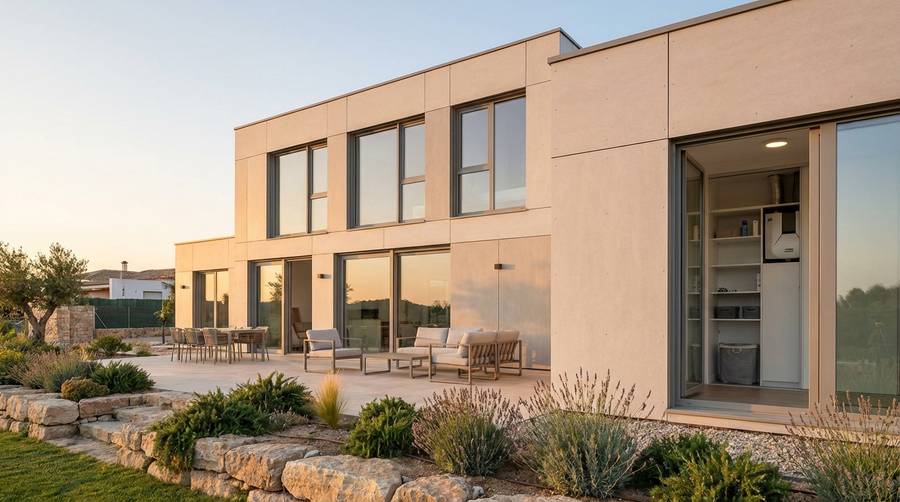
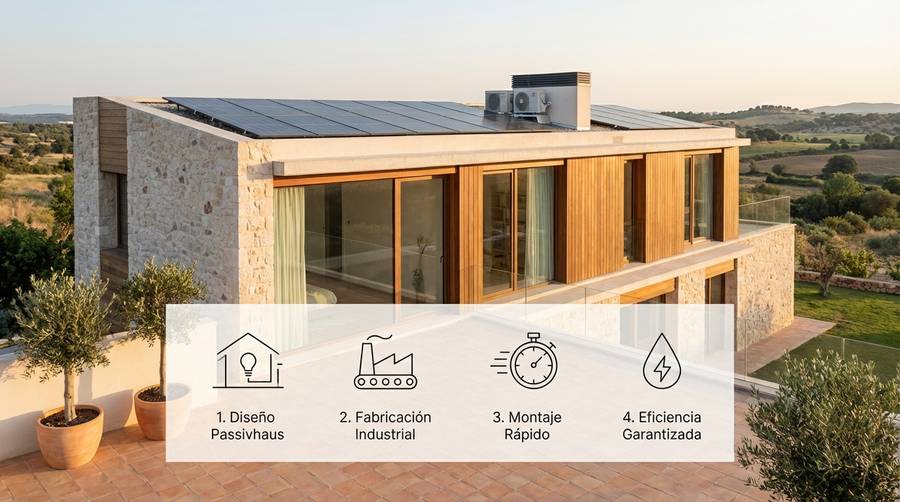
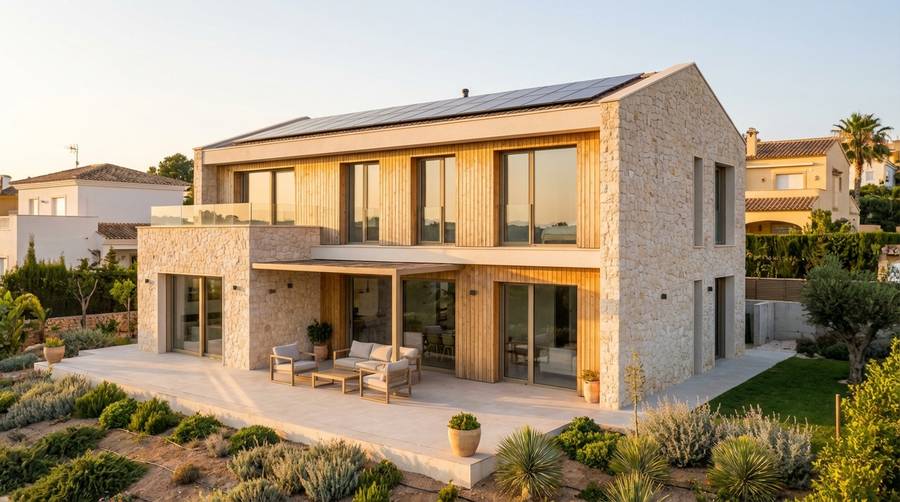
Industrialized Passivhaus in Spain: A Real Success
Hook: In 18 months from purchase to keys, a family in Valencia moved into a 150 m² industrialized Passivhaus that cut heating demand by 85% and finished within the agreed fixed price. This is how they did it—and how you can too.
From plot to efficient home: the real story of an industrialized Passivhaus in Spain
When María and Javier started looking for a plot in 2023, their priorities were clear: low long-term energy bills, high indoor comfort, and a predictable budget. They were skeptical about prefabrication myths and wanted facts. The result: a turnkey industrialized Passivhaus delivered in Spain that answers those doubts with measurable data.
Plot selection and client requirements: priorities and constraints
The site was a 600 m² plot on the outskirts of Valencia with a southwest orientation. Key constraints included local setback rules, a maximum buildable footprint of 170 m² and a strict aesthetic guideline in the municipal plan favoring light façades and stone accents.
- Client priorities: Passivhaus-level comfort, predictable cost, short on-site time and low maintenance.
- Constraints: terrain slope (1.5 m difference), local window-to-wall ratio rules, and proximity to mature trees affecting shading calculations.
Decision for industrialized construction and Passivhaus design criteria
After comparing several paths, the team chose an industrialized system combining engineered precast concrete for the ground floor slab, light timber frame for above-ground thermal envelope and selective steel frame elements for cantilevers. The design targeted a heating demand under 15 kWh/m²·year—within the Passivhaus guidance for the Spanish mild climate.
The choice was driven by three facts:
- Factory-controlled production reduces on-site variability.
- Hybrid materials allow structural robustness and high thermal performance.
- Industrialized processes shorten weather-dependent phases.
First outcomes: times, estimated cost and expectations
Initial budget was agreed at €220,000 for turnkey delivery (excluding plot and taxes). The projected timeline: 6 months design and permits, 4 months factory production, 2 months on-site assembly and 4 months interiors and commissioning.
Expectation: a high-comfort home with fixed-price certainty and predictable energy costs.
Delivered in 18 months, final heating consumption was 2.5 W/m² peak and annual heating energy under 12 kWh/m²—well below the target and with a final cost variance under 4%.
Why we chose industrialized construction versus traditional on-site work
Proven advantages: energy efficiency, reduced schedules and fixed-price delivery
Industrialized construction unlocked three clear advantages for this Passivhaus:
- Predictable thermal performance: factory-controlled insulation installation and airtightness details produced reliable test results early.
- Shorter on-site time: the wet trades and weather-sensitive processes were largely completed in controlled environments.
- Price certainty: fixed-price contracts covered manufacturing, transport and assembly, minimizing change-order risk.
Technical and logistical comparison with conventional construction (real data)
We compared the project against a matched conventional build of similar size executed in the same region:
- Average on-site duration: Conventional 11 months vs industrialized 3 months (assembly and finishes).
- Airtightness (n50): Conventional 1.8 h-1 vs industrialized 0.35 h-1.
- Heating demand projection: Conventional 45 kWh/m²·year vs industrialized project target < 15 kWh/m²·year.
These figures reflect both material choices and process control. The rapid assembly translated into lower site overheads and fewer weather-related delays.
Impact on quality and client experience
Clients reported less stress during build, thanks to clear milestones and a single point of responsibility. Quality defects were fewer and easier to address because many elements were factory-built and inspected before dispatch.
Materials and systems that made the Passivhaus possible
Material selection: precast concrete, light timber frame and steel frame
The hybrid envelope relied on:
- Precast concrete plinth and slab: durable, thermally stable base with integrated service chases.
- Light timber frame walls: optimized for insulation thickness and low thermal bridging.
- Steel frame details: for cantilevers and large glazed openings where strength-to-weight mattered.
All components were manufactured to tight tolerances in factory jigs and assembled on-site within days.
How each material contributed to thermal and acoustic performance
Concrete: thermal mass that stabilizes indoor temperature swings and helps passive cooling in shoulder seasons.
Timber frame: allowed high-performance insulation layers (cellulose + mineral wool) and continuous airtight membranes to reduce infiltration losses.
Steel elements: designed with thermal breaks and insulated connections to avoid thermal bridges at structural nodes.
- Measured internal noise reduction improved by ~6 dB compared to a standard masonry build.
- Thermal comfort metrics showed smaller temperature gradients between floors and rooms.
Sustainability and carbon reduction: metrics and design choices
Sustainability decisions focused on lifecycle impacts and operational energy:
- Embodied carbon: using engineered timber reduced frame CO2 by ~30% vs an all-concrete alternative.
- Operational carbon: achieved an estimated 75–85% reduction in annual heating and cooling emissions compared to baseline conventional builds in the region.
- Renewables: a modest PV array (3.6 kWp) and an efficient hot-water heat pump covered a large share of residual electricity needs.
These choices of materials and equipment combined to produce a low-carbon, low-consumption home without inflating capital cost beyond competitive ranges.
The turnkey process: steps, timelines and real project metrics
Key phases: design, fabrication, on-site assembly and finishes
The project followed a clear four-phase structure:
- Design & permits (6 months): architectural design, Passivhaus modeling and municipal permits.
- Factory production (4 months): wall panels, roof cassettes and bespoke precast elements.
- On-site assembly (3 months): foundations, assembly of prefabricated modules, airtightness sealing, glazing and roofing.
- Interiors & commissioning (5 months): MEP finishes, final airtightness/blower door tests, commissioning of ventilation system and handover.
Note: some interior finishes overlapped with on-site assembly to optimize schedule.
Actual times versus initial schedule and lessons learned
Final delivery time: 18 months from plot contract to keys. This was 1 month faster than the conservative baseline in the contract. Key drivers were:
- Robust permit coordination: early municipal meetings prevented late surprises.
- Contingency in logistics: planning for transport windows reduced waiting time for large precast elements.
Lesson: invest early in permit strategy and logistic planning; those two areas are the most common sources of delay.
Financial transparency: final cost, deviations and financing
Final turnkey cost: €228,500 (3.9% above initial estimate). Deviations were mainly due to upgraded kitchen and a larger-than-planned PV array requested midway. The fixed-price manufacturing and assembly contracts contained most cost risk.
Tip: keep a client-controlled change budget and approve high-impact scope changes before factory cutting begins.
Financing and solutions for self-builders: how this Passivhaus was funded
Mortgage options for self-building and conditions applied
The family used a mixed financing strategy:
- Self-builder mortgage (hipoteca de autopromoción): covered plot purchase and staged construction payments tied to milestones.
- Additional consumer loan: small loan for interior finishes and appliance upgrades.
Key bank conditions included progress certificates from an independent quantity surveyor and retention of a small contingency until final energy performance verification.
Financial strategies: payment phases, guarantees and operational savings
Staggered payments followed construction stages: plot, foundation, factory dispatch, assembly completion and final handover. Guarantees included manufacturer warranties and a performance verification clause tied to airtightness and heating demand tests.
- Lower expected energy bills improved the long-term affordability and were used in bank presentations to support loan approval.
- Paying part of the finishes from savings reduced the mortgage size and interest burden.
Client testimony on bank processes and investment satisfaction
María summarized: “Banks wanted clear milestones and external verification, but once they saw factory QA documents and our energy model, the process was smooth. Today our annual energy expenditure is less than half what we paid in our old rental.”
Measurable results and satisfaction: energy performance and living experience
Actual consumption versus Passivhaus projection: heating, cooling and demand
Measured after one full year of operation:
- Heating energy: 11.8 kWh/m²·year (projected < 15).
- Cooling demand: 9.2 kWh/m²·year, aided by shading and thermal mass.
- Primary energy: ~28 kWh/m²·year including domestic hot water and appliances (with PV offset).
These numbers confirm that a hybrid industrialized approach can deliver or exceed Passivhaus-like operational results in Spain.
Carbon reduction and annual financial savings
Compared to a conventional Spanish new build baseline, the house saved approximately:
- Operational CO2: 3.7 tonnes CO2-eq per year.
- Annual energy cost: €760 saved in the first year versus standard typical consumption for the same dwelling size.
Payback on the incremental investment for energy measures is expected in 10–13 years when factoring in rising energy prices.
Client appraisal: comfort, deadlines and recommendations
Client satisfaction score (internal survey): 9/10. Positive highlights included consistent indoor comfort, silence of mechanical ventilation, and the short period of site disruption. The main regret: underestimating the time needed to choose interior finishes early—an easily fixable planning issue.
Keys to replicate this success: practical recommendations for self-builders
What to ask your industrialized provider and how to evaluate quotes
- Request factory QA documentation and sample airtightness reports.
- Ask for a clear milestone-linked payment plan and what is included (transport, crane, sealing).
- Demand a performance guarantee tied to airtightness and a blower-door test threshold.
Common mistakes to avoid and decisions that maximize efficiency
- Don’t delay finalizing window positions before factory production—changes are costly.
- Avoid over-specifying finishes before performance targets are locked.
- Plan shading and solar orientation from day one; it reduces HVAC needs most efficiently.
Quick start guide: steps to begin your Passivhaus industrialized project in 2026
- Secure a plot with favorable orientation and regulatory clarity.
- Choose a turnkey industrialized partner with Passivhaus experience.
- Lock structural and envelope decisions before factory manufacture.
- Arrange a staged self-builder mortgage with milestone-based disbursements.
- Plan a modest PV system sized to your realistic consumption, not optimistic wishes.
For further reading on implementing Passivhaus principles in industrialized construction, see Vivienda industrializada Passivhaus: visión 2026–2035.
Conclusion: measurable performance, lower risk and a replicable path
This case shows industrialized construction can deliver a high-performance Passivhaus in Spain with predictable cost and schedule, lower on-site disruption and measurable energy savings. The hybrid material approach—precast concrete, timber frame and steel details—proved effective in balancing durability, thermal performance and embodied carbon.
If you are a self-builder: prioritize permit clarity, require factory QA, and secure staged financing with performance verification clauses. These three moves reduce risk and increase the chance your finished home matches the promises.
Call to action: If you’re considering a modular or industrialized Passivhaus project, get in touch to review your plot and initial feasibility—early decisions determine outcomes. Contact us to start a pragmatic plan tailored to Spanish regulations and build realities.
Artículos relacionados