


Industrialized Housing Success: Spanish Self-Build Case
From idea to keys: a real family story who chose industrialized housing
Hook: When Marta and Jorge decided to build their home in Valencia, they had one non-negotiable: certainty on price and delivery date. What they found in industrialized housing was a predictable process that delivered a high-quality, energy-efficient home in a fraction of the usual time.
Initial context: the family's situation and motivation to self-build
Marta (38) and Jorge (41) were a dual-income family with two children. They owned savings for a deposit, had a small plot in a peri-urban area, and wanted a breathable, modern home that would age well and cost less to run. Their priorities were clear: fixed budget, short construction time, and low energy bills.
Why they discarded traditional stick-built housing: time, cost and transparency
They interviewed local builders and received open-ended schedules and variable quotes. Recurrent concerns were: lengthy wet trades, weather delays, and change-order risks. They rejected the uncertainty of incremental billing and long site programs. Industrialized housing offered:
- Price transparency: fixed turnkey contract.
- Shorter on-site duration: faster enclosure and reduced subcontractor interferences.
- Quality control: factory inspections and standardized assembly.
Project objective and success criteria
The family defined measurable targets before signing:
- Budget cap: €240,000 build cost (excluding plot)
- Hand-over within 9 months from contract signing
- Operational energy < 40 kWh/m²·year (target close to low-energy/Passivhaus standards)
- Comfort and daylight with Mediterranean aesthetics
Financing route: how the self-build mortgage was structured
Mortgage products considered: land loan, construction mortgage, and bridge financing
The family reviewed three product types:
- Land mortgage: short-term loan to secure the plot.
- Construction (obra) mortgage: disbursed by milestones as the build progresses.
- Bridge loan: interim cover when cash flow timing did not match bank disbursements.
They ultimately chose a combined approach: refinance the land loan into a single construction mortgage with staged disbursements tied to factory and on-site milestones. This reduced refinancing fees and simplified monthly planning.
Risk segmentation and negotiation: milestones, disbursements and bank requirements
Key negotiation points with the bank:
- Linking disbursements to clearly defined factory milestones (design sign-off, factory production start) and two on-site milestones (delivery and enclosure; final connection/acceptance).
- Providing a turnkey contract from the industrialized housing provider to cap the bank's perceived risk.
- Including a retention reserve (5–10%) until final completion and municipal occupancy certificate.
Outcome: The bank approved a 25-year mortgage with a construction phase where interest only was paid on disbursed amounts. The family avoided a costly bridge loan.
Financial results: final terms, duration and estimated monthly payment
Final financing snapshot (anonymized):
- MORTGAGE AMOUNT: €200,000 (covering construction and refinancing of the plot)
- TERM: 25 years after completion
- INTEREST: variable margin + Euribor (negotiated caps during construction)
- ESTIMATED MONTHLY PAYMENT AFTER COMPLETION: €900–€980 (principal + interest) depending on long-term Euribor
These numbers gave the family the predictability they sought. The staged disbursal model also aligned bank risk with factory-controlled production.
Construction choices that optimized cost and time
System selection: industrialized concrete, light timber frame, or steel frame
The client considered three systems:
- Industrialized precast concrete: high thermal mass, durability, and acoustic performance.
- Light timber frame (entramado ligero): fast production, excellent insulation, and biogenic carbon storage.
- Steel frame (steel frame): precise tolerances and long spans for open-plan living.
Their final choice blended light timber frame for the main envelope with factory-finished insulating panels and a concrete base slab. The hybrid approach preserved rapid assembly while ensuring durability and thermal inertia where needed.
Practical advantages: enclosure times, quality control and fixed pricing
Benefits observed in practice:
- Enclosure in days: The factory modules and panels were installed in three weeks, drastically reducing exposure to weather.
- Factory QA: Each panel had documentation for thermal performance and airtightness tests, reducing rework.
- Price certainty: The turnkey contract covered finishes and key services, avoiding incremental cost creep common in traditional builds.
How a turnkey offer affects financing and risk management
A genuine llave en mano (turnkey) contract does three things for banks and clients:
- Provides a clear scope for bank underwriting
- Limits variations and claims during construction
- Enables faster handover and transition to mortgage amortization
For Marta and Jorge, the turnkey contract was decisive in obtaining favorable financing conditions.
Real timeline and cost breakdown: metrics from the success case
Key timings: plot search, design, manufacture, assembly and delivery
Actual timeline achieved:
- Plot search and purchase: 4 months
- Design development and permits: 3 months (parallel fast-track permit strategy)
- Factory manufacturing: 8 weeks
- On-site assembly and finishes: 10 weeks
- Total from contract to keys: 8.5 months
Compared to a typical 14–20 month traditional build, this was a 50–60% reduction in program time.
Cost comparison: initial budget vs final cost (broken down)
Budget vs actual (high-level, anonymized):
- Initial turnkey build estimate: €240,000
- Final turnkey cost: €238,500 (0.6% under budget)
- Cost breakdown:
- Factory panels & modules: 48%
- Foundation & slab: 12%
- MEP & finishes: 22%
- Transport & assembly: 8%
- Approvals, taxes & contingencies: 10%
Two drivers for staying under budget were fixed-price factory contracts and early decisions on finishes.
Client satisfaction and post-delivery tracking metrics
Marta and Jorge reported high satisfaction at 6 and 12 months post-handover:
- Overall satisfaction: 9/10
- Perceived value vs cost: 8.5/10
- Timeliness: 9.5/10
The provider also ran a mechanical commissioning and airtightness test at delivery. A one-year post-occupancy visit resolved two minor punch-list items within days.
"We wanted certainty. The industrialized process gave us a fixed price, a predictable schedule and a home that costs far less to run than we expected." — Marta, homeowner
Measuring performance: energy efficiency and carbon footprint
Passivhaus strategies and measures applied
Although full Passivhaus certification was not pursued (to balance cost and schedule), the project integrated key Passivhaus principles:
- Airtightness target n50 ≈ 1.0 h−1 (measured at delivery)
- High-performance triple-glazed windows with low-e coatings and Mediterranean solar control
- Continuous exterior insulation (factory-applied) and thermal bridge minimization
- Mechanical ventilation with heat recovery (MVHR)
Measurable results: annual energy use and emissions reduction
Measured first-year performance:
- Primary heating demand: ~32 kWh/m²·year
- Total delivered energy: ~45 kWh/m²·year
- Estimated CO2 reduction vs typical regional new-build: ~35% lower annual emissions
These results translated to tangible bills: the family reported average annual heating and hot water costs reduced by nearly 60% compared to an average regional reference home they previously rented.
Economic and comfort benefits: bills and lived experience
Beyond energy savings, the family noted:
- Stable indoor temperatures in shoulder seasons
- Lower acoustic transmission to the exterior
- Higher perceived air quality and comfort due to controlled ventilation
Key takeaways and advice for future self-builders seeking secure financing
Preparing documentation to speed bank approvals
To accelerate mortgage approvals, gather:
- Turnkey contract with clear scope and milestones
- Factory production schedule and QA documentation
- Detailed cost breakdown and retention clauses
- Energy strategy and estimated operational costs
Providing this up front reduces bank queries and shortens the underwriting timeline.
Common mistakes to avoid in mortgage segmentation and turnkey contracts
Watch out for:
- Undefined milestones that trigger bank hesitance
- Contracts that leave many finish selections open until late (creates cost risk)
- Not accounting for VAT, connection fees or local taxes in the initial budget
Final checklist: financial, technical and legal milestones before signing
Before you commit, ensure you have:
- Clear turnkey price and excluded items list
- Permits or a fast-track plan with your provider
- Mortgage in principle tied to the turnkey contract
- Production and assembly schedule with liquidated damages or performance guarantees
- Post-occupancy checks and warranty terms spelled out
Conclusion: why industrialized housing delivered for this family — and how it can for you
For Marta and Jorge, industrialized housing offered the combination they needed: cost certainty, speed to keys and measurable energy savings. The hybrid timber approach, a solid turnkey contract and a staged mortgage aligned incentives across the bank, the manufacturer and the client.
If you are an autopromoter in Spain: industrialized solutions can reduce risk and accelerate delivery — but the outcome depends on clear contracts, aligned financing and early decisions on performance targets.
Reflect on your priorities and prepare the specific documentation banks expect. When those pieces are in place, the path from idea to keys becomes predictable and empowering.
Would you like a practical checklist or a template of milestone-driven mortgage clauses used in this case? Contact us to get a tailored guide for your project.
Related reading
Learn more about the advantages and trade-offs of industrialized housing in our deep dive: Vivienda industrializada: ventajas y desventajas en 2026.
Image description for AI generator (Findnido brand)
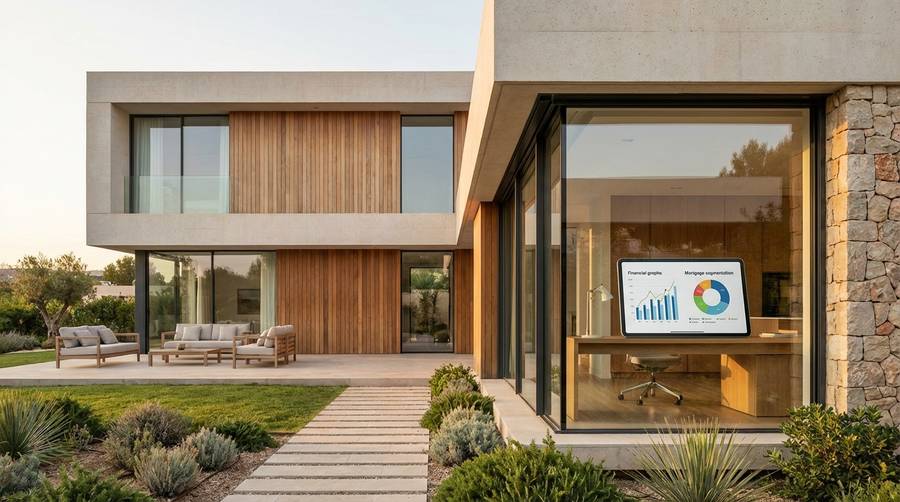
High-quality photographic scene in the Findnido visual identity: a finished Mediterranean contemporary home in Spain with light façade combining natural wood, pale stone and smooth concrete. Large windows and warm golden-hour light create soft interior glow. The house sits in a residential garden with a terrace set for family life (outdoor chairs, potted plants, a folded project folder or blueprint subtly placed on the terrace table). Composition evokes trust, comfort and sustainability. Family members (blurred background) walk toward the home. Photo-realistic, architectural magazine quality, natural colors, balanced framing. Avoid showing construction, exposed modules, containers or tiny-house appearance. The image should clearly read as a completed, premium home that suggests sensible financing/planning without technical visuals.
Artículos relacionados
Industrialized Housing in Spain: Balanced Pros & Cons
A concise, actionable comparison between industrialized (prefabricated) housing and traditional construction in Spain. Learn when modular makes sense, which systems to choose, financing options, real case metrics and a practical decision checklist.