


Industrialized Housing Guide: Timber Frame Homes in Spain
Hook: If you want a high-quality, energy-efficient home delivered on a fixed schedule and budget in Spain, timber-frame industrialized housing can be the fast, sustainable solution—this guide shows you how to make it real, step by step.
Why choose structural timber prefabrication for your industrialized home in Spain
What makes timber structural systems different? They combine precision factory production with fast on-site assembly. The result: consistent quality, predictable costs and strong performance for modern Spanish living.
Key benefits: speed, fixed costs and factory quality control
- Short, reliable construction windows: on-site assembly often takes weeks, not months.
- Fixed-price contracting: factory workflows reduce surprises; many suppliers offer firm turnkey prices.
- Higher quality control: panels and frames manufactured under controlled humidity and temperature reduce onsite rework.
Sustainability and carbon reduction with structural timber
Timber stores carbon. Compared to mono-material concrete solutions, responsibly sourced timber can lower embodied emissions. When combined with high-performance insulation and airtightness, lifecycle emissions fall further.
- Embodied carbon: timber structural systems typically show lower embodied carbon per square meter than comparable concrete frames.
- Operational efficiency: factory-installed continuous insulation and precision airtightness simplify compliance with standards like Passivhaus.
Which self-builders benefit most?
Timber prefabrication suits:
- Families seeking a fixed timeline and budget.
- Owners targeting high energy performance (near-Passivhaus).
- Clients on constrained sites where on-site disruption must be minimized.
Practical comparison: timber prefabricated house vs traditional construction
Direct comparisons help decide. Below are measurable factors you will encounter when choosing between timber prefabrication and conventional masonry or cast-in-place concrete.
Construction times and locked schedules: real data and examples
Typical benchmarks from recent Spanish projects:
- Design to permit: similar durations for both systems (3–6 months) depending on municipal timing.
- Factory production: 4–10 weeks depending on size and complexity.
- On-site assembly: 2–8 weeks for timber-frame houses vs. 6–12+ months for traditional builds.
Example: A 140 m2 two-story timber-frame home in Valencia reached weather-tight status in 7 weeks of on-site work; a comparable masonry home took 9 months to reach the same milestone.
Costs and financing: fixed prices, variations and predictable savings
Cost structure differences: timber prefabrication concentrates cost into manufacturing and finishes rather than long-duration labor. This reduces exposure to labor inflation and weather delays.
- Predictability: turnkey offers typically include manufacturing, transport and installation, lowering risk of overruns.
- Variability: finishes, services and plot works (foundations, connections) still require careful specification to avoid change orders.
Energy efficiency and comfort: measurable results
Performance metrics to request: U-values, airtightness (n50), thermal bridging strategy and expected heating demand (kWh/m2·year).
- Well-executed timber prefabricated homes commonly achieve n50 ≤ 1.0 h‑1 and heating demands under 30 kWh/m2·year when optimized—comparable to low-energy benchmarks.
- Passivhaus certification is feasible with careful detailing and MVHR (mechanical ventilation with heat recovery).
Case snapshot: A Passivhaus-level timber home in Murcia recorded annual heating demand of 12 kWh/m2 and airtightness n50 = 0.6 h‑1 after occupant adjustments.
Materials and systems: lightweight timber frame in detail
Understanding what a factory wall contains helps you evaluate offers and compare technical performance.
Structural components and insulation: what an industrialized wall includes
- Primary frame: kiln-dried timber studs and plates, precisely cut and assembled.
- Sheathing: structural OSB or CLT panels for racking and diaphragm action.
- Insulation: mineral wool, wood-fiber or blown cellulose in multiple layers for thermal and acoustic control.
- Vapor and airtight layers: factory-applied membranes and tapes that ensure consistent airtightness.
- Exterior cladding: breathable rainscreen options (timber, stone veneer, lime render) suitable for Mediterranean climates.
Compatibility with hybrid systems: combining timber, concrete and steel
Hybrid approaches are common. Use reinforced concrete for foundations and basements, combine timber upper floors with a steel frame for long spans, or integrate a concrete core for acoustic mass. These hybrids let you choose the best material for each function.
Standards and quality control: certifications relevant in Spain
- CE marking for manufactured components.
- Quality control: factory QA systems, moisture-control certificates and fire safety compliance per Spanish Código Técnico de la Edificación (CTE).
- Third-party verification: test reports for structural connections, thermal transmittance and airtightness.
How to design and manufacture a timber prefabricated home: step-by-step
A clear process reduces surprises. This section gives a practical sequence from concept to turnkey delivery.
From idea to project: requirements, program and modular optimization
- Define the program: rooms, orientations, budget range and performance targets (e.g., Passivhaus aspirations).
- Plot analysis: access, topography, solar orientation and connections determine foundation type and logistics.
- Modular strategy: design around factory panel widths and transport limits to minimize cutting and cost.
Factory production and transport: timelines and coordination
Typical workflow:
- Detailed design and production drawings (2–8 weeks).
- Factory cutting, panel assembly and internal fit-out (4–10 weeks).
- Transport coordination: route checks, permits and delivery windows—plan for early-morning deliveries in urban areas.
On-site assembly and interior finishes: the turnkey calendar
On-site stages:
- Foundations and services trenching (2–6 weeks depending on soil).
- Superstructure crane days: panels and modules set in days to a few weeks.
- Weather-tight finishes and MEP connections (2–10 weeks).
- Final commissioning, tests and handover.
Real cases and metrics: industrialized housing studies
Data informs decisions. Below are anonymized case studies with concrete metrics and client feedback.
Study A: timeline, final cost and client satisfaction
Project: 150 m2 single-family timber home, Sevilla province.
- Design to delivery: 9 months total.
- On-site assembly: 5 weeks.
- Final cost: within 2% of initial turnkey estimate (excluding plot acquisition).
- Client satisfaction: high—primary praise for timeline certainty and indoor comfort.
Study B: Passivhaus performance and measured consumption
Project: 120 m2 two-storey, Girona, certified near-Passivhaus.
- Measured heating demand: 14 kWh/m2·year.
- Airtightness: n50 = 0.55 h‑1.
- Notes: mechanical ventilation with heat recovery and solar-shaded glazing were key contributors.
Lessons learned and iterative improvements
- Early alignment on service routing avoided mid-process changes.
- Investing in airtightness detailing in the factory saved weeks and reduced commissioning adjustments.
- Client orientation and realistic furniture/lighting allowances improved post-occupancy satisfaction.
Financing, permits and legal steps for your timber prefabricated home
Practical financing and regulatory steps: autopromoters must coordinate banks, architects and local authorities.
Mortgage options for self-build and modular financing in Spain
Common routes:
- Promotor/autopromotor mortgage: staged drawdowns tied to milestones (foundations, shell, completion).
- Turnkey mortgage or standard mortgage: some lenders finance turnkey modular projects similarly to traditional builds when a single supplier is contracted.
- Private finance bridge: short-term bridging for plot purchase combined with construction loans for the build phase.
Licenses, plot management and technical responsibility
- Obtain the building permit (licencia de obras) with clearly defined project documents.
- Appoint an architect (project and execution manager) and an aparejador/ingeniero for site coordination and health & safety.
- Ensure supplier liability and delivery times are explicitly in the contract.
Turnkey contracts and guarantees: what to review before signing
Key clauses to check:
- Clear scope of supply (foundations included or not).
- Penalty clauses for missed delivery dates and remedies for defects.
- Warranties for structure, envelope and critical systems; transfer of certifications and test results at handover.
Action plan to get started: a practical roadmap for self-builders
Follow this checklist to move from idea to keys.
Initial checklist: plot, budget, technical team and timing
- Confirm plot viability: access, topography, utilities and local planning constraints.
- Set a realistic budget range including contingencies for plot works (10–15%).
- Hire an architect experienced with industrialized timber systems early.
- Define performance targets (e.g., near-Passivhaus) to guide supplier selection.
Criteria to choose a supplier and compare offers
Ask for:
- Detailed production drawings and a component list.
- Third-party test reports (airtightness, U-values).
- Reference projects with comparable scale and climate.
- A clear turnkey price with exclusions noted.
Next steps: visits, contract and schedule toward handover
- Visit at least two completed projects and one factory if possible.
- Negotiate a phased payment plan tied to milestones and independent inspections.
- Define the handover checklist including tests, certifications and manuals for the homeowner.
Image description for Findnido
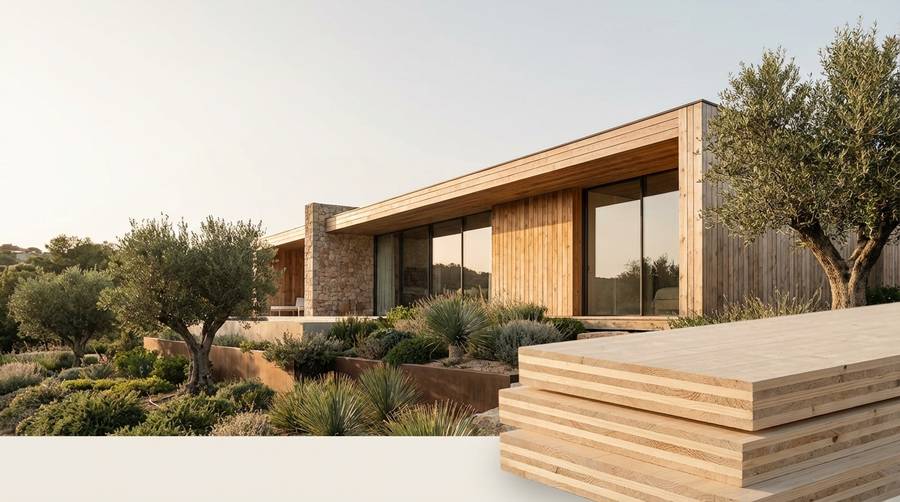
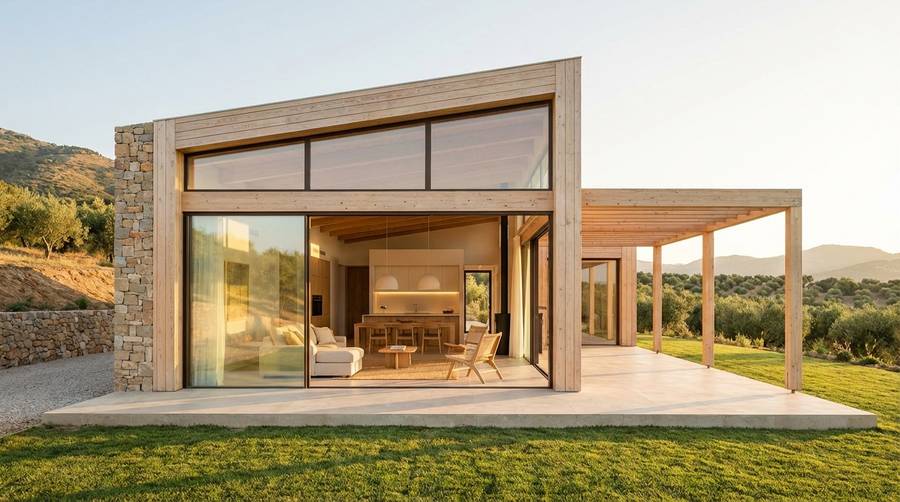
Photographic brief: Editorial-quality image of a finished Mediterranean contemporary home in Spain built with lightweight timber framing. Bright, light façade with natural wood and stone accents, large windows glowing with warm golden-hour light. Garden and terrace with Mediterranean planting; a discreet family (two adults, one child) enjoying the outdoor space to convey comfort and trust. Composition like an architectural magazine: balanced framing, natural colors, premium but lived-in feel. No construction scenes, no exposed structural systems, and no container-style modules. Optional small Findnido logo in the corner.
Conclusion
Timber prefabrication is a proven path to faster delivery, better cost control and strong energy performance for homeowners in Spain. By focusing on early technical alignment, clear contractual scope and measurable performance targets, autopromoters can reduce risk and achieve a premium finished home.
If you are assessing options for your self-build, start by defining your program and performance goals, visiting reference homes and requesting factory test data. For a customized roadmap or to review turnkey offers, feel free to contact a specialist who can translate technical promises into a reliable delivery plan.
Ready to take the next step? Evaluate your plot and performance targets, then ask three shortlisted suppliers for factory test data and a turnkey timeline—compare apples to apples and choose certainty.
Artículos relacionados
Prefabricated Structural Timber Homes: Common Errors & Fixes
A focused guide for self-builders in Spain: identify the most frequent mistakes in prefabricated structural timber projects and apply concrete, technical and managerial fixes to deliver a high-quality turnkey home on time and on budget.