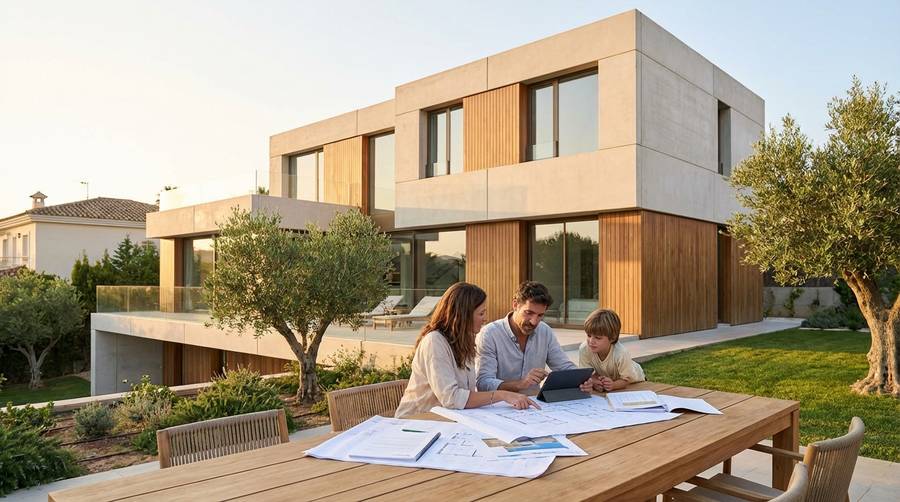
Industrialized Housing in Spain: Balanced Pros & Cons
Why consider industrialized housing in Spain in 2026
Hook: If you plan to self-build in Spain, choosing industrialized housing can cut uncertainty—and in many projects, deliver a finished home faster and with fewer budget surprises than traditional builds.
Industrialized housing (often called prefabricated or modular homes) has moved beyond stereotypes. In 2026 its value proposition centers on predictable costs, shorter on-site timelines, and improved energy performance. For Spanish self-builders (autopromotores), these strengths address the most common pain points: financing delays, weather interruptions and rising labor costs.
Market trends and demand among self-builders
Demand for industrialized housing in Spain is rising among buyers who want more control over design and schedule. Key drivers include:
- Higher awareness of energy-efficient standards like Passivhaus.
- Limited, volatile construction labor in urban and peri-urban zones.
- Developers and small manufacturers offering turnkey modular services.
Primary benefits: efficiency, cost control and closed-site timing
Closed-site construction—factory production of elements—reduces exposure to weather and on-site delays. That translates to:
- Lower schedule variance: predictable production and assembly windows.
- Fewer change-order risks because many decisions are made during design and manufacturing phases.
- Opportunities for fixed-price contracts when scope is defined early.
How industrialized housing aligns with sustainability and Passivhaus
Modern industrialized systems integrate high-performance envelopes and mechanical systems efficiently. Prefab workflows enable tighter quality control on insulation, airtightness and thermal bridging—key Passivhaus requirements. As a result, carbon footprint and long-term energy costs can be lower when the project is properly specified.
Choosing an industrialized approach can reduce on-site waste by up to 60% and improve airtightness consistency—two decisive factors for low-energy homes.
Objective comparison: prefabricated vs traditional housing
Total cost: budgets, deviations and predictability
Cost comparison hinges on project scope, design complexity and site conditions.
- Prefabricated: Often offers a more predictable budget when the design is standardized. Fixed-price manufacturing contracts are common, but consider transport, crane and foundation costs separately.
- Traditional: Potentially lower initial bid for simple projects, but higher risk of cost escalation from unforeseen site conditions, delays, and change orders.
Actionable tip: Request a breakdown separating factory costs, on-site assembly, foundations and connections to utilities. That makes lender appraisals and contingency planning easier.
Execution timelines: on-site times and factory advantages
Timelines are where industrialized housing frequently excels.
- Factory production runs in parallel with site work (foundations, permits), shortening overall calendar time.
- On-site assembly often takes days to weeks rather than months.
- Weather-related delays drop significantly because critical elements are made indoors.
Realistic expectation: allow time for permits and site prep—industrialized does not eliminate those steps, it compresses the build phase.
Quality and durability: standards, warranties and maintenance
Quality depends on system and manufacturer controls:
- Reputable manufacturers use factory QA/QC, third-party testing and offer component warranties.
- Durability is comparable to traditional construction when materials and detailing match local climatic requirements.
- Maintenance differs: some modular systems centralize service access for easier replacement of mechanical units; others require specific supplier parts.
Actionable tip: ask for test reports (U-values, airtightness, fire resistance) and documented maintenance schedules before contract signing.
Materials and systems: options and when to pick them
Industrialized concrete: strength, insulation and use cases
Industrialized concrete (precast or insulated concrete panels) excels for thermal mass, acoustic performance and long-term durability. It suits sites with higher exposure to wind or fire risk and where a heavier, low-maintenance façade is desired.
- Pros: longevity, sound insulation, thermal inertia.
- Cons: heavier transport costs, more complex foundation requirements.
Light timber frame: efficiency, sustainability and constraints
Entramado ligero de madera (light timber frame) is popular for its sustainability credentials and fast assembly. It performs well in energy-focused designs but requires careful detailing for moisture control in humid climates.
- Pros: renewable material, good thermal performance, speed.
- Cons: needs robust moisture protection; fire-resistance detailing must meet regulations.
Steel frame: speed, performance and compatibility
Steel frame systems (cold-formed steel) offer great dimensional stability and speed, especially for multi-level homes or where large spans are needed. They pair well with varied façades and modern aesthetics.
- Pros: precise tolerances, rapid erection, compatibility with prefab panels.
- Cons: thermal bridging risk if not thermally broken; corrosion protections needed in coastal areas.
How to choose: match the system to your priorities—durability (concrete), sustainability and warmth (timber), or precision and span (steel).
Financing and mortgages for self-builders and modular homes
Types of financing: construction mortgage, self-builder loan and leasing
Spanish lenders typically structure financing in several ways:
- Mortgage-to-build (hipoteca obra): Disbursed in stages as construction milestones are met.
- Self-builder loan (préstamo autopromotor): More flexible for owners coordinating parts of the project themselves.
- Leasing or asset-backed options: Occasionally used for factory-built modules with retained ownership models.
Actionable tip: banks want clear schedules and cost breakdowns. Provide manufacturer contracts showing production timelines to strengthen applications.
Requirements, valuation and disbursement phases
Lenders typically require:
- Detailed project budget with manufacturer quotes.
- Building permit and technical documentation (CTE compliance, energy certs).
- Phased disbursements tied to milestones: foundations, delivery, on-site assembly, completion.
Valuation: ask the bank how they appraise modular homes. Some banks appraise factory-built elements and on-site completion separately; early clarity avoids surprises.
Comparative financial costs and negotiation tips
Interest and fees for self-build loans can be higher due to perceived risk. To negotiate better terms:
- Present fixed-price, turnkey contracts and clear schedules.
- Show Passivhaus or high efficiency specs—banks may view reduced running costs positively.
- Use reputable insurers and include performance guarantees in contracts.
Turnkey process: from plot search to move-in
Project phases: design, permits, production and assembly
A turnkey industrialized project typically follows these stages:
- Pre-design and plot analysis (topography, access, utilities).
- Architectural design and technical detailing for factory production.
- Permitting and approvals with local authorities.
- Factory production and site foundation work in parallel.
- On-site assembly, finishing works and commissioning.
Strong coordination between manufacturer, design team and local contractors is essential.
Real timelines and case studies with metrics
Selected anonymized metrics from recent turnkey projects in Spain (typical ranges):
- Project A (timber frame, 140 m²): design-to-permit 3 months; factory production 6 weeks; assembly and finishing 8 weeks. Total on-site time: 2 months. Final cost within 4% of initial budget. Client satisfaction: 9/10.
- Project B (steel frame with precast panels, 200 m²): design and permits 4 months; production 10 weeks; assembly 3 weeks. Total delivered in 7 months from contract. Cost deviation: 6% due to additional site drainage work. Client satisfaction: 8/10.
These metrics show consistent reductions in on-site time versus traditional builds, but underline the importance of thorough site surveys to control unforeseen costs.
Common risks and mitigation through contracts and guarantees
Main risks:
- Site surprises (soil, access, utilities).
- Permitting delays unrelated to manufacture.
- Misaligned expectations on finishes or interfaces.
Mitigation strategies:
- Include site survey and geotechnical reports in bids.
- Use clear interfaces in contracts: what the manufacturer supplies vs. what the on-site contractor completes.
- Specify performance guarantees and holdbacks tied to airtightness or energy targets.
How to decide: key advantages, disadvantages and final checklist
Main advantages summarized for self-builders
- Predictable schedules due to parallel factory and site work.
- Cost transparency when scope is fixed early.
- Improved energy performance through controlled fabrication and integration of high-efficiency components.
- Reduced on-site disruption and waste.
Disadvantages and limitations to weigh
- Less flexibility for late-stage design changes—modify early or accept costs for changes.
- Logistics constraints: road access, crane availability and module transport limits.
- Perception and resale: while attitudes are changing, some buyers still prefer traditional builds—document quality and certifications to support resale value.
Practical checklist for deciding and next steps
- Confirm plot constraints: access, slope, utilities and local regulations.
- Request detailed quotes separated by factory, transport, crane, foundations and finishing.
- Obtain manufacturer QA/QC reports, warranties and test certificates (airtightness, U-values).
- Build a financing plan with staged disbursements and a contingency of 5–10%.
- Specify energy targets early (e.g., Passivhaus) and include performance guarantees in the contract.
- Plan for a neutral third-party inspector during assembly to validate milestones for lenders.
Conclusion: balanced guidance and subtle call to action
Industrialized housing in Spain offers a compelling, modern path for self-builders who value time certainty, energy performance and cost transparency. It is not a universal solution: success depends on early decisions, careful site assessment and clear contracts that separate factory scope from on-site responsibilities.
Final recommendation: If your priorities include a fixed-ish budget, shorter on-site time and a high-performance envelope, pursue industrialized housing—but prepare detailed documentation and reserve contingencies for site-specific work.
For most self-builders aiming for sustainability and schedule certainty in 2026 Spain, industrialized housing is no longer a niche—it's a pragmatic strategy when paired with rigorous planning.
If you want a tailored assessment for your plot and goals, consider reaching out to a modular specialist who can provide a transparent cost breakdown and a realistic timetable. Thoughtful planning now saves months of delays and unexpected expense later.