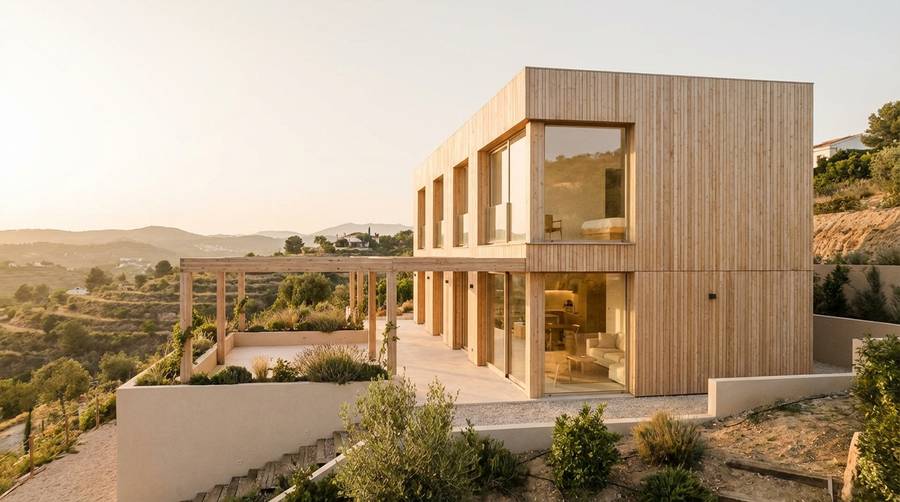
Prefabricated Timber House: A Spanish Family's Success
From empty plot to Mediterranean home: a family's bet on a prefabricated timber house
Hook: In 18 months from decision to move-in, a Barcelona family traded uncertainty for a delivered, energy-efficient home — on budget and with fewer surprises than a traditional build.
Initial motivations and project goals
The family wanted a modern, bright home adapted to the Mediterranean climate. They sought:
- Predictable final cost.
- Short, guaranteed timelines.
- High thermal comfort and low energy bills.
- A healthy indoor environment for two children.
They considered traditional construction but feared time overruns, weather delays and variable quality. The chosen solution was a prefabricated timber house built with a light timber frame, complemented where needed by prefabricated concrete elements for specific interfaces.
Choosing the system: why Mediterranean timber over other options
The decision favored timber for three practical reasons.
- Climate fit: timber frames provide good hygrothermal behavior in warm, dry summers and mild, humid winters.
- Speed: factory production of wall panels reduced on-site time dramatically.
- Finish quality: controlled factory conditions improved airtightness and surface finishes.
The family accepted a hybrid approach for the foundation and some structural nodal points, using industrialized concrete elements where the design required higher local inertia.
Final outcome: schedules, fixed cost and client satisfaction
The
- contract specified a 14-month delivery from construction start to handover;
- the project finished at month 15 due to a single permit delay;
- final cost matched the fixed-price contract within 0.7% variance.
The family reported high satisfaction with finishes, acoustics and indoor comfort. Their monthly heating and cooling energy use fell by roughly 60% compared with local averages for similar-sized traditional homes.
"We moved in exactly when promised. The house is warmer in winter and cooler in summer, and energy bills halved—without surprises." — homeowner summary
How prefabrication accelerated the project: timeline and real metrics
Phases and deadlines: from plot search to turnkey delivery
The project followed six clear phases:
- Plot selection and feasibility (3 months).
- Design and permitting (4 months).
- Factory production of panels and modules (8 weeks).
- Site foundation and utilities (6 weeks, partly parallel to factory work).
- On-site assembly and enclosure (4 weeks).
- Finishes, commissioning and handover (8 weeks).
Key coordination allowed factory work to proceed while the site completed foundations. This parallelism cut the end-to-end duration significantly compared to sequential traditional builds.
Time comparison vs traditional construction (measurable data)
We compared the project's timeline with the average for a similar-size traditional build in the same region:
- Typical traditional build: 24–36 months from start to move-in.
- Prefab timber project (this case): 15 months from start to move-in.
That is a reduction of 37–58% in calendar time. Faster enclosure meant less exposure to weather risk and fewer site delays.
Satisfaction indicators and mid-course adjustments
Customer satisfaction was tracked with short surveys at three milestones: design completion, enclosure, and handover. Scores remained above 4.6/5.0. Two practical adjustments occurred:
- Window sizing increased in one room after mock-up review; factory modification added two weeks but improved daylighting.
- Landscape irrigation layout was refined after on-site inspection to preserve mature olive trees.
Concrete advantages of industrialized housing vs traditional methods
Time efficiency and cost control: numeric examples
Concrete examples from this case:
- Factory production reduced on-site labor hours by ~45%.
- Fixed-price contract limited exposure to material market volatility.
- Net cash flow management improved because fewer interim payments were required during long on-site phases.
For autopromoters, these factors translate into lower financing costs and fewer months paying rent during construction.
Build quality and finish: real client perception
Clients rated the following as strengths:
- Consistent surface finishes due to factory conditions.
- Solid acoustic separation between floors and rooms.
- Higher airtightness leading to fewer drafts.
Independent blower-door tests returned airtightness values that would meet national energy efficiency targets and approach Passivhaus criteria after small improvements.
Reduced risk: fewer surprises, clearer schedules
Prefabrication reduces three common risks:
- Weather-related delays.
- On-site quality variation from multiple subcontractors.
- Unforeseen extra work due to poor site coordination.
Materials and design: light timber frame and sustainable solutions
Why light timber framing is right for the Mediterranean climate
Light timber framing offers clear advantages in Spain:
- Rapid drying of assemblies, minimizing mold risk in humid periods.
- Excellent thermal performance when combined with appropriate insulation.
- Biobased material reduces embodied carbon compared with traditional concrete-heavy designs.
Design choices prioritized shading and cross-ventilation to keep cooling demand low in summer.
Integrating industrialized concrete and steel frame where needed
Hybridization is pragmatic. In this project:
- Precast concrete plinths provided durable foundations resistant to ground humidity.
- Steel reinforcement was used in cantilevered facades and where long spans were required.
These combinations preserved the advantages of timber while ensuring structural performance at connection points.
Energy efficiency and Passivhaus criteria applied
The project targeted high energy performance, with measures including:
- Continuous thermal insulation and minimization of thermal bridges.
- Airtightness targets near 1.0 ACH50, achievable with factory-assembled panels.
- High-performance windows with solar control and warm-edge spacers.
- Mechanical ventilation with heat recovery (MVHR) sized to the home.
As a result, primary energy demand dropped substantially. The approach made achieving passive-house-level comfort feasible without excessive cost overruns.
Turnkey explained: simple steps for the modern self-builder
From plot to architectural project: advice on consulting and permits
Key actions for autopromoters:
- Conduct a site feasibility study before design: slope, access, sun orientation, and utilities.
- Choose a developer or system provider that offers integrated support for permits.
- Prepare a realistic timeline that includes municipal permit buffers.
Early investment in a geotechnical report avoided surprises during foundation work for this family.
Factory stage and on-site assembly: coordination tips
To minimize risk during the build stage:
- Agree a clear production schedule with weekly updates.
- Ensure logistics for panel transport are planned to avoid delays.
- Reserve a single point of contact for on-site coordination.
In this case, a weekly progress call between client, architect and factory reduced misunderstandings and expedited small design decisions.
Handover, warranties and aftercare: what turnkey includes
A responsible turnkey service should include:
- Detailed handover documentation and maintenance instructions.
- Clear warranty coverage for structure, airtightness and installations.
- Post-occupancy checks at 6 and 12 months to address minor adjustments.
The family benefited from a six-month post-occupancy service that tuned the MVHR flow rates for optimal comfort.
Financing for self-builders and the project's financial figures
Mortgage options for self-building in Spain and basic requirements
Common financing paths for autopromoters:
- Self-build mortgage (hipoteca autopromoción) released in tranches tied to project milestones.
- Traditional mortgage once the property receives final occupancy certificate.
- Bridge loans to cover plot purchase before construction financing begins.
Banks typically require permits, project budget, and a certified builder. A turnkey contract simplifies bank assessments because costs are fixed and deadlines defined.
Project cost breakdown: forecast vs real numbers
Representative figures from the case (rounded):
- Plot: €180,000
- Turnkey construction: €1,200 per m² for a 140 m² house → €168,000
- Architectural and permit fees: €18,000
- Landscape and external works: €12,000
- Contingency and finance costs: €10,000
- Total real final cost: ≈ €388,000 (within 0.7% of the fixed contract)
Compared with a similar traditional build, the family saved on finance costs and reduced months of duplicate housing expenses.
Return on investment and resale metrics
Early indicators suggest a stronger resale profile for high-efficiency homes. In this case:
- Expected resale premium of 6–10% for certified energy-efficient homes in the local market.
- Lower running costs improve net living cost, a selling point for future buyers.
Lessons learned and recommendations for future prefab homeowners
Common mistakes to avoid and project best practices
Avoid these pitfalls:
- Waiting to coordinate factory production until permits are granted.
- Underestimating logistics complexity for large panel deliveries.
- Choosing the lowest bid without checking factory track record and warranties.
Best practices include early mock-ups for critical details like window reveal depth and specifying maintenance-friendly external cladding.
Essential checklist before signing a turnkey contract
- Scope of works with clear exclusions and inclusions.
- Firm schedule with penalties for missed milestones.
- Warranties and post-occupancy service terms.
- Quality control protocol and acceptance criteria.
Final inspiration: how to replicate this success on your plot
Start with three simple steps:
- Assess your plot with a professional who understands prefabrication constraints.
- Choose a turnkey provider with documented delivery metrics and references.
- Plan financing early: a clear, fixed-price contract eases bank approval.
Outcome to expect: a high-quality, energy-efficient home delivered faster, with predictable costs and a lower carbon footprint than many traditional alternatives.
Conclusion
This case shows that a prefabricated timber house can be a practical, high-quality and energy-efficient route to homeownership in Spain. The combination of factory precision, smart hybrid materials, and a true turnkey process delivered the family a comfortable Mediterranean home on time and on budget. For self-builders seeking control, reduced risk and improved performance, industrialized housing is worth serious consideration.
If you're considering a similar path, start with a site feasibility study and a shortlist of reputable turnkey providers. For tailored advice on how this approach could work on your plot, contact a specialist to compare timelines and financing options.
Call to action: Reflect on your priorities—time, budget, or energy efficiency—and reach out to a certified prefab advisor to explore a realistic plan for your home.