Common Mistakes in Industrialized Housing — Solutions
Introduction — Hook: Why most industrialized housing projects stall (and how yours won't)
Building a modern prefabricated home in Spain is faster and greener than traditional construction — but only when you avoid a handful of predictable mistakes. In this article you’ll get direct, professional fixes for the five errors that most derail modular and industrialized housing projects. No fluff: checklists, contract clauses, financial steps and measurable outcomes so you can act with confidence.
Projects that define scope, site compatibility and energy goals up front finish on time, within budget and with higher occupant satisfaction — often saving 10–25% on lifecycle costs compared with poorly planned builds.
Before you start: essential keys for your industrialized housing project in Spain
Start with clarity. The decisions you take before signing a contract shape costs, timelines and regulatory work needed later. Focus on three pillars: site compatibility, turnkey scope and the construction system.
Real advantages vs traditional construction: time, fixed price and control
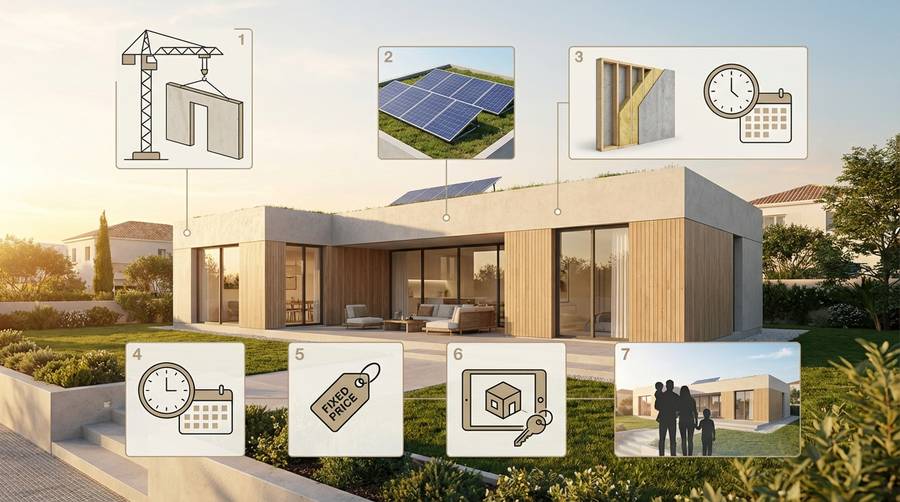
Industrialized housing reduces on-site time and gives predictable costs. Factory production compresses weather-related delays and allows parallel workflows: foundations and systems can be prepared while modules or panels are built. Expect typical reductions of 30–50% in on-site schedule compared with traditional builds when the project is planned properly.
How the turnkey process fits with parcel search and financing
Turnkey (“llave en mano”) should include defined deliverables and milestones. Align the turnkey offer with the mortgage or autopromotion loan schedule: lenders need a clear project timeline, technical dossier and fixed-price commitment to underwrite properly.
Choosing the construction system: industrialized concrete, timber frame and steel frame
Each system has trade-offs: industrialized concrete excels for durability and thermal mass; timber frame offers speed and low embodied carbon; steel frame provides precision and large-span flexibility. Choose based on climate, desired finish, lifecycle maintenance and budget — not on single-line price bids.
Error 1 — Choosing a parcel without checking technical and planning compatibilities
This is the single most common early error. A well-located plot can become a legal and technical headache if you skip local regulations and site constraints.
What urban planning and local rules to check before you sign
- Land use and allowable housing type: local PGOU/Normas Urbanísticas can restrict prefabricated or industrialized systems in certain zones.
- Occupancy and maximum buildable area: check buildability, FAR, and footprint limits.
- Topography and slope limits: steep plots increase foundation complexity and cost.
- Setbacks, easements and access: verify vehicle and crane access for module delivery.
- Utilities and connections: distance to mains for water, electricity and wastewater affects budget.
Practical solution: a pre-purchase checklist and when to call a technician
- Run a site compatibility checklist before committing (see checklist below).
- Hire a local architect or gestor urbanístico to request a pre-application meeting with the town hall if there is any doubt.
- Obtain a topographic survey and geotechnical report early when slope or soil variability exists.
Quick checklist before signing:
- Valid title and lack of encumbrances
- Zoning and permitted use confirmation
- Buildability and occupancy quotas
- Vehicle and crane access for modular transport
- Proximity and cost of utility connections
- Preliminary soil report or commitment to fund geotech
Common consequences and how to prevent them
Typical issues: project redesign, delays, unexpected foundation costs or planning refusals. Prevent with due diligence: get technical reports and a conditional planning check before the purchase is finalized.
Error 2 — Underestimating design and energy integration from the start
Design decisions drive energy performance and occupant comfort. Failing to set energy targets early forces expensive corrections later.
Risks of not planning for efficiency (orientation, envelopes, Passivhaus)
- Poor orientation increases heating/cooling loads and reduces daylighting.
- Inadequate envelope specification leads to thermal bridges and moisture risk.
- Skipping Passivhaus or near-passive criteria often raises operating costs and reduces resale value.
Practical fix: embed bioclimatic criteria and efficiency certification from design start
- Set a target (e.g., Passivhaus component standards or a quantified U-value target) in the brief.
- Use simple bioclimatic moves: solar orientation, shading, thermal mass, high-performance glazing and airtightness strategy.
- Require an energy model (or PHPP input) during schematic design to validate decisions early.
Quantifiable benefits: timelines, comfort and medium-term savings
Projects that commit to energy targets typically add 3–6% to upfront cost but reduce energy bills by 60–90% and increase occupant satisfaction. Faster handover can also result from fewer on-site remedial fixes when panels and interfaces are designed for airtight factory assembly.
Error 3 — Not clearly defining ‘turnkey’ scope and responsibilities
Ambiguous contracts are the main cause of disputes and unfinished work in turnkey modular projects.
Typical problems: exclusions, unfinished finishes and legal disputes
- Missing elements (landscaping, boundary walls, final utility hookups).
- Vague descriptions of finishes leading to client disappointment.
- Late discovery of excluded works and compensatory claims.
Practical solution: essential clauses and handover documentation
Include these in the turnkey contract:
- Detailed scope annex listing all works, materials and tolerances.
- Clear milestones and linked payments with retention for defects.
- Handover checklist including as-built plans, warranties, maintenance manuals and energy certificates.
- Snagging period and correction schedule with defined response times.
Financial tip: how clear scope protects financing and prevents overruns
Lenders evaluate the risk of cost overruns. A well-specified turnkey contract and professional documentation increases the probability of mortgage approval and limits interim drawdown disputes. Keep a contingency (typically 5–10%) and map payments to construction milestones to prevent cash shortfalls.
Error 4 — Choosing materials or systems without assessing maintenance and sustainability
Short-term price focus often hides long-term costs and carbon impacts. Evaluate whole-life performance, not just initial cost.
False economies: low initial cost vs lifespan and carbon footprint
- Cheap finishes may require replacement within a decade, adding lifecycle cost.
- High embodied carbon materials increase future regulatory and resale risk as standards tighten.
Practical solution: compare real cases by material (concrete, timber, steel)
Use case-based metrics rather than general claims:
- Industrialized concrete: higher embodied carbon but excellent durability and low maintenance; effective in climates where thermal mass reduces HVAC loads.
- Timber frame (light-frame): low embodied carbon, fast assembly, good thermal performance; requires attention to moisture detailing.
- Steel frame: precise tolerances, excellent for open spans and repeatability; combine with high-quality insulation to limit thermal bridging.
Recommendation: selection criteria for durability and efficiency
- Cradle-to-grave embodied carbon estimate
- Expected maintenance cycle and accessible parts
- Compatibility with high-performance envelopes and airtightness
- Local availability and supplier track record
Error 5 — Ignoring the permitting and financing process specific to autopromoters
Autopromotion and modular financing require documentation and timing different from standard home loans.
Frequent mistakes with autopromotion mortgages and modular financing
- Presenting lenders with incomplete technical dossiers or no fixed-price offer.
- Expecting standard mortgage timelines for phased drawdowns without a schedule aligned to turnkey milestones.
Practical solution: steps, documents and how to present the project to banks
- Prepare a lender packet: site purchase contract, turnkey contract with milestones, technical dossier, energy targets and cost breakdown.
- Ask for written confirmation of drawdown terms and conditions before signing major contracts.
- Consider specialized lenders or lines for self-build and autopromotion; they understand modular delivery rhythms better.
Cashflow tip: how to calendarize payments to avoid delays
- Map all supplier payments to project milestones and expected drawdowns.
- Include a contingency reserve and schedule for potential inspections or municipal payments.
- Keep communication channels open between lender, turnkey provider and project manager.
Practical close: action plan to avoid errors and secure your modular project
Convert the lessons above into a short action plan you can implement today.
Final checklist before signing: parcel, design, contract and financing
- Parcel: check zoning, access, geotech and utilities.
- Design: set energy targets and confirm system choice (concrete, timber, steel).
- Contract: demand detailed turnkey scope, milestones and handover documentation.
- Financing: prepare lender dossier and align drawdowns to milestones.
6-step micro-plan from parcel search to turnkey delivery
- Pre-purchase due diligence: zoning check, topo and geotech.
- Schematic design with energy targets and preferred system.
- Request fixed-price turnkey proposals with itemized scope.
- Secure financing with a complete lender packet and agreed drawdowns.
- Factory production and site preparation in parallel; monitor milestones weekly.
- Handover, snagging and commissioning; collect as-built and warranties.
Success indicators: timelines, costs and client satisfaction metrics
- Delivery within agreed turnkey timeline ±10%.
- Final cost within contingency (5–10%) of contract value.
- Post-occupancy comfort score: target 80%+ satisfaction at 6 months.
For concrete guidance on why industrialized housing is often the best choice, see Top 7 razones para elegir vivienda industrializada en España.
Conclusion — Take action: prevent these mistakes and protect time, budget and quality
Don’t let preventable errors turn a promising project into a drawn-out problem. Use the checklists and contract clauses above, demand early energy and site validation, and align financing to clear milestones. These interventions are low-effort but high-impact.
If you’re preparing a modular or industrialized home project in Spain and want a tailored checklist or a review of your turnkey offer, contact a specialist early — a short review now can save months and a significant portion of your budget.
Ready to get a practical review of your parcel, turnkey quote or financing package? Consider booking a technical pre-check before signing anything.