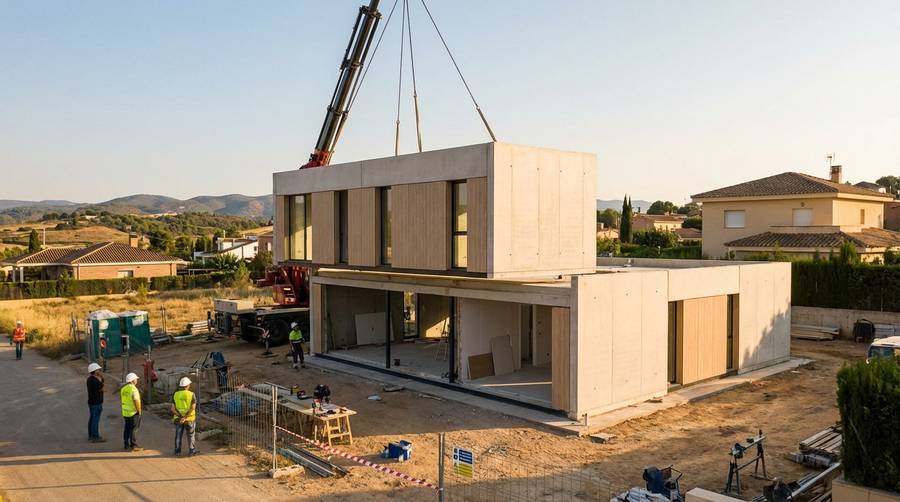
Industrialized Housing: Common Errors and Fixes
Before you start: what you must know about factory-built homes and why it matters
Hook: Building off-site can shave months and uncertainty from your project—but one wrong decision on the plot, the design or logistics can wipe out those savings. This guide pinpoints the most common mistakes in industrialized housing in Spain and gives clear, actionable fixes so your turnkey project succeeds.
Advantages versus traditional on-site construction: fixed price, predictable timelines and efficiency
Industrialized housing brings three practical advantages when properly managed:
- Fixed-price contracting: factory workflows reduce surprises on materials and labor.
- Closed schedules: parallel processes (foundation and building modules) shorten time to delivery.
- Quality and waste control: controlled environments mean better tolerances and less material waste.
These benefits only materialize if early decisions match the industrial process. The rest of this article shows where projects commonly derail and how to prevent that.
Frequent pre-start mistakes: unrealistic lead times, wrong parcel choice and underestimating permits
Mistakes often happen before the first drawing is signed. Typical failures include:
- Expecting a factory slot in 2–4 weeks instead of 8–20 weeks.
- Buying a plot without transport or crane access analysis.
- Assuming urban permits are routine—urban planning constraints and utility connections can take months.
Practical fix: treat procurement as a phased timeline: parcel due diligence → preliminary manufacturing feasibility → permit application → factory booking.
Practical checklist for self-builders (permits, financing and brief)
- Urban constraints report: topography, servitudes, set-backs, local building coefficients.
- Access and logistics plan: delivery route, weight limits, crane radius.
- Financing: confirm mortgage or self-build loan conditional on the turnkey contract.
- Program brief: spaces, envelope performance targets (e.g., Passivhaus ambition), preferred systems (concrete panels, steel frame, timber frame).
Investing two to four weeks in front-end diligence typically avoids delays of two to six months later.
Error 1 — Choosing the wrong plot or ignoring site constraints: how to avoid it
Common problem: easements, slopes and access that inflate costs and schedule
A plot with hidden servitudes, steep slopes or poor road access often forces design changes, expensive foundations or oversized cranes. These are the most common cost multipliers in modular projects.
Practical solution: a prior site study for transport and assembly requirements
Commission a short, targeted site study before purchase. The study should include:
- Topographic survey and soil report focused on bearing capacity and excavation risk.
- Transport analysis: the widest module dimension and the largest truck you can access legally.
- Assembly footprint: verified crane locations and hard-standing requirements.
Tip: get the manufacturer's module dimension limits early. If the plot requires segmenting modules into smaller pieces, confirm factory implications and extra joints in the envelope.
Actionable budgetary advice: include contingency for adaptations and permits
When you budget, add line items for:
- Site adaptations (retaining walls, ramps) — typically 3–8% of construction cost on constrained lots.
- Transport and special permits — fixed cost per delivery depending on municipal rules.
- Time buffer — 4–8 weeks contingency for permits and road closures.
Error 2 — Not adapting the design to the chosen industrial system
Common problem: conventional designs that create expensive factory rework
Designs created for in-situ construction often assume continuous masonry or bespoke assemblies. Translating those directly into factory production increases join work, bespoke panels and on-site sealing tasks.
Technical solution: coordinate architect and manufacturer early using parametrized design
Integrate the manufacturer's BIM or CAD rules into the architect's process. This ensures module dimensions, service chases and panel joints are resolved in design, not on site. Key steps:
- Define module grid early (width, depth, transport envelope).
- Agree on service distribution (vertical shafts vs. horizontal trays).
- Standardize repeated elements to benefit from factory economies.
Practical tips: select materials and systems aligned to climate and budget
Match system choice to your priorities:
- Industrialized concrete panels: excellent thermal mass, low maintenance, ideal for Mediterranean climates with high diurnal swings.
- Steel frame (steel frame): high precision, long spans, fast assembly; good where slim sections are needed.
- Light timber frame: fast, renewable material with excellent thermal performance when well detailed.
Choose the system that minimizes on-site complexity for your plot and local labor market. Ask the manufacturer for performance data and typical build times for comparable projects.
Error 3 — Neglecting the thermal envelope and ventilation: effects on comfort and bills
Frequent failure: thermal bridges, weak insulation and undersized ventilation
Even if modules are well-made, poor detailing at joints, roofs and service penetrations produce comfort issues and higher energy use than predicted.
Practical solution: specify Passivhaus-level criteria or equivalent energy targets
Set measurable targets in the contract: U-values, airtightness (n50), and system efficiency. Insist on as-built verification:
- Airtightness testing (blower door) before interior finishes.
- Thermal imaging during handover or commissioning to detect cold bridges.
- Commission mechanical ventilation with heat recovery (MVHR) sized and balanced for actual occupancies.
Technical checklist: airtightness, ventilation and on-site verification
- Detailed junction details between modules: overlapping insulation, continuous air barrier and sealed service penetrations.
- Specify MVHR or balanced ventilation with filters; include commissioning by a certified technician.
- Require documentation: as-built thermal calculations, test reports and maintenance manuals.
Error 4 — Underestimating logistics, transport and on-site assembly
Typical risk: partial deliveries and inadequate access delaying assembly
Modular projects rely on tight sequencing. Missed deliveries, blocked roads or absent crane bookings cascade into delay and extra cost.
Operational solution: a turnkey assembly plan with a detailed schedule and a site manager
Contracts should include a clear assembly plan and a named site coordinator responsible for interface tasks. The plan must cover:
- Delivery windows and a back-up plan for weather or municipal restrictions.
- Crane bookings with exact lift charts and exclusion zones.
- Quality gates: pre-lift inspections and acceptance checks before each module goes in place.
Practical coordination tips: cranes, timing and pre-lift checks
- Book crane and traffic permits weeks in advance; confirm two working days before delivery.
- Perform a pre-lift meeting: roles, safety plan, and an acceptance checklist for module conditions.
- Inspect module interfaces for transport damage and ensure mechanical connections and sealants are staged for immediate use.
Error 5 — Insufficient quality control and weak post-delivery guarantees
Recurring problem: lack of formal tests, certificates or handover protocols
Handover without a structured quality protocol leaves the client exposed to latent defects and unclear warranty responsibilities.
Recommended solution: enforce a quality checklist with metrics and client sign-offs
Adopt a checklist that becomes part of the turnkey contract. Include measurable metrics such as:
- Delivery and assembly schedule compliance (milestone dates).
- As-built performance: airtightness (m3/h·m2 at n50), thermal transmittance verification.
- Client satisfaction indicators: defects list closed within defined timescales.
Resolutive advice: include maintenance and warranty in the turnkey agreement
Ensure the contract states:
- Warranty period for structure, envelope and systems, with clear claim procedures.
- Post-delivery commissioning visit schedule (e.g., 1 month, 6 months, 12 months).
- Obligations for spare parts or replacement components and response times.
Practical conclusion: final checklist and first steps for a successful project
Summary of key solutions and red flags you must not ignore
Key solutions: front-load site due diligence, align design with factory rules, mandate airtightness and MVHR, schedule logistics precisely, and use a binding quality checklist with warranties.
Red flags: vague module dimensions, missing transport plan, absence of airtightness targets, or no named assembly coordinator.
Action plan: from plot study to financing and delivery
- Commission a site feasibility and transport study before purchase.
- Agree system and module grid with manufacturer during schematic design.
- Secure financing conditional on a turnkey contract with performance metrics.
- Book factory slot and crane dates early; build a documented quality and commissioning protocol.
- Perform airtightness and thermal commissioning; close snagging lists within agreed times.
Recommended resources and questions to ask your manufacturer
- Request sample schedules for comparable projects: typical factory lead time, assembly days on site and total turnkey delivery time.
- Ask for as-built test results from past projects (blower door, thermal imaging, client references).
- Demand an itemized inclusion of guarantees: structure, waterproofing and mechanical systems.
Ask your manufacturer: "Show me three comparable homes delivered in the last 24 months with documented airtightness and client contacts." If they cannot provide this, treat it as a major warning sign.
Final note: industrialized homes offer a clear path to faster delivery, predictable costs and superior energy performance—but only with disciplined front-end work and contractual clarity. Use the checklists above as your baseline and insist on measurable outcomes.
Call to action: If you are planning a self-build in Spain and want a tailored front-end checklist or a feasibility review for a specific plot, contact a specialised industrialized housing advisor to validate your assumptions and protect your schedule and budget.