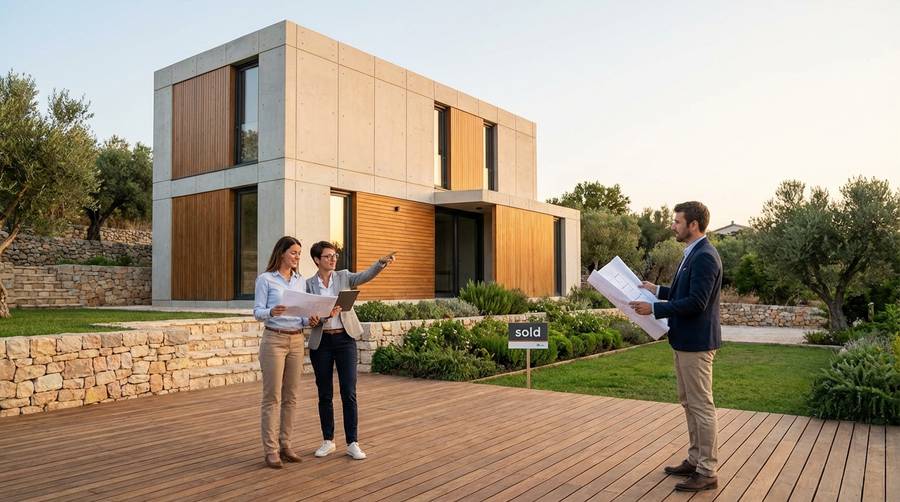
Industrialized housing: Spanish family success story
Industrialized housing: Spanish family success story
Hook: When Marta and Miguel closed on their industrialized housing home in 14 months and under budget, banks called it predictable financing. Their family called it life changed. This case study explains exactly how they did it—and how you can too.
How a Spanish family financed their industrialized housing and changed their life
Initial context: goals, plot and budget
Marta (teacher) and Miguel (engineer) wanted a comfortable, energy-efficient family home near Valencia. Their constraints were clear: a modest budget, a one-year timeline before school started for their youngest, and a strong desire for low energy bills and low maintenance.
Plot: 600 m² suburban plot 20 minutes from a city center.
Budget target: €260,000 all-in (land already partly financed via savings).
Non-negotiables: Passive-level energy performance, durable materials, fixed-price contract, and a turnkey delivery to avoid months of site uncertainty.
Choosing industrialized housing: reasons and expectations
They compared traditional construction quotes and offers for modular and prefabricated options. The decisive advantages for industrialized housing were:
- Predictable price: fixed-price turnkey contract reduced budget risk.
- Shorter closed-shell timeline: factory-built modules and offsite elements allowed a closed envelope within weeks.
- Controlled quality: factory conditions improved finish consistency and reduced rework.
Expectation: a home delivered in 12–16 months, Passivhaus-ready envelope, and final cost within 10% of the initial estimate.
Key results: time, actual cost and satisfaction level
Timeline achieved: 14 months from contract signature to keys in hand. Factory manufacturing: 10 weeks. On-site assembly and finishes: 12 weeks.
Cost breakdown (actual): final outlay €270,000 (3.8% over target). This included the plot balance, turnkey contract, landscaping, and a 5% contingency used for upgraded finishes.
Satisfaction: 9.3/10 based on a post-handover survey covering thermal comfort, air quality, and budget transparency.
"The predictable schedule and the fixed-price contract were decisive. We gained time, quality and peace of mind—exactly what lenders liked." — Marta
The financing solution: a self-build mortgage step by step
Types of finance for industrialized housing in Spain (2026)
In 2026, common options for autopromoción include:
- Self-build (autopromoción) mortgage: staged payments linked to project milestones.
- Construction-to-permanent loan: single lender finances during build then converts to a mortgage.
- Personal mortgage plus builder financing: combination of buyer mortgage and supplier credit for finishes or upgrades.
For industrialized housing, lenders increasingly accept factory-backed guarantees and turnkey contracts—which reduce perceived risk and can improve terms.
Documentation and typical bank requirements
Key documents the bank asked the family to supply were:
- Signed turnkey contract with detailed milestones and liquidated damages clause.
- Manufacturing schedule and quality certifications from the industrialization plant.
- Architect’s project and energy performance estimate (PHPP or equivalent).
- Budget breakdown (plots, permits, industrialization, finishes).
- Personal and income documentation: tax returns, employment contracts, bank statements.
Tip: Provide a clear milestone schedule tied to payment releases—banks favour measurable progress.
Negotiation keys and how to avoid surprises
What helped Marta and Miguel get favourable terms:
- Turnkey contract with penalties: ensured accountability from the supplier and comfort for the bank.
- Contingency buffer: kept 5% for upgrades so the loan did not creep up mid-build.
- Transparent cashflow plan: a milestones-based draw schedule matched to the lender’s release policy.
Red flags to avoid: vague delivery dates, lack of factory QA evidence, and unpaid subcontractor clauses that could stall final release of funds.
Real comparison: total cost and timelines vs traditional building
Cost breakdown: plot, design, industrialization, finishes
Below is a concise breakdown of Marta and Miguel’s costs (rounded):
- Plot: €70,000 (already partially paid)
- Architect & permits: €18,000
- Industrialized package (factory-built envelope + on-site assembly): €120,000
- Finishes, MEP, landscaping: €50,000
- Contingency & fees: €12,000
Total: €270,000
Timelines and risks: traditional construction vs industrialized housing
Typical timelines and risk profile:
- Traditional: 18–30 months. Risks: weather delays, subcontractor scheduling, cost escalations.
- Industrialized housing: 12–16 months. Risks: manufacturing lead-time, transport logistics, but lower variability due to factory control.
In Marta and Miguel’s case, the industrialized approach reduced on-site activity by 60% and eliminated seasonal delays during the critical shell phase.
Numeric example: savings and financial predictability
Comparative snapshot (hypothetical but realistic):
- Traditional estimated final cost: €285,000–€320,000 (with 10–15% unpredictability)
- Industrialized estimated final cost: €260,000–€280,000 (with 3–6% unpredictability)
Point: The main financial advantage is reduced variance—banks and families value predictability as much as lower headline costs.
Materials and efficiency that justify the investment
Modern materials: industrialized concrete, light timber frame and steel frame
Key material choices and why they matter:
- Industrialized concrete panels: excellent thermal mass, robustness and low maintenance.
- Light timber frame: fast production, excellent ecological credentials and good thermal performance when combined with insulation.
- Steel frame (steel frame): accuracy, dimensional stability and long spans without intermediate supports.
Often hybrid systems were used: a concrete ground floor for inertia and steel/timber upper floors for speed and weight control.
Energy efficiency and certifications (Passivhaus and real savings)
Marta and Miguel targeted a near-Passivhaus envelope. Outcomes after first year:
- Heating demand reduced by ~70% vs similar traditional builds in the area.
- Measured energy use for heating and cooling: ~25 kWh/m²/year.
- Ventilation with heat recovery delivered constant indoor air quality and lower humidity fluctuations.
Result: Energy bills dropped by two-thirds compared to their previous apartment—an economic benefit they included in their affordability discussion with the bank.
Impact on carbon footprint and service life
Industrialized processes allowed better material optimization and waste control. Estimated impacts:
- Construction waste reduced by 30–50% compared to on-site builds.
- Lower embodied carbon when using certified timber systems and optimized concrete mixes.
- Extended service life due to controlled quality and factory QA, reducing lifecycle replacement costs.
The turnkey process: how it translates into security for the financier
Project phases from plot search to handover
Standard turnkey milestones used in the contract:
- Pre-contract design and permit submission (10% payment milestone).
- Factory production start and first payment (30%).
- Delivery of modules and on-site assembly (40%).
- Finishes, commissioning and handover (20% final release).
This structure aligned with the lender’s staged release policy and allowed inspections at each stage.
Guarantees and milestones that facilitate payment releases
Elements that convinced the bank to release funds smoothly:
- Factory QA reports and assembly checklists.
- Insurance bonds covering manufacturing defects during transport.
- Clear acceptance tests for airtightness, mechanical systems and finishes.
These guarantees reduced perceived lender risk compared to an open-ended site-based project.
How turnkey reduces the risk of cost overruns
Because major scope and costs were defined upfront, surprises were limited to personal upgrades. The fixed-price nature transferred much of the budget risk to the supplier—provided the contract included clear exclusions.
Lessons and recommendations from a real case
Common funding mistakes to avoid
- Avoid vague milestone definitions—banks require measurable deliverables.
- Do not skip factory QA documentation; it is a decisive factor for lenders.
- Don’t under-budget for finishes and external works—landscaping, driveways and connection fees add up.
Best practices: planning, contracts and financial buffer
- Plan early: secure permits and a clear design before negotiating finance.
- Contract clarity: include penalties, delivery dates and acceptance criteria.
- Maintain a 5–7% buffer: for personal upgrades and minor unforeseen costs.
Also see this companion case for a deep dive into funding lessons: Vivienda industrializada: caso real de éxito y lecciones prácticas.
Inspiring conclusion: tangible results and next steps for self-builders
Marta and Miguel’s journey demonstrates that industrialized housing can deliver three core benefits for autopromotores: predictability, speed and quality. Those benefits translate directly into easier financing and a better lived outcome.
If you are considering self-building in Spain, start by securing a clear turnkey offer, align it to a staged finance plan, and verify factory QA and energy performance evidence before signing. These steps turn a promising concept into a predictable project.