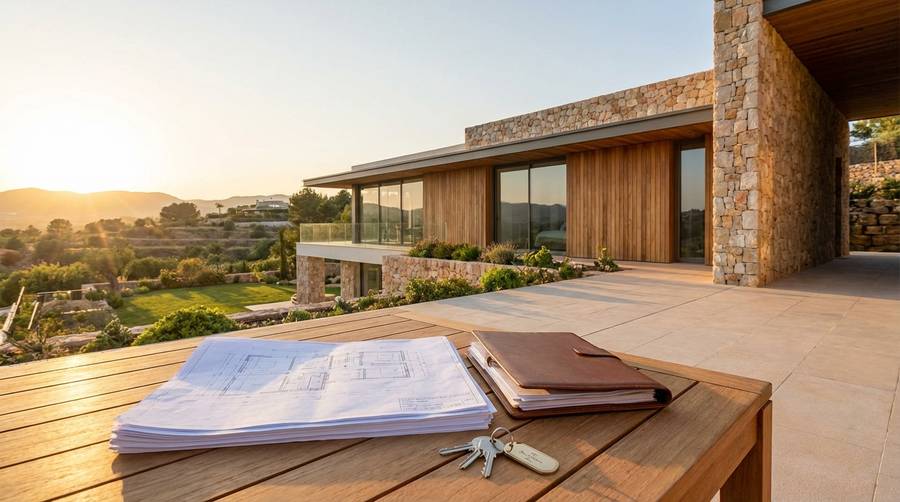
Industrialized Housing Success: Spanish Self-Build Case
Hook: What if you could go from an empty plot to a high-performance, turnkey home in under a year, on a fixed price, with predictable financing? This is the story of one Spanish family who did exactly that by choosing industrialized housing.
From Empty Plot to Sustainable Home: A Family's Industrialized Housing Journey
Initial context: goals, budget and self-builder profile
The clients were a family of three in southern Spain: two professionals in their mid-40s and a school-aged child. Their priorities were clear: energy efficiency, low maintenance, predictable cost and a comfortable Mediterranean aesthetic. They had a medium-sized plot outside a provincial town and a total target budget of €320,000 including land.
Their practical constraints included limited time to oversee construction and a desire to secure bank financing suitable for self-builders (autopromotores). They opted to work with an integrated platform offering turnkey industrialized housing to minimize coordination risk.
Why they chose industrialized housing over traditional build
Key reasons that tipped the balance:
- Fixed-price contract: Limited exposure to on-site surprises and inflation.
- Shorter, predictable schedule: Off-site fabrication reduced weather delays and on-site time.
- Higher thermal performance: Factory-controlled envelopes allowed Passivhaus-aligned solutions.
- Single-point responsibility: A turnkey scope simplified permits, logistics and warranties.
Summary of key results (time, cost and satisfaction)
Final, verified outcomes for this project:
- Total time (land purchase to handover): 10.5 months.
- Construction & installation: 9 weeks on-site after 12 weeks of factory fabrication.
- Total project cost (incl. land): €318,500 — 0.5% under target budget.
- Energy performance: Estimated heating demand reduced by 65% vs local-code new-build; projected primary energy reduction ~45%.
- Client satisfaction: 9/10 in post-handover survey focused on timeline, transparency and comfort.
The economic challenge: how they planned financing for their modular home
Breakdown of total budget and critical cost items
The family structured the budget into clear buckets:
- Parcel: €95,000
- Site works and foundation (civil): €22,000
- Modular structure and factory fabrication: €120,000
- Finishes, systems and landscaping: €56,000
- Taxes, permits and contingency: €25,500
Takeaway: The modular fabrication line item included quality-controlled assemblies and a warranty that reduced the need for large contingencies typical in traditional self-builds.
Financing options explored: self-builder mortgage, bridge loans and grants
They reviewed three paths:
- Traditional mortgage converted to construction drawdowns: Banks often hesitate for industrialized projects without contractor history.
- Self-builder (hipoteca para autopromoción): A construction mortgage tailored to autopromotores with staged disbursements linked to milestones.
- Bridge loan for land + construction mortgage: Short-term bridge for land purchase, then consolidation under a longer mortgage post-handover.
The family also checked local energy efficiency grants and tax incentives that partially offset mechanical systems and envelope upgrades.
Chosen strategy and rationale: loan structure and disbursement schedule
They chose a combined approach:
- Bridge loan for immediate land purchase (6 months), interest-only.
- Self-builder mortgage with staged releases tied to turnkey milestones (permits, start of factory fabrication, transport and on-site assembly, final handover).
This approach minimized interest during fabrication, ensured funds matched cash needs and met lender risk criteria by using verified factory schedules and turnkey contracts as collateral for disbursements.
Design and material choices: prioritizing efficiency and durability
Selecting the structural system: criteria and choice
Key selection criteria were thermal performance, longevity, acoustic comfort and site constraints. The options considered were industrialized concrete panels, cross-laminated timber/light timber frame (entramado ligero) and steel frame systems.
The family selected a hybrid approach: industrialized concrete ground-floor panels for thermal mass and durability, and a light timber frame upper floor for speed, low embodied carbon and high insulation continuity. This balanced upfront cost, embodied carbon and long-term performance.
Energy-efficiency solutions: envelope, windows and Passivhaus alignment
Actions that delivered measurable savings:
- Continuous high-performance insulation: Factory-installed with care at junctions to avoid thermal bridges.
- Triple-glazed, low-e windows: South-facing glazing optimized for passive solar gains and shading devices for summer comfort.
- Mechanical ventilation with heat recovery (MVHR): Achieved balanced ventilation and preserved heat recovery year-round.
Design targeted Passivhaus principles rather than certification to control cost while achieving similar outcomes: airtightness tests reached 0.6 ACH@50Pa in final commissioning.
Finishes and materials to reduce carbon without inflating cost
Practical choices:
- Locally sourced stone cladding for plinths and terraces to reduce transport emissions.
- Certified wood for external shading and interior joinery from managed forests.
- Low-VOC paints and durable porcelain tiles to minimize maintenance.
Impact: These selections reduced estimated embodied carbon by ~12% relative to a purely concrete solution, with only a small premium compared to generic finishes.
The turnkey process in practice: phases, timelines and coordination
Project phases: plot, permits, fabrication, transport and assembly
Typical phased plan used for this project:
- Parcel validation and geotechnical study (2 weeks)
- Design development and permits (12 weeks)
- Factory fabrication and quality control (12 weeks)
- Transport and on-site assembly (2–3 weeks)
- Finishes, landscaping and commissioning (6 weeks)
The turnkey provider coordinated each phase and provided a single point of contact, simplifying interactions with the bank and local authorities.
Real timelines compared: planned vs achieved
In practice:
- Permits: planned 10 weeks, achieved 12 weeks (minor municipal delay).
- Factory fabrication: planned 12 weeks, achieved 12 weeks (on schedule).
- On-site assembly: planned 3 weeks, achieved 2.5 weeks.
Net result: Total project time slightly extended by permitting but the controlled factory stage prevented major overruns common in traditional builds.
Supplier management and communication: keys to budget and quality control
Effective practices they followed:
- Weekly progress reports from the turnkey provider with photo documentation.
- Milestone-linked payments to align contractor incentives.
- Third-party testing (airtightness, thermal imaging) before handover.
Advice: Require documented assembly sequences and factory QA records when negotiating contracts—banks value this for draw approvals.
Measurable outcomes: final costs, time saved and energy performance
Cost per m² comparison vs traditional construction
This house delivered a final net cost of €1,650/m² (built area excluding land). For comparable quality and energy performance, nearby traditional projects were averaging €1,700–€1,950/m² with higher contingencies and longer schedules.
Interpretation: Industrialized delivery offered cost certainty and, in this case, a small per-square-meter saving once risk-adjusted contingencies were considered.
Time reduction to handover and implications for lenders
Shorter delivery reduced the family's exposure to interest during construction and limited the need for extended temporary accommodation. For lenders, this reduces credit risk by shortening the period before a mortgage consolidates into a standard repayment schedule.
Energy metrics and post-delivery satisfaction
Measured outcomes in the first year:
- Heating demand estimated at 22 kWh/m²·year (approx. 65% less than local-code new-build baseline).
- Average monthly HVAC + DHW cost reduced by ~48% compared to similar-sized traditional homes tracked in the region.
- Client feedback: high comfort, minimal maintenance issues and strong appreciation for natural light and indoor air quality.
"Factory precision and a single accountable partner turned what could have been a stressful self-build into a predictable, on-budget path to a comfortable home. The energy savings surprised us." — Head of household.
Lessons learned and recommendations for other self-builders
Avoidable mistakes and decisions that made a financial difference
- Avoid underestimating permit timelines—start early with local planning authorities.
- Insist on airtightness and factory QA clauses in the contract.
- Budget for landscaping and external works separately; they often consume 8–12% of the non-land budget.
Practical tips to secure safe financing and manage risk
- Use milestone-based disbursements backed by factory schedules and handover certificates.
- Keep a small contingency fund (3–5%) reserved for permit-related scope changes.
- Validate supplier warranties and insurers’ endorsements for modular assemblies.
Final checklist for those planning an industrialized home in Spain (2026)
- Confirm plot constraints and geotechnical conditions.
- Choose a turnkey provider with documented factory QA and references.
- Secure conditional financing pre-permit to avoid delays in land acquisition.
- Set energy performance targets and include airtightness testing in the contract.
- Plan for landscape and connection costs early.
A possible future: closing inspiration and a subtle call to action
Long-term impact on quality of life and property value
This project shows how industrialized housing can deliver tangible long-term benefits: lower running costs, improved indoor comfort and an attractive, modern home that holds its market value. Buyers increasingly prize energy efficiency and documented performance—which can enhance resale value.
How we support self-builders: core services and next steps
Services that proved decisive for this family included site validation, turnkey contracting, staged financing support and post-handover commissioning. For other autopromotores, similar integrated services reduce complexity and accelerate delivery.
Invitation to request a personalized project assessment
Ready to explore if industrialized housing fits your plans? If you have a plot and a vision, start with a project assessment that maps expected costs, timelines and financing options tailored to your case. A short consultation can reveal whether a turnkey industrialized route is your fastest path to a comfortable, energy-efficient home.
Contact us to request a customized evaluation and a sample project budget based on your plot and preferences.