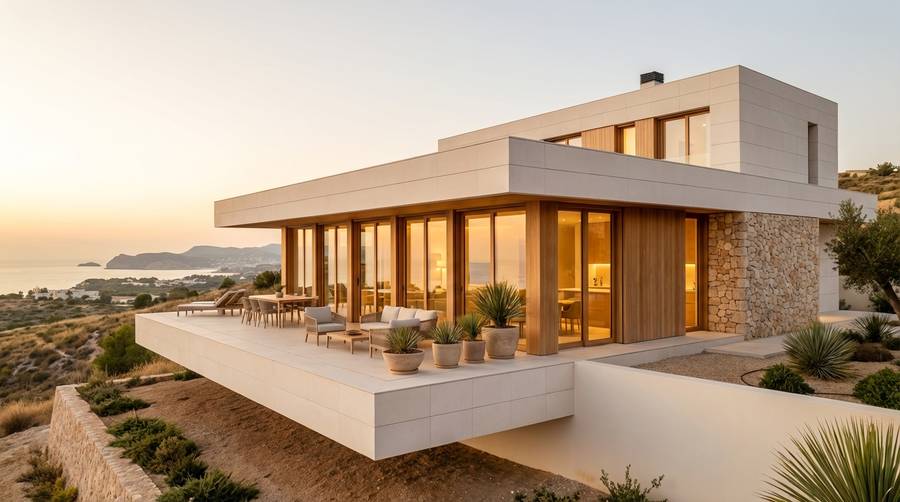
Industrialized Housing: A Regional Success Story
Industrialized Housing: A Regional Success Story
Hook: In 18 months a rural comarca went from long waiting lists and rising prices to delivering 120 high-quality homes with fixed budgets, Passivhaus-level efficiency and a measurable social impact. This is how they did it.
A project that transformed a comarca: real story of regional industrialization
Local context: why the region needed fast, sustainable housing solutions
The comarca faced three converging pressures: an aging housing stock, limited construction workforce and urgent demand from young families priced out of local markets. Traditional building methods could not guarantee delivery times or fixed costs. Public administrations sought a solution that combined speed, quality and environmental ambition—so they partnered with a comprehensive industrialized housing platform to pilot a regional program.
Key actors: promoters, municipalities and the integrated platform
The program brought together:
- Local municipalities that provided serviced plots and streamlined permitting.
- Private autopromoters and a social housing promoter that aggregated demand and secured financing.
- An integrated industrialized housing platform that coordinated design, off-site manufacture, site assembly and turnkey delivery.
Coordination through regular governance meetings and a single technical protocol for energy, acoustics and accessibility reduced friction and avoided rework.
Initial results: social and economic impact metrics
Within the first 18 months the program achieved:
- 120 homes delivered (mix of single-family and duplex)
- Average on-site assembly time: 10–12 working days per house
- Contractual cost deviations: under 2%
- Local employment: 140 FTEs over peak months
These figures show how standardized industrial processes can unlock predictability while supporting local economies.
From plot to handover: the turnkey path, step by step
Plot search and adaptation: permits and local constraints
Success began with parcel selection. The integrated platform provides a checklist used during land assessment:
- Topography and drainage feasibility
- Access for delivery vehicles and cranes
- Grid and utility connection points
- Local planning constraints (setbacks, heights, materials)
Working early with municipal planners reduced permit time by an average of 40% in the pilot, because designs were pre-aligned with local rules.
Design and manufacturing: choosing materials and systems
Design decisions focused on resilience, thermal performance and cost certainty. The program validated three primary systems depending on the brief:
- Industrialized concrete elements for foundations and lower floors where robustness and fire resistance were priorities.
- Light timber frame (entramado ligero) for rapid, lightweight envelopes with excellent thermal behavior.
- Steel frame for longer spans and open-plan layouts where speed and precision mattered most.
Each house used prefabricated façades, high-performance windows and factory-integrated MEP (mechanical, electrical and plumbing) modules. This reduced on-site interfaces and improved QC.
Assembly, finishes and handover: real timelines and quality control
Typical sequence and average durations:
- Site preparation and foundations: 4–6 weeks
- Factory production: 8–10 weeks (parallel to site works)
- Transport and assembly: 10–12 working days
- Finishes, commissioning and handover: 3–6 weeks
Quality control relied on a factory QA protocol and a site commissioning checklist. Third-party testing of airtightness and thermal bridging was performed pre-handover to ensure promised performance.
Efficiency and sustainability proven: project figures
Energy efficiency and Passivhaus performance: measured consumption and savings
Homes in the pilot achieved airtightness between 0.4 and 0.6 ACH@50, with U-values typically below 0.20 W/m²K on envelopes. Measured results after 12 months showed:
- Average heating demand: 12 kWh/m²·year (Passivhaus-range in the local climate)
- Primary energy reduction: ~65% vs. local conventional stock
These gains translated into annual energy bills typically 55–70% lower than nearby traditionally built houses.
Carbon footprint reduction vs traditional construction: comparative data
A cradle-to-handover assessment showed an average embodied carbon reduction of 18–30% compared with conventional in-situ concrete and masonry construction. Savings came from:
- Optimized material use through factory precision
- Lower waste rates and higher recycling in production
- Efficient transport logistics and fewer on-site deliveries
Closed budgets and timelines: deviations, savings and compliance
Key financial outcomes:
- Contractual cost variance: median 1.6% (mainly due to client upgrades)
- Time to occupancy: delivered on average 24 weeks from permit approval
- Cost per m²: competitive with local conventional builds when factoring lower lifecycle energy and maintenance costs
Client experience: human story and satisfaction metrics
Narrative testimony: an autopromoter family's journey
"We went from a dream to a key-in-hand house in under a year. The fixed price gave us peace of mind; the quality surprised even our architect. Our heating bills were half what we expected." — Marta, homeowner
Marta and her partner purchased a plot through the municipal scheme. Their priorities were healthy indoor air, predictable cost and a design that fit the local vernacular. The platform delivered a timber-frame home with daylighting optimized for passive gains, and the couple reported immediate comfort improvements and clear budget control.
Satisfaction indicators: surveys, complaints and follow-ups
Post-handover surveys at 6 and 12 months recorded:
- Overall satisfaction: 92%
- Maintenance issues reported: 4% (mostly minor finish adjustments)
- Willingness to recommend: 89%
Rapid response to defects and a clear two-year warranty policy were crucial to client trust.
Lessons learned and adjustments for future projects
Principal takeaways:
- Early alignment with local planners speeds permitting.
- Standardized modules must allow contextual façade variations to avoid a cookie-cutter look.
- Clear communication of technical performance to inhabitants improves perceived value.
Technical and economic comparison: industrialized vs traditional
Detailed cost breakdown: construction, finishes, systems and financing
When comparing two equal-spec homes, differences emerged in:
- Construction cost: similar base cost per m², but industrialized housing reduced contingency needs.
- Finishes: factory-finishes were often higher quality and quicker to install.
- Systems: pre-integrated MEP lowered coordination costs and reduced concealed defects.
Timelines and risks: calendar control and managing contingencies
Industrialized processes transferred many weather and labour risks from site to factory. This resulted in:
- Shorter critical path on-site
- Fewer schedule days vulnerable to inclement weather
- Improved predictability attractive to lenders and clients
Build quality and durability: maintenance and guarantees
Factory conditions improved consistency in joins, airtightness and finishes. Combined with robust warranties, long-term maintenance forecasts show lower lifecycle costs for industrialized homes.
Financing and autopromotion: making modular housing viable in Spain
Mortgage options for autopromotion and modular-specific products
Banks increasingly recognise the lower risk profile of turnkey industrialized homes. Options include:
- Autopromotion mortgages that disburse by construction milestones tied to factory and site stages.
- Specific modular products with valuation models that incorporate energy efficiency and predictable completion dates.
- Green loan top-ups for Passivhaus or low-energy certifications that reduce interest costs.
Real financial plan from the case: disbursements, milestones and social return
Typical cashflow pattern used in the pilot:
- Deposit at contract signature: 10%
- Factory start payment: 40%
- On-site assembly: 30%
- Handover: 20%
This structure aligned lender risk with tangible assets and tied lender disbursements to measurable progress—reducing financing friction for autopromoters.
Practical tips for negotiating with banks and securing viability
- Present airtightness and energy test plans to justify valuation uplift.
- Use turnkey contracts to clarify final scope and control contingency.
- Negotiate milestone-linked disbursements that match factory production timelines.
Keys to replicate the success: a practical guide for autopromoters (2026)
Checklist for design and permits aligned with current Spanish regulation
Essential items before signing:
- Verify local PGOU constraints and allowable plot coverage.
- Confirm utility capacities and schedule for connections.
- Obtain clear conditions for wastewater and stormwater management.
- Align architectural envelope choices with thermal regulations and Passivhaus targets where possible.
For a deep design roadmap see the Guía 2026: Diseñar una vivienda industrializada en España.
How to choose materials and systems by climate and budget
Decision principles:
- Choose timber frame in moderate climates for speed and thermal performance.
- Use industrialized concrete where ground conditions or fire regulation demand greater mass.
- Consider steel frame for open plans or where transport constraints favour lighter modules.
Final steps to ensure on-time delivery and client satisfaction
- Implement a shared digital dashboard for milestones and approvals.
- Schedule client walkthroughs at predetermined factory and site stages.
- Include a post-handover review at 3 and 12 months to capture defects and feedback.
Closing inspiration: impact and lessons for regional industrialization
Summary of outcomes and territorial ripple effects
The pilot demonstrated that industrialized housing can produce high-quality, energy-efficient homes at predictable cost and timeframes. Beyond the houses themselves, the project:
- Stimulated local suppliers and temporary employment.
- Lowered energy demand in the housing stock, reducing municipal energy poverty risks.
- Provided a replicable model for neighbouring comarcas.
Future opportunities to scale the model in other comarcas
Key scaling levers:
- Aggregation of demand across municipalities to reach manufacturing economies of scale.
- Standardized technical protocols that allow regional aesthetic variation.
- Financial instruments that reward energy performance and lower lender risk.
Call to action: for autopromoters, administrations and private partners
If you're an autopromoter, start by mapping your plot constraints and asking for factory-led feasibility studies. Municipalities can unlock similar programs by pre-certifying small batches of plots and streamlining basic services. Private developers can partner with industrialized platforms to reduce delivery risk and reach sustainability targets.
For a practical next step, explore comparative analyses such as Vivienda industrializada vs tradicional: ventajas y desventajas and consider a feasibility conversation with an integrated provider to test the model for your plot or comarca.
Artículos relacionados
Industrialized Housing vs Traditional Homes: Pros & Cons
A concise, evidence-based comparison to help Spanish self-builders decide between industrialized (modular/prefab) housing and traditional construction—covering costs, timelines, materials, sustainability, financing and a real case study with metrics.