Industrialized Housing: Complete Guide to Time & Cost Control
Why industrialized housing is key to saving time and controlling costs
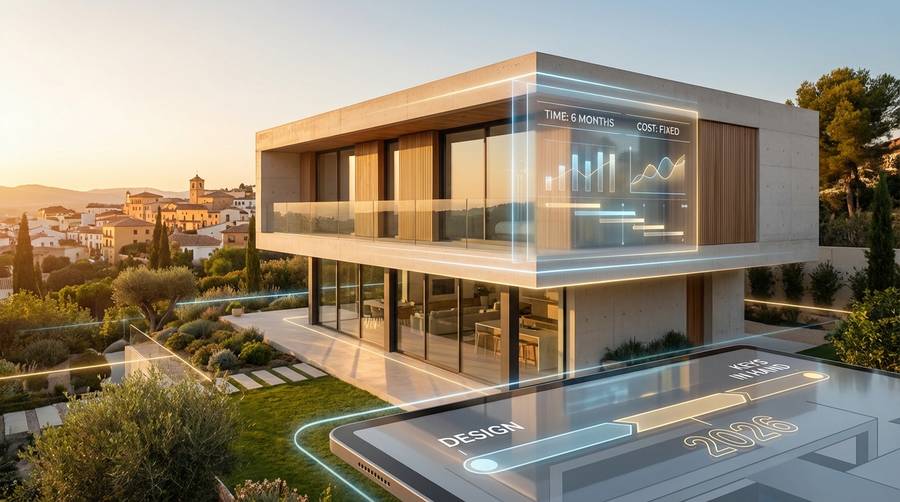
Hook: If you want predictable delivery dates and a fixed final price for your home, industrialized housing is the most reliable route for self-developers in Spain. This guide explains exactly how to achieve those outcomes — no myths, only actionable steps and real metrics.
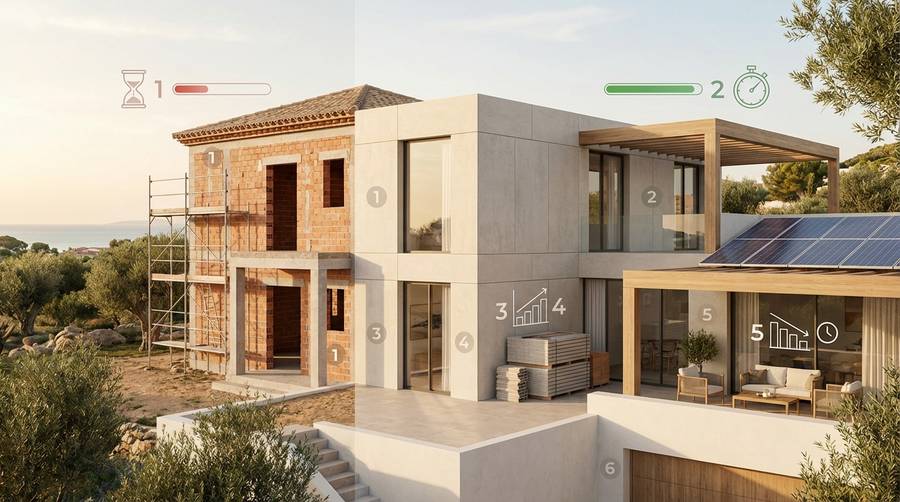
Industrialized housing (also called modular or prefabricated housing) moves most construction into a controlled factory environment. The result is a reduction in on-site uncertainty, compressed schedules and a far stronger control of costs. Below we analyze why this matters and how to realize tangible savings.
Advantages vs traditional construction: fixed price and closed schedules
Predictability is the main advantage. Factory production shortens on-site exposure to weather, labour variability and subcontractor delays. That translates into:
- Fixed-price contracts are easier to define because factory processes reduce scope creep.
- Shorter on-site schedules: typical on-site assembly ranges from 2 to 8 weeks for a detached home depending on system and size.
- Quality control: repeatable factory inspections cut rework rates.
Impact on project planning and risk reduction
Moving tasks to the factory shifts risk from the site to the production line. That reduces the unknowns you would normally budget for in traditional builds — weather delays, on-site coordination costs and long provisional sums.
- Reduced contingency needs: projects can often budget a lower contingency (5–8% vs the 10–15% commonly used in traditional builds).
- Simpler schedule dependencies: procurement and certification are more linear and auditable.
Real cases: metrics on time and cost savings
Recent Spanish projects demonstrate consistent patterns:
- Average total delivery time from permit to handover: 7–10 months (industrialized) vs 12–18 months (traditional).
- Average on-site assembly: 2–8 weeks (modular) vs 20–40 weeks (traditional structural phase).
- Typical final cost variance: ±3–6% (industrialized) vs ±10–20% (traditional) against initial budget.
Moving core build work into a factory commonly reduces on-site duration by 60–80% and halves the most frequent causes of budget overruns.
Practical comparison: timelines and costs — prefabrication vs traditional build
This section breaks down common phases and typical durations so you can compare like-for-like.
Time breakdown: factory phases vs site phases (typical schedules)
- Design & approvals: 2–4 months. Same for both approaches but industrialized projects require earlier technical coordination with the manufacturer.
- Factory production: 8–16 weeks depending on complexity and system chosen.
- Transport and site assembly: 2–8 weeks (including crane and finishing on site).
- On-site finishes and commissioning: 2–6 weeks for utilities, tests and handover.
Compare that to traditional builds where the structure and envelope alone can take 20–40 weeks on site, plus the same finish and commissioning period.
Economic comparison: budget per m² and variable costs
Costs vary by system, location and specification. Typical ranges in Spain (2025–2026 benchmarks):
- Industrialized housing (high-spec): €1,600–2,400 / m² delivered turnkey.
- Traditional build (high-spec): €1,700–2,600 / m², with higher contingency advised.
Key drivers of difference:
- Labour efficiency: factory labour is more productive and predictable.
- Procurement: bulk purchasing of components lowers material costs.
- Transport & site logistics: add costs for oversized panels or modules; consider access limitations on your plot.
Sensitivity analysis: plot, permits and design influence
Costs and times are sensitive to three variables:
- Parcel constraints: tight access increases crane and staged assembly costs.
- Permits: delayed approvals stall factory start — align permit timeline with production slots.
- Design complexity: highly bespoke façades or non‑standard geometries increase factory time and price per m².
Materials and systems: how choice impacts time and cost
Choosing the right structural system is a direct lever on schedule, cost and energy performance. Below we compare the main modern options used in Spain.
Industrialized concrete: speed, durability and associated costs
Industrialized precast concrete delivers high durability and acoustic performance. It is well-suited to urban contexts and complex geometries.
- Advantages: longevity, fire resistance, thermal mass.
- Drawbacks: heavier logistics costs, longer lead for bespoke panels.
- Typical use-case: multi-storey dwellings or homes where acoustic and structural robustness are priorities.
Light timber frame and steel frame: assembly speed and energy performance
Timber frame (lightweight) and steel frame systems are the fastest to assemble on site and usually provide excellent thermal performance when combined with modern insulation.
- Advantages: rapid assembly (days to weeks), lighter transport, excellent embodied carbon profile for timber.
- Drawbacks: attention required for detailing to ensure long-term durability in varied climates.
- Typical use-case: single-family homes aiming for Passivhaus-level performance.
Selecting materials by objective: Passivhaus and carbon footprint
Your target performance changes choice of system:
- For Passivhaus: timber or steel frame with high-performance insulation and meticulous airtightness detailing is most cost-effective.
- To lower embodied carbon: prioritize responsibly sourced timber and optimized componentization to reduce waste.
The turnkey process explained step-by-step for self-developers
A turnkey (llave en mano) delivery transfers coordination to a single point of responsibility. Here is a concise, actionable roadmap.
From finding a plot to project permission: timelines and checkpoints
- Plot feasibility (2–6 weeks): check access, zoning, topography, connection costs.
- Brief & schematic design (4–8 weeks): define spaces, budget target and energy goals. Engage a manufacturer early.
- Planning & building permits (variable, 2–6 months): submit coordinated documents tailored to the modular system.
Production and logistics: factory time, transport and site assembly
- Factory slot and production (8–16 weeks): confirm production slots when contract is signed to avoid delays.
- Transport planning: route surveys, permits for oversized loads and crane planning are needed early.
- On-site assembly (2–8 weeks): prepare foundations and utility pre-connections before modules arrive.
Handover and commissioning: tests, certificates and client satisfaction
- Commissioning: air-tightness, thermal tests and utility connections.
- Documentation: as-built drawings, warranties and operation manuals must be delivered.
- Client walk-through: structured snagging list with deadlines for resolution.
Financial planning: mortgages, funding and budget control
Financing industrialized housing requires adapting typical mortgage processes to a sequential factory+assembly workflow.
Financing options for self-development and modular builds in Spain
- Construction-to-permanent mortgages: banks are increasingly comfortable with modular builds; present a production schedule and turnkey contract to lenders.
- Autopromotion mortgage: structured drawdowns tied to milestones (permit, production start, assembly, handover).
- Green loans: favourable terms may be available for projects targeting Passivhaus or low carbon certifications.
How to structure payments and guarantees to preserve a fixed price
- Link payments to milestones: permit, factory start, module dispatch, assembly completion, handover.
- Retentions & warranties: include a 5–10% retention released after final commissioning.
- Price escalation clauses: avoid broad material escalation clauses; cap them or define indexation explicitly.
Tips to avoid cost overruns: contractual and forecasting best practices
- Define fixed scope with clear change control procedures.
- Include realistic contingencies for permits and unexpected site works (minimum 5%).
- Obtain manufacturer lead-time guarantees in the contract.
Case studies and metrics: real examples with time and cost data
Below are anonymized examples that illustrate typical outcomes.
Case 1 — Single-family home (2025): timeline, final cost and satisfaction
- Size: 160 m² net living area.
- System: light timber frame, high insulation.
- Timeline: permit to handover = 9 months; factory production = 12 weeks; on-site assembly = 3 weeks.
- Cost: €1,850 / m² delivered. Final cost variance: +2% due to plot-specific connection works.
- Client satisfaction: 9/10 — main praise: reduced noise and predictable schedule.
Case 2 — Passivhaus industrialized project: investment vs energy savings
- Size: 130 m².
- System: steel frame with triple-glazed windows and mechanical ventilation with heat recovery.
- Investment premium: +6% vs a good standard industrialized spec.
- Operational savings: estimated 60–75% heating energy reduction; payback on energy premium: 10–14 years depending on energy prices.
Lessons learned and recommendations for future self-developers
- Engage manufacturers during schematic design to align technical details and cost targets.
- Verify transport access and crane feasibility early to avoid late add-ons.
- Prioritize airtightness and balanced ventilation if operational costs matter to you.
Practical conclusion: how to decide about time and cost for your project
Industrialized housing is the pragmatic choice for self-developers who value time certainty and tight budget control. The decision comes down to:
- Project priorities: speed and fixed price vs absolute lowest initial cost.
- Energy and sustainability goals: Passivhaus targets lean toward timber/steel systems.
- Plot logistics and permit timelines: these can make or break expected savings.
Checklist to evaluate providers and systems
- Ask for documented lead times and production slots.
- Request a turnkey price with a clear change control mechanism.
- Check references and completed projects with similar plots and specs.
- Verify warranties, retention mechanisms and commissioning procedures.
Recommended roadmap for self-developers in Spain
- Assess parcel feasibility and costs.
- Define budget bands and energy targets (standard vs Passivhaus).
- Engage a modular manufacturer for early technical input.
- Secure permits while booking a factory slot.
- Structure finance with milestone payments and limited escalation clauses.
Resources & next steps: Request a turnkey proposal that details production schedules, transport logistics and a line-item price per m². Compare at least two systems (timber vs steel vs precast) against your energy and carbon goals.
If you want a tailored assessment for your plot and budget, contact a specialized industrialized housing platform to get an itemized roadmap and manufacturer comparisons. A short feasibility study will reveal whether you capture the typical 20–40% time savings and the narrower cost variance documented above.
Ready to evaluate your project? Reach out for a tailored feasibility study and a side-by-side comparison of materials, timelines and finance options.