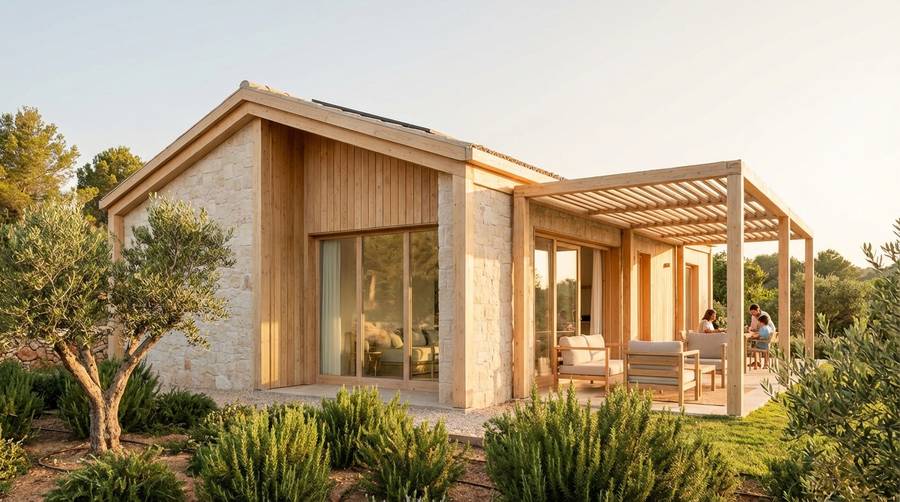
Industrialized Housing: Complete Guide to Modular Homes in Spain
Why choose industrialized housing with Mediterranean timber in 2026
Hook: If you want a high-quality home delivered faster, with predictable costs and lower energy bills, industrialized housing is the practical path forward.
Industrialized housing (also called a prefabricated house or modular home) is now a mainstream alternative to traditional construction in Spain. This section explains the core advantages and why light-frame timber performs especially well in Mediterranean climates.
Advantages vs traditional construction: time, cost and quality
- Faster delivery: Factory production reduces on-site time by 40–70%, shortening weather-related delays.
- Fixed-price predictability: Modular contracts commonly offer clear cost breakdowns and price guarantees that protect autopromoters from common overruns.
- Higher quality control: Components produced under factory conditions have repeatable tolerances, meaning better airtightness and fewer defects.
Benefits of light-frame timber for the Mediterranean climate
- Thermal comfort: Timber assemblies combined with proper insulation and thermal mass elements keep indoor temperatures stable.
- Moisture control: Modern timber systems with breathable membranes and rainscreens avoid condensation issues in warm, humid coastal areas.
- Design flexibility: Wood frame allows wide spans and large openings—ideal for Mediterranean facades with terraces and generous glazing.
Impact on energy efficiency and carbon footprint
Industrialized housing can be designed to meet Passivhaus principles. Factory precision improves airtightness and reduces thermal bridges. When paired with low-embodied-carbon materials—engineered timber, recycled insulation, and low-carbon concrete—modular homes can cut operational and embodied emissions significantly compared with conventional builds.
Well-planned industrialized housing can reduce construction time by half while lowering lifecycle carbon emissions by 20–40% compared to many traditional projects.
How to plan your industrialized project step by step
Moving from idea to a turnkey home requires disciplined planning. Follow these steps to reduce risk and keep the schedule and budget under control.
Finding and assessing the plot: regulations, orientation and soils
- Check local planning rules: Verify maximum buildable area, roof pitch limits, and permitted heights. Municipalities vary greatly in Spain.
- Assess orientation: Prioritize south-facing living spaces for passive solar gains and place service rooms on the north side.
- Soil and access: Commission a geotechnical report and confirm vehicle access for delivery of modules or large panels.
Defining program and budget: finishes, size and financing
- Create a clear program: required rooms, future expansion, and target performance (e.g., Passivhaus or NZEB).
- Set a cost envelope: include land, project fees, factory cost, transport, foundations and VAT.
- Align budget with financing: explore autopromoter mortgages and modular housing loans early to match cashflow to construction phases.
Choosing a construction system: timber, industrialized concrete or steel frame
Selecting the structural system affects schedule, cost and performance:
- Light-frame timber: Lightweight, fast assembly, excellent for high-insulation envelopes and aesthetic Mediterranean finishes.
- Industrialized concrete: Best for heavy thermal mass and acoustic separation; often used for basements, plinths and multi-storey projects.
- Steel frame: Good for large spans, slimmer profiles and very predictable factory fabrication.
Design and technical development: idea to executable project
This stage turns intentions into drawings, specifications and planning documents ready for permits and production.
Bioclimatic design and Passivhaus criteria applicable in Spain
- Optimize solar gains with shading for summer and passive heat capture in winter.
- Prioritize continuous insulation, airtightness targets and controlled mechanical ventilation with heat recovery (MVHR).
- Use thermal mass where appropriate—concrete floors or masonry walls can dampen temperature swings in coastal zones.
Selecting materials and Mediterranean construction solutions
Choose materials that balance low embodied carbon, durability and an aesthetic that fits the context:
- Engineered timber frames with ventilated facades—natural stone or light-colored renders—suit the Mediterranean palette.
- High-performance glazing with solar control coatings for large openings to minimize overheating.
- Mechanical systems sized for the airtightness and occupancy of the modular home, not for leaky conventional levels.
Documentation and permits: project, site management and licenses
Prepare the complete package for the town hall: architectural project, structural calculations, energy certificate and construction management plan. For modular projects, include logistics and crane plans for transport and installation to secure approval.
Factory production and turnkey assembly process
A turnkey project bundles factory production, site works and final delivery. Knowing the factory-to-site flow reduces surprises.
Factory phases: quality control and prefabrication of modules or elements
- Component manufacturing: Wall panels, floor cassettes and roof elements produced with precise tolerances.
- Integrated MEP assembly: Pre-install plumbing, electrics and ventilation where possible to accelerate onsite fit-out.
- QA procedures: Factory tests for airtightness, dimensional checks and moisture control before dispatch.
Transport and on-site assembly: timelines and logistics coordination
- Plan road permits and escort requirements for oversized loads.
- Coordinate crane lifting windows, foundation completion and temporary protection to keep assembly within a tight window.
- Typical timeline: foundations 2–6 weeks; factory production 6–12 weeks; onsite assembly 1–4 weeks depending on complexity.
Finishes, systems commissioning and handover guarantees
Final phase includes installation of built-in furniture, commissioning HVAC, airtightness testing and user training. Ensure contractually defined defects liability periods and performance guarantees for envelope and systems.
Financing and legal matters for self-builders
Financing modular projects differs slightly from conventional builds. Early engagement with lenders avoids cashflow pinch points.
Mortgage options for self-build and modular loans
- Autopromoter mortgage: staged payments tied to milestones (foundations, structure, completion).
- Specialized modular loans: some banks offer loans recognizing factory guarantees and fixed-price contracts.
- Tip: present a turnkey contract and factory warranty to the lender to strengthen the financing case.
Contracts, insurance and guarantees in industrialized projects
- Demand a fixed-price turnkey contract with clear scope, milestones and liquidated damages for delays.
- Require ten-year structural guarantees where applicable and appropriate insurance during transport and assembly.
- Verify the warranty coverage for airtightness and thermal performance—these are critical for Passivhaus-level outcomes.
Negotiation tips to secure fixed price and avoid overruns
- Lock finishes and engineering scope early; changes during production often trigger costly revisions.
- Include a change-order process with pre-defined rates and approval thresholds.
- Allocate contingency (typically 5–10%) for site-specific surprises, not for factory-built elements if the contract is robust.
Case studies and technical comparisons
Real metrics help autopromoters choose the right route. Below are anonymized, realistic case summaries and a direct comparison with conventional construction.
Case A: 120 m² Mediterranean timber home — time, cost and satisfaction
- Program: 120 m², 3 bedrooms, open-plan living, south terrace.
- System: Engineered timber frame, ventilated stone-façade, MVHR, solar PV.
- Timeline: Foundation 3 weeks; factory 8 weeks; assembly and finishes 4 weeks — total on-site duration 7 weeks after foundation.
- Cost indicators: Turnkey delivered cost (excluding land): competitive with traditional build when accounting for reduced supervision and faster occupancy.
- Satisfaction: High occupant comfort, lower bills, and strong appreciation for build quality and speed.
Read a deeper example in Casa prefabricada: caso real de éxito con entramado ligero.
Comparative metrics: timber prefabrication vs traditional build
- Time to occupancy: Prefab 3–6 months vs traditional 9–18 months.
- Cost variance: Prefab typically offers lower risk of overruns; base cost parity depends on finishes and site complexity.
- Energy performance: Prefab with Passivhaus-level detailing outperforms average new traditional builds by 30–60% in heating/cooling demand.
Lessons learned and practical recommendations for autopromoters
- Choose a manufacturer with transparent QA and on-site coordination capabilities.
- Prioritize a clear scope of work and fixed-price agreement that includes penalties for late delivery.
- Invest early in site surveys (geotech, topography) to avoid foundation surprises.
Closing: launching your project with confidence
Industrialized housing offers a credible route to a modern, energy-efficient Mediterranean home delivered on time and with predictable costs. Below are practical next steps and selection criteria to start confidently.
Final checklist before signing any contract: 10 essential checks
- Confirm scope and fixed price in writing.
- Verify factory QA processes and warranties.
- Check logistical plan for transport and crane access.
- Obtain geotechnical and topographic surveys.
- Ensure planning permissions allow modular delivery.
- Validate energy performance targets and commissioning plan.
- Confirm payment milestones tied to verifiable deliverables.
- Review defects liability and structural warranty terms.
- Secure appropriate insurance during transport and assembly.
- Plan for final testing: airtightness, thermal comfort and systems commissioning.
How to choose the right industrial partner in Spain
Look for manufacturers with:
- Proven turnkey projects and local references.
- Transparent production schedules and digital coordination tools.
- Experience with Mediterranean detailing and Passivhaus workflows.
Resources and next steps to start your project today
Begin by collecting three comparable turnkey proposals, request references and a factory visit. Align your lender early and lock in the program and finishes to preserve the fixed price. For a practical example of a timber prefabricated home and deep cost insights, see our case study link above.
Final thought: Industrialized housing is not about compromise; it is a strategic approach to deliver better homes faster, with predictable costs and modern energy performance.
If you are ready to take the next step, evaluate turnkey offers with a checklist and ask your potential partner for a factory QA walkthrough and a full fixed-price proposal.
Call to Action: Contact a trusted industrialized housing specialist to request a tailored feasibility review for your plot and program.