Modular Passivhaus Homes: Spain's 2026 Roadmap
Hook: The next five years will decide whether Spain adopts industrialized Passivhaus homes at scale. For self-builders, that means predictable costs, faster delivery and measurable energy savings—if you know how to evaluate offers and avoid the common traps.
Why now: the future of Passivhaus and industrialized smart housing in Spain
Market momentum is real. From 2024 to 2026 regulatory pressure, consumer demand for low-energy homes, and financing options for self-build have aligned. Builders and industrializers report shrinking lead times and more repeatable quality.
Market evidence 2024–2026: demand, regulation and investment trends
- Demand: Increasing interest in high-performance second homes and primary residences outside dense urban cores.
- Regulation: Stricter energy codes and municipal incentives for low-carbon projects favor modular Passivhaus solutions.
- Investment: More capital flowing into factory capacity and digital tooling—BIM and production automation.
Advantages vs traditional construction: time, cost and quality control
Predictability is the primary advantage. Industrialized workflows convert uncertainty into fixed, auditable processes:
- Shorter on-site assembly—reducing weather risk.
- Fixed-price manufacturing packages—capping budget surprises.
- Factory QA—consistent thermal bridging control and airtightness.
5–10 year vision: convergence of Passivhaus, domotics and industrialized housing
By 2030 expect mass adoption where energy targets, smart control and prefabrication are bundled into a single offering from turnkey providers. The winners will combine robust financing, warranties and measurable post-occupancy performance data.
Well-executed industrialized Passivhaus projects can cut on-site time by 40–60% and reduce heating energy by 80–90% compared to typical Spanish new builds.
Technological and design trends shaping 2026
Technology is moving from novelty to baseline. The focus is on integration: efficient envelopes, simple automation and engaged owners.
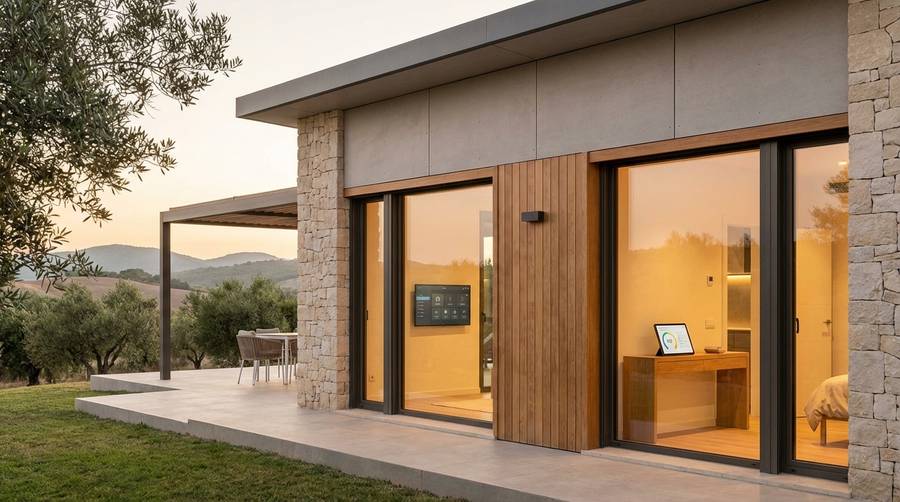
Smart home integration focused on energy efficiency and comfort
- Use cases: predictive heating tied to weather forecasts, automated ventilation demand control, and demand-response ready systems for grid interaction.
- Design principle: place sensors and actuators to maximize energy gains while keeping interfaces intuitive for occupants.
Bioclimatic design and Passivhaus principles applied to modules
Modules must be conceived as parts of an overall environmental strategy:
- Orientation and shading layered into modular layouts.
- Compact volumes to reduce transmission losses.
- High-performance windows and thermal breaks integrated in factory conditions.
Digitalization: BIM, digital twins and post-delivery monitoring
Digital continuity—from design to operation—reduces errors and enables performance verification. Expect production models exported directly from BIM to factory CAM systems and a lightweight digital twin for warranty monitoring.
Materials and systems: real impact on efficiency and carbon footprint
Choosing the right structural system is a trade-off among carbon, cost, speed and durability. Here’s a practical, comparative view.
Quantitative comparison: industrialized concrete vs light timber frame vs steel frame
- Industrialized concrete: High embodied carbon, excellent thermal mass and fire performance; well-suited in coastal or humid sites when combined with low-embodied cement alternatives.
- Light timber frame: Low embodied carbon, fast assembly, high thermal efficiency when detailed correctly; requires moisture protection and insect treatment planning.
- Steel frame: High precision and long spans; higher embodied carbon than timber but can be recycled easily. Best when paired with external insulation layers to avoid thermal bridging.
Life-cycle analysis and metrics relevant to Passivhaus
Key metrics to request from providers:
- Embodied carbon (kg CO2e/m²) for structural frame and envelope.
- Primary energy demand (kWh/m².year) and measured heating demand post-occupancy.
- Airtightness target (n50) and in-factory QA results.
Material selection by cost, lead time and thermal performance
A pragmatic selection matrix:
- Lowest embodied carbon: certified timber systems.
- Shortest lead time: modular panels in factory production runs.
- Best thermal performance: multi-layered envelopes with continuous insulation and high-performance glazing.
The optimized turnkey process for self-builders
Turnkey industrialized delivery must be transparent and stage-gated. Self-builders need clarity at every milestone.
Key phases: land search, design, manufacture, assembly and handover
- Land feasibility: site reports, orientation, access and local code review.
- Design & approvals: Schematic to detailed design in BIM; permits obtained before factory work begins.
- Manufacture: off-site fabrication with QA records and traceable materials.
- Assembly: condensed site schedule with defined scope for civil works and connections.
- Handover: commissioning, airtightness testing and digital twin provision plus warranty documentation.
Financing models and accessibility: self-build mortgages and alternatives
Financing options have matured. Key paths:
- Self-build mortgage: staged draws aligned to manufacturing and assembly milestones reduce borrower exposure.
- Developer-financed turnkey: single-price offers with warranty but less flexibility on customization.
- Mixed models: private lenders or cooperatives funding early phases, with standard mortgage conversion on completion.
Common risks and how to mitigate them
- Schedule slippage: insist on factory QA metrics and penalty clauses for delayed assembly.
- Performance gap: require pre-delivery airtightness and thermal tests and post-occupancy monitoring clauses.
- Communication failures: stage-gated approvals and a single point of contact are non-negotiable.
Case studies: real data on times, costs and satisfaction
Below are anonymized, benchmarked summaries based on projects delivered in Mediterranean Spain between 2023–2025. Data emphasize reproducible metrics, not vendor claims.
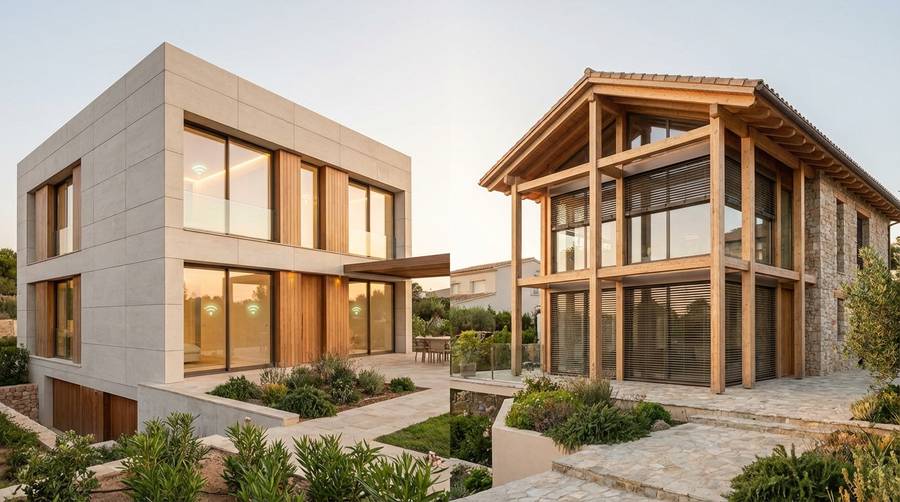
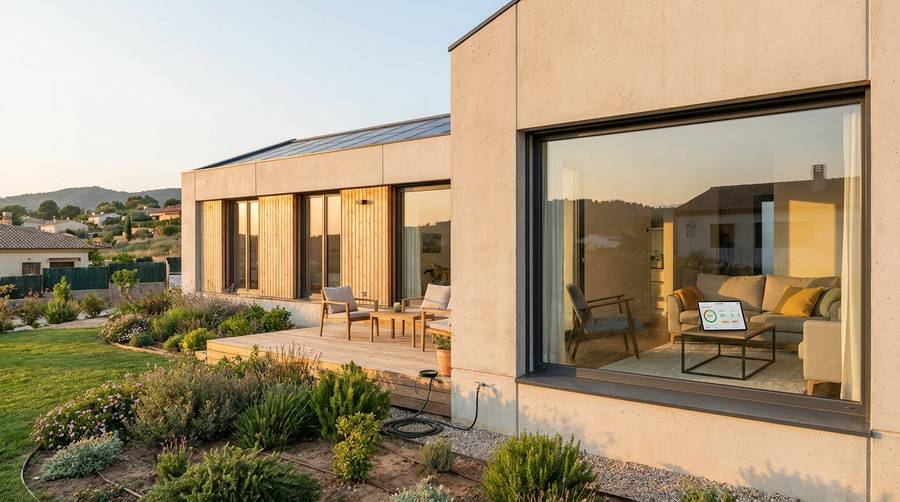
Case 1 — Passivhaus home in a Mediterranean setting
- Footprint: 140 m² net living area.
- Timeline: 6 months design & permitting, 8 weeks factory, 4 weeks site assembly.
- Cost: €1,650/m² turnkey (including site works).
- Energy: measured heating demand 8 kWh/m²·year; energy bills down ~78% vs local baseline.
- Satisfaction: owners rated overall process 4.6/5, citing predictability and comfort.
Case 2 — Turnkey domotic project: comfort metrics and ROI
- Approach: integrated HVAC, ventilation with demand control, and simple occupant app.
- Results: 25% reduction in occupant-reported discomfort events and estimated 12% energy savings beyond envelope gains.
- Payback: incremental cost for smart systems recovered in 7–10 years via energy and comfort benefits in this climate.
Lessons and benchmarks for Spanish self-builders
- Early clarity on budget and program reduces change orders.
- Demand measurable guarantees (airtightness, U-values) and insist on post-occupancy checks.
- Choose materials and systems matched to site-specific risks (humidity, coastal salt, seismic zones).
Technical comparison with competitors: how to choose a provider
Choosing the right partner requires a structured assessment of performance, service and financial terms.
Technical checklist to evaluate proposals
- Declared U-values for all envelope components.
- Airtightness target and factory testing records.
- Material certifications and lifecycle data.
- Service definitions: commissioning, defects period, and post-occupancy support.
Key indicators: delivery time, budget deviation and measured efficiency
Ask for historical averages and deviations:
- Average time from contract to delivery (weeks).
- Realized vs quoted budget deviations (%) across comparable projects.
- Measured heating demand for completed comparable homes (kWh/m²·year).
How to read commercial offers without bias
Don’t be swayed by glossy brochures. Require hard evidence:
- Third-party test reports (blower door, U-value certificates).
- Documented post-occupancy results from at least two completed homes.
- Clear change-order pricing and warranty scope in the contract.
Practical guide: designing your modular Passivhaus home step by step (2026)
This checklist converts strategy into action for self-builders who want control without getting bogged down.
Decisions before commissioning: program, budget and local rules
- Define spaces, priorities and fixed budget bands.
- Obtain a site report and confirm local height, footprint and connection constraints.
- Decide upfront on the level of finish and smart features to avoid scope creep.
Collaborative design with architect and industrializer: deliverables and milestones
- Schematic design and energy targets (Passivhaus or near-Passivhaus).
- Detailed BIM files for factory production and permit submission.
- Production release after permit and financing secured.
Handover checklist and domotics commissioning
- Airtightness and thermal imaging reports.
- Commissioning certificate for mechanical systems and ventilation.
- Digital twin delivery and user training for occupants on smart systems.
For an in-depth case study on a completed Passivhaus project with mortgage context, see Casa prefabricada Passivhaus: caso de éxito real. For common errors and fixes related to smart homes and Passivhaus delivery, refer to Casa prefabricada Passivhaus: errores y soluciones. For a technical comparison that helps decide the right package, consult Vivienda industrializada Passivhaus: comparativa y decisiones.
Closing: opportunities and recommendations for visionary self-builders
Summary of competitive advantages and manageable risks
Advantages: faster delivery, predictable budgets, measurable energy savings and improved comfort. Manageable risks: performance gaps and financing complexity—addressable with clear contracts and staged monitoring.
Decision priorities for 2026: sustainability, service and financing
- Prioritize verified energy performance over aesthetic promises.
- Choose providers with comprehensive warranties and digital monitoring.
- Structure financing around production milestones to reduce exposure.
Next steps: metrics to track and how to get expert help
Track these core metrics during selection and after delivery:
- Embodied carbon (kg CO2e/m²)
- Airtightness (n50)
- Measured heating demand (kWh/m²·year)
- Delivery time and budget deviation (%)
If you are planning a self-build in Spain, start by asking shortlisted providers for documented test results and post-occupancy data. If you want a structured review of proposals or a neutral checklist to evaluate offers, contact specialized advisors who combine architectural and industrialized housing experience.
Call to action: Reflect on which of the above metrics matter most for your project and reach out to experts who can translate those priorities into a realistic turnkey plan.