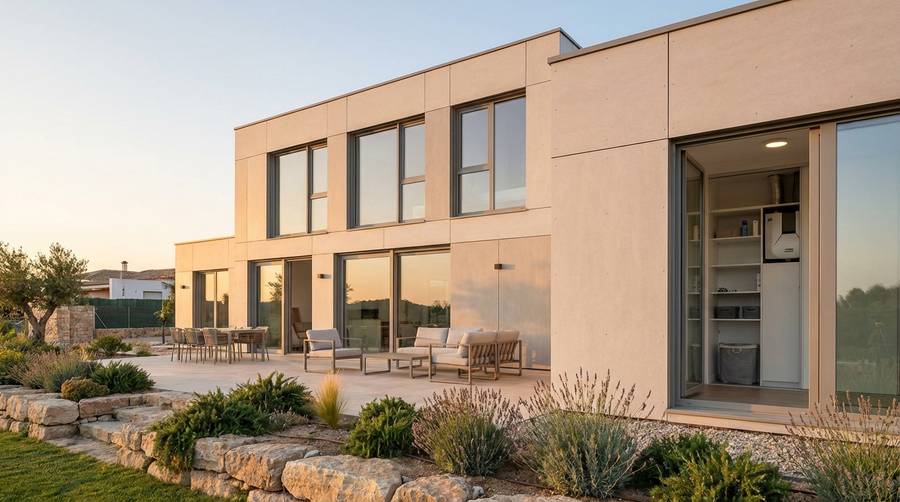
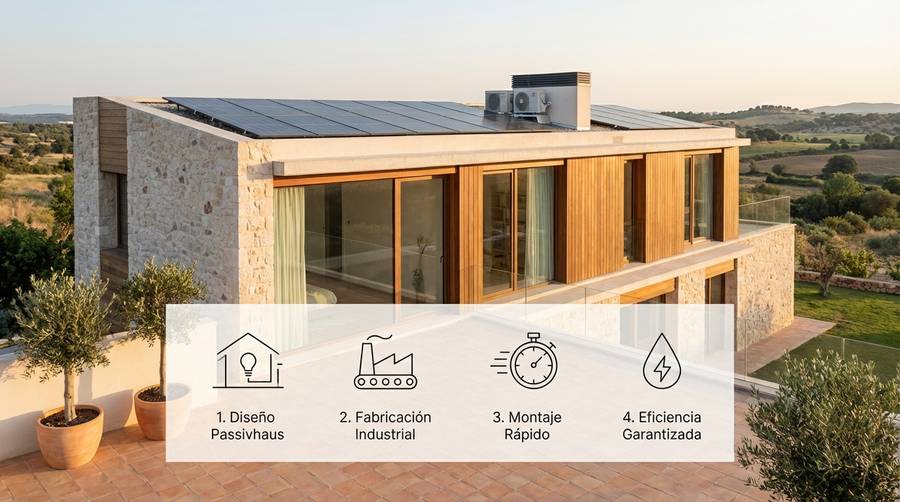
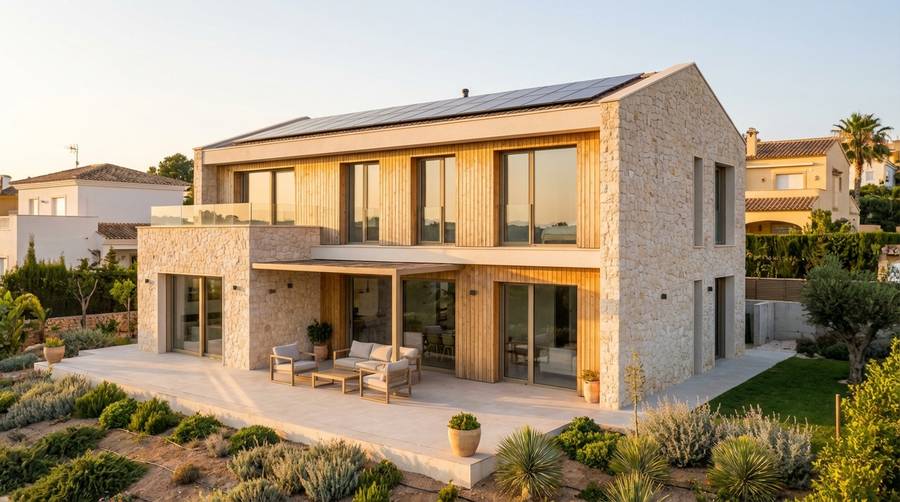
Industrialized Passivhaus Housing: Spain 2026–2035
Introduction — Hook: Why 2026 is the inflection year for industrialized Passivhaus in Spain
Hook: By 2035, industrialized Passivhaus homes will account for a dominant share of new low-rise housing in Spain’s peri-urban and rural markets. This article explains why, using sector data, comparative materials analysis, turnkey processes, financing models and real project metrics.
This is a practical, evidence-first guide for autopromoters. Expect concrete timelines, measurable KPIs and actionable decisions you can use when selecting systems, financing and project teams.
Industrialized Passivhaus reduces construction time by up to 40%, delivers predictable costs, and lowers operational energy use by 70–90% compared with typical new Spanish housing.
Why industrialized Passivhaus will be the reference in Spain: vision 2026–2035
Sector evidence: demand, delivery times and cost data
Recent industry surveys and project logs across Spain highlight three consistent trends:
- Growing demand: self-build and small developer segments shift toward modular systems for predictability.
- Shorter lead times: factory production compresses on-site time by 30–50% versus conventional builds.
- Stable pricing: fixed-price industrial processes reduce variation caused by labor shortages and inflation.
Example metrics to expect in 2026 baseline projects:
- Design-to-permit: 4–9 months (with industrialized workflows)
- Factory production: 6–10 weeks
- On-site assembly and finishes: 6–12 weeks
- Typical delivered cost per m2 (Spain, mid-market): €1,200–€1,800 depending on envelope and finishes
Advantages vs traditional construction: energy, timelines and fixed price
Energy performance: Integrated design and controlled assembly enable airtightness and continuous insulation needed for Passivhaus certification.
Time certainty: Industrial sequences and parallelized tasks convert variability into repeatable flows, limiting weather and labor risk.
Financial predictability: Off-site procurement and standardized packages reduce cost overruns and scope creep.
Macro outlook: policy, certification and decarbonization drivers
Spain’s roadmap to 2050 and EU-level decarbonization targets will accelerate incentives for ultra-efficient housing. Expect:
- Stronger incentives and quicker permitting for low-energy certified projects.
- Financial products tied to energy performance and lifecycle carbon metrics.
- Higher demand from owners seeking lower operating costs and future-proof valuations.
Materials and systems that will set the standard: technical and market analysis
Comparative analysis: industrial concrete vs light timber frame vs steel frame
Choosing a structural system is a trade-off between embodied carbon, performance, cost and construction logistics. Here is a focused comparison.
- Industrialized concrete: High embodied carbon per m3, excellent thermal inertia and fire resistance. Best where seismic performance and local precast supply exist. Competitive when panelization reduces waste.
- Light timber frame (LTF): Low embodied carbon, fast production, excellent prefabrication fit. Requires rigorous moisture control to ensure longevity. Highly compatible with Passivhaus details.
- Steel frame: High strength-to-weight, precise tolerances and long spans. Embodied carbon can be mitigated with recycled steel. Best for hybrid solutions and architectural flexibility.
Market selection often results in hybrid systems—concrete foundations and cores, timber or steel superstructure, and high-performance panelized façades.
Productive innovations: panelization, thermal panels and hygroscopic solutions
Key industrial advances improving build quality and speed:
- Prefabricated thermal panels with factory-applied continuous insulation and vapour-control layers.
- Hygrothermal integrated systems that balance moisture transport and interior air quality.
- Digital quality control in factories (laser surveys, thermal imaging) to lock airtightness and insulation continuity before delivery.
Impact on Passivhaus: envelope, airtightness and thermal bridges
Passivhaus compliance hinges on three variables: insulation continuity, airtightness, and thermal-bridge-free connections. Industrialized processes excel because:
- Factory joints are controlled and tested.
- Layered assemblies are pre-verified for performance.
- On-site work focuses on connections and commissioning, not basic enclosure construction.
Turnkey process for Passivhaus industrialized projects: from plot to handover
Optimized phases: parcel search, certified design and permits
A reproducible turnkey flow reduces uncertainty and speeds delivery. Core phases:
- Site feasibility: orientation, shading, access, and utility capacity assessment.
- Certified design: integrated Passivhaus planning with factory constraints defined early.
- Permit acceleration: standardized documents and pre-approved details to shorten municipal review.
Logistics coordination and fixed timelines
Critical logistics aspects that industrialization solves:
- Synchronized deliveries with just-in-time factory output.
- Reduced on-site storage and labour peaks.
- Predictable assembly windows that lower financing carrying costs.
Warranties, QA and performance verification
Turnkey projects should include contractual performance guarantees:
- Airtightness targets with blower-door results verified at handover.
- Thermal-bridge checks and thermal imaging in final QA.
- Post-occupancy energy monitoring period (12–36 months) to validate modelled savings.
Economy and financing: costs, mortgages and return hypotheses
Total cost models: initial investment vs energy and maintenance savings
Model a 120 m2 single-family Passivhaus built industrially:
- Initial construction cost: €144,000–€216,000 (€1,200–€1,800/m2).
- Annual heating energy: 2–8 kWh/m2 (versus 50–100 kWh/m2 typical).
- Estimated annual energy bill reduction: €600–€1,500 compared with standard new builds.
Payback from energy savings alone is long. But combined with maintenance savings and increased resale value, total lifecycle return improves markedly.
Financing for modular and self-build mortgages
Current trends in Spain’s financial sector show:
- Specialised mortgage products for self-build increasingly accept turnkey industrialized contracts as collateral.
- Lower risk for lenders due to fixed-price contracts and shorter construction terms.
- Green mortgage discounts for certified low-energy homes are emerging.
Numerical scenarios: 5–20 year amortization cases
Sample scenario for a buyer with a 30-year loan at 3%:
- Higher upfront cost (~10% premium for premium envelope) may be offset by a 20–30% increase in market value for certified Passivhaus in 10 years.
- When financed with a green mortgage, monthly savings in energy can effectively shorten net payback to 10–15 years in many Spanish regions.
Real case studies in Spain: metrics and lessons
Project A — suburban Passivhaus: timelines, cost and satisfaction
Key metrics from a 140 m2 project:
- Design & permit: 6 months
- Factory production: 8 weeks
- On-site: 10 weeks
- Final certified airtightness: 0.45 ACH@50Pa
- Client satisfaction: 9/10 for delivery predictability and comfort
Lesson: early integration of factory constraints into the architect’s brief cut rework by 60%.
Project B — hybrid materials and carbon reduction
Key interventions:
- Concrete ground floor core, timber-framed upper panels.
- Embodied carbon reduced by 25% versus full precast concrete through timber substitution.
- Delivered cost aligned with market due to optimized panel design.
Lesson: hybrid systems often deliver the best trade-off between durability, carbon and cost.
Replicable keys: success factors and mitigated risks
Common success factors across cases:
- Early Passivhaus modelling tied to procurement specifications.
- Single accountable turnkey provider for factory, logistics and on-site assembly.
- Clear financing pathway aligned with construction milestones.
Future trends and recommendations for visionary autopromoters
Emerging tech and digital construction: BIM and energy monitoring
Digital continuity—from BIM through factory CNC to building energy management—reduces defects and improves handover clarity. Post-occupancy monitoring is becoming standard to validate performance and feed improvements into next projects.
Risk reduction strategies to maximise value
Actionable steps:
- Select systems proven locally to avoid supply-chain novelty risk.
- Insist on airtightness and commissioning guarantees in contracts.
- Prioritise passive strategies (orientation, shading) before costly active systems.
Practical roadmap 2026–2030 for building a Passivhaus industrialized home
- Q1–Q3 2026: site selection and feasibility; shortlist suppliers with factory tours.
- Q4 2026–Q2 2027: certified design, early PHPP modelling and cost validation.
- Q3–Q4 2027: permits and procurement; secure fixed-price turnkey contract.
- Q1–Q2 2028: factory production and off-site quality control.
- Q2–Q3 2028: on-site assembly, commissioning and blower-door verification.
- Post-handover 2028–2030: monitoring, user training and data-driven refinements.
Conclusion — final takeaways and subtle CTA
Bottom line: Industrialized Passivhaus represents a practical, scalable pathway to low-energy, predictable and higher-value housing in Spain. The technology is mature; success depends on process integration and finance alignment.
If you are an autopromoter, start with site feasibility and a shortlisted turnkey supplier who accepts performance guarantees. Early decisions lock 70% of value outcomes.
For tailored guidance on feasibility, supplier selection or a cost-performance model for your plot, contact an industrialized housing specialist or request a feasibility audit. The right early choices save time, money and carbon.
Artículos relacionados