Industrialized Housing in the Mediterranean (2026–2035)
Why industrialized housing will lead the Mediterranean market (vision 2026–2035)
Hook: By 2030, industrialized housing will no longer be an alternative— it will be the standard route for efficient, sustainable Mediterranean homes in Spain. The convergence of policy, supply-chain maturity and proven technical performance is shifting risk away from the plot and into controlled factory processes. This article explains why—and what autopromoters must do now to benefit.
Sector trends: production, demand and policy signals in Spain
Recent industry surveys and manufacturing aggregates indicate a consistent annual growth in modular and prefabricated production of 8–12% in Spain since 2022. Key drivers:
- Shorter construction cycles reducing exposure to price inflation.
- Regulatory incentives for energy-efficient buildings aligned with EU carbon goals.
- Increasing bank familiarity with industrialized models, easing financing for autopromotores.
What to watch 2026–2035: zoning updates favoring off-site methods, more local factory capacity, and standardized component certifications that will lower compliance friction.
Competitive advantages vs traditional building: time, cost and quality control
Industrialized processes shift work from variable on-site conditions to controlled factory environments. That yields three measurable advantages:
- Time certainty: on-site assembly windows shrink to weeks; overall delivery typically 30–50% faster than comparable traditional builds.
- Price predictability: fixed-price contracts become realistic because fewer scope changes occur during build.
- Quality assurance: factory testing, repeatable assembly and traceable materials reduce defects and rework.
Impact on sustainability and carbon-reduction goals
Industrialized housing facilitates thermal envelope precision and material optimization. When combined with Passivhaus-inspired design strategies, it delivers:
- Lower operational energy demand (often >70% reduction vs pre-2000 stock).
- Reduced embodied carbon through material-efficient systems and local sourcing.
- Less waste on site—factory cut-offs are quantified and more easily recycled.
Fact: A mid-size modular Mediterranean home built under industrialized processes can reduce on-site waste by up to 60% and construction time by nearly half compared to traditional builds.
How Mediterranean industrialized homes are designed today: step-by-step guide
Choosing typologies and materials: industrialized concrete, light timber frame and steel frame
Three material families dominate contemporary Mediterranean industrialized housing. Each suits different priorities:
- Industrialized concrete: excellent for thermal mass, durability and fire resistance. Best for coastal sites needing robustness and acoustic performance.
- Light timber frame: highest speed in factory manufacture, excellent embodied carbon profile, and natural finish options that fit Mediterranean aesthetics.
- Steel frame: ideal for larger spans, open-plan layouts and mixed-use ground floors; combines with insulated panels for high-performance envelopes.
Selection should be driven by site constraints, budget envelope and target performance (e.g., Passivhaus certification goals).
Turnkey process: from plot search to final delivery
Efficient turnkey projects follow a predictable sequence. For autopromotores, understanding each stage reduces surprises:
- Plot analysis: legal constraints, access, orientation, microclimate and utilities.
- Design phase: volumetrics, envelope strategy, material palette and cost model.
- Factory production: component fabrication, QA testing and logistics planning.
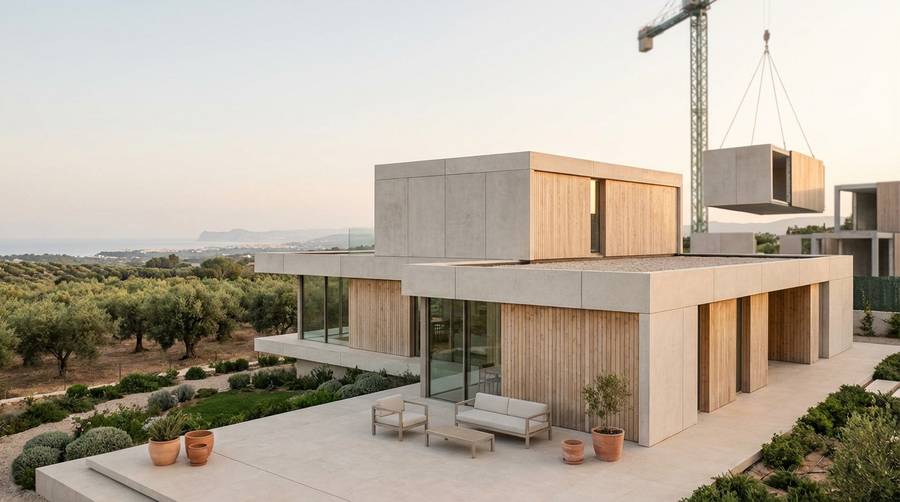
- On-site assembly: foundation, craning and envelope sealing—typically the shortest phase.
- Commissioning and handover: systems testing, client walkthrough and warranty activation.
Practical tip: insist on a detailed production and logistics plan in the contract—delays more often happen in transport and on-site sequencing than in fabrication.
Energy-efficiency criteria and Passivhaus principles for Mediterranean architecture
Applying Passivhaus in a Mediterranean context requires adaptation: focus on summer overheating control as much as winter heat retention. Key measures:
- High-performance envelope with continuous insulation and air-tightness detailing.
- Shading strategies: overhangs, brise-soleil and deciduous planting.
- Balanced ventilation with heat recovery tuned for humid, warm seasons.
Industrialized systems enable precision in these areas, making certification or equivalent performance targets more cost-effective.
Case studies: real projects and key metrics
Project A: execution times, cost per m² and client satisfaction
Summary: A 160 m² single-family Mediterranean home built using a hybrid system (concrete base + timber upper modules).
- Turnkey delivery in 24 weeks from contract (design + factory + onsite).
- Final cost: €1,650/m² (including landscaping and utility connections).
- Client satisfaction: 4.7/5 at 12 months—high marks for acoustic comfort and indoor air quality.
Lesson: early integration of landscaping and shading produced immediate occupant comfort gains during first summer.
Project B: annual energy savings and emissions reduction vs traditional build
Summary: A 120 m² Passivhaus-informed prefabricated dwelling with timber frame.
- Measured primary energy use: 28 kWh/m²·year (heating + cooling + hot water).
- Operational CO2 reduction: ~75% vs a local-code-built traditional home of comparable size.
- Embodied carbon advantage: optimized panelized timber reduced material CO2 by ~20% against standard concrete-heavy designs.
Lesson: coupling material choice with envelope rigor delivers both operating and embodied carbon wins.
Lessons learned and replicable best practices for self-builders
- Lock down the plot and orientation before detailed design to avoid costly rework.
- Choose suppliers with documented logistics experience in Spain—transport windows and crane availability are common bottlenecks.
- Include performance targets (air-tightness, thermal bridges) in the contract with measurable acceptance criteria.
Technical and economic comparison: prefabricated vs traditional (industrial data)
Analysis of direct and indirect costs: initial budget, variability and fixed-price guarantees
Direct costs (materials, fabrication, assembly) are often comparable or slightly higher for prefabricated solutions. The decisive advantage lies in indirect costs: shorter financing periods, fewer change orders and lower site overhead. Typical breakdown:
- Traditional: lower initial contractor bids but higher contingency for overruns (8–15%).
- Prefabricated: slightly higher base cost but with a predictable fixed-price component and lower contingency (3–7%).
For autopromotores, the fixed-price predictability frequently outweighs minor unit-cost premiums.
Risks and mitigations: factory quality control, logistics and on-site assembly
Top risks and practical mitigations:
- Logistics delays: mitigate with early route surveys and contingency crane bookings.
- Interface errors on site: require clear as-built tolerances and mock-up panels tested before shipment.
- Regulatory interpretations: align with local building control early and use documented precedents.
Value indicators: durability, maintenance and resale premium
Industrialized homes designed with durable external finishes and serviceable systems show lower maintenance over 10–20 years. Early market data suggests a modest resale premium where quality and energy performance are certified—buyers increasingly value verified energy bills and comfort metrics.
Financing and access: mortgages for self-build and modern financial models
Mortgage options for modular housing in Spain and common requirements
Spanish lenders have adapted to industrialized housing. Typical options include:
- Construction-to-permanent mortgages that disburse on milestones (design, factory start, on-site assembly, completion).
- Specialized autopromoción loans supporting turnkey projects, often requiring controlled escrow accounts.
Common lender requirements: certified budgets, delivery schedule, factory certifications and proven contractor track record. Early engagement with banks reduces underwriting friction.
Payment models and financial schedule for turnkey projects
Common payment cadence:
- 15–25% on contract signature (design development)
- 40–50% at factory start/production milestone
- 20–25% on on-site assembly completion
- Retentions (5–10%) released after commissioning
Recommendation: negotiate retention release based on measurable performance (air tightness, systems commissioning).
How to convince banks: metrics and documentation to prepare
To secure favorable financing present:
- Detailed turnkey contract with fixed-price clauses and delivery schedule.
- Factory QA records and third-party certifications (CE marks, structural reports).
- Operational performance projections (kWh/m²·year) and, if available, measured data from previous projects.
Future opportunities for Mediterranean self-builders
Emerging innovations: digitalization, scalable industrialization and local supply chains
Three converging innovations will accelerate adoption:
- Digital design-to-fabrication workflows: BIM-integrated panel manufacture reduces errors and accelerates approvals.
- Modular standardization: families of repeatable components that lower per-unit costs when scaled regionally.
- Localized value chains: regional factories shorten logistics and strengthen supplier accountability.
Market scenarios 2026–2035: demand, regulation and the role of sustainability commitments
Scenario A (accelerated adoption): supportive regulation and subsidies push modular share to 25–30% of new single-family builds. Scenario B (steady growth): continued gradual adoption with strong niches in self-build. Across scenarios, sustainability commitments will be a major differentiator for buyers and lenders.
How self-builders should prepare: strategic checklist
- Define performance targets (energy, acoustic, durability) before selecting systems.
- Shortlist manufacturers with Spanish project references and logistics capability.
- Secure conditional financing pre-design to strengthen negotiating position.
- Document decision points (materials, façade treatments, MEP interfaces) early to avoid scope creep.
Closing inspiration: build today the Mediterranean home of tomorrow
Summary of benefits and actionable first steps
Industrialized housing brings measurable advantages for Mediterranean self-builders: predictable schedules, superior quality control and clear pathways to low-energy performance. Actionable first steps:
- Assess your plot against orientation and shading opportunities.
- Set clear performance targets (e.g., kWh/m²·year, airtightness level).
- Request factory QA dossiers and logistics plans from prospective suppliers.
- Talk to lenders early and prepare the documents listed above.
For a practical comparison between processes, see Casa prefabricada vs tradicional: guía para autopromotores.
Recommended resources and next moves for self-builders
- Collect three turnkey proposals with full cashflow schedules.
- Visit one factory and one completed project to validate claims.
- Ask for independent performance verification (blower door, thermal imaging) at handover.
Call to action: If you are planning a Mediterranean self-build, start by compiling performance targets and site data—contact a qualified industrialized housing advisor to convert those targets into a realistic turnkey proposal tailored for Spain’s market.
Artículos relacionados