


Prefabricated Houses Spain: Market Outlook 2026–2035
Introduction — Hook: Why 2026 is the tipping point for prefabricated houses in Spain
Hook: By 2028, industrialized housing could account for a double-digit share of new single-family homes in Spain if current adoption rates and regulatory trends continue. This article explains the data and the practical steps autopromoters need to take now to benefit.
This in-depth analysis combines industry metrics, technical comparisons, case studies and actionable guidance. Read on if you are planning a self-build, advising clients, or evaluating investment in modular construction.
Industrialized housing reduces on-site labor by up to 60% and cuts time-to-handover by half compared with traditional builds — a structural advantage as labor shortages and material volatility persist.
Why prefabricated houses will dominate Spain's residential market (vision 2026–2035)
Market trends and industry projections based on data
Three measurable drivers are converging: rising construction costs, a persistent skilled-labor gap, and stronger policy incentives for energy-efficient housing. Recent surveys and municipal permits show steady growth in offsite construction enquiries — a lead indicator that market share will expand.
- Cost pressure: Volatility in raw materials drives demand for fixed-price industrialized solutions.
- Time-to-completion: Faster production cycles mean developers and self-builders can reduce financing costs and market time.
- Regulation: Stricter energy codes and incentives for low-carbon buildings favor factory-controlled assembly that delivers predictable performance.
Competitive advantages vs traditional construction: efficiency, closed schedules and fixed price
Prefabricated processes transfer many variables into a controlled factory environment. That results in three practical advantages:
- Predictable schedules: Weather-independent production avoids seasonal slowdowns common in on-site builds.
- Fixed-price contracting: Clear scope and modular packages reduce scope creep and change orders.
- Higher quality control: Repeatable processes and factory testing lower defect rates at handover.
Current barriers and regulatory and demand opportunities
Barriers remain: municipal permit processes are still oriented to site-built norms; financing instruments for self-builders are evolving but not universal. However, EU and Spanish climate targets create incentives for whole-building certification (e.g., Passivhaus-aligned solutions) that factory processes can deliver more reliably.
Materials and construction systems that will shape the next decade
Industrialized concrete: performance, durability and use cases
Industrialized precast and tilt-up systems are no longer crude. Modern mixes, thermal breaks and integrated insulation produce durable envelopes with predictable thermal mass. Ideal applications include multi-level suburban homes and basements where moisture and robustness matter.
- Advantages: fire resistance, structural continuity, longevity.
- Considerations: heavier logistics and crane requirements at site.
Light timber framing and steel frame: technical comparison and energy performance
Entramado ligero de madera (light timber frame) and steel frame are leading choices for single-family prefabricated homes in Spain because of their lightweight transportability and thermal performance.
- Timber frame: Excellent embodied-carbon profile, rapid on-site assembly, strong thermal properties when coupled with modern airtight detailing.
- Steel frame: Higher strength-to-weight ratio; suitable for open-plan layouts and larger spans but requires attention to thermal bridging.
Both systems can achieve Passivhaus-level performance when paired with controlled airtightness processes and high-performance insulation.
Innovations in sustainable materials and their impact on carbon footprint
New materials — cross-laminated timber (CLT) variants, low-carbon concrete, and recycled insulation materials — are reducing embodied carbon. The net effect: industrialized homes can lower lifetime CO2e by 20–40% relative to typical brick-and-block houses when considering both construction and operational phases.
How to design an industrialized house step-by-step in Spain (Guide 2026)
Choosing a plot and regulatory checks: key factors
Selecting a plot is not only about orientation and views. For industrialized homes, logistical and regulatory checks are critical:
- Access for delivery: Road width, turning radii and crane placement.
- Foundations and topography: Does the parcel require deep excavation or can a simplified slab suffice?
- Local planning rules: Maximum height, facade materials and thermal envelope requirements.
Turnkey process: timeline, milestones and responsibilities (from project to handover)
A realistic turnkey timeline for a medium-size single-family prefab home in Spain looks like this:
- Design & permitting: 3–6 months
- Factory production: 6–10 weeks
- Site works & foundations: 4–8 weeks (can overlap with factory work)
- On-site assembly & services connection: 2–6 weeks
- Fit-out & handover: 2–4 weeks
Responsibility matrix: The turnkey provider usually assumes factory production, offsite QA and final assembly. The client or a local technical coordinator often handles permits, utilities and land survey unless specified in the contract.
Customization vs standardization: design decisions, costs and estimated timings
Customization increases lead time and cost. A practical approach is a modular catalog with certified performance packages:
- Standardized modules: Lower cost, shorter delivery times, proven performance.
- Tailored options: Façade finishes, interior layouts and upgraded systems — add 10–25% to cost and 4–8 weeks to production.
Financing models and mortgages for modular self-builds
Financing options specific to Spain and common requirements
Financing modular self-builds in Spain typically follows two paths:
- Self-build mortgages: Tranches released against milestones (land, foundations, structural completion, final handover).
- Developer-style mortgages: Fixed-price turnkey contracts with a final mortgage upon completion.
Key lender requirements: certified construction schedule, technical project, and a fixed-price turnkey contract to mitigate valuation risk.
Cost-benefit analysis: numeric financing examples
Example model for a 150 m2 prefab home (numbers illustrative):
- Land: €120,000
- Turnkey prefab house: €210,000 (including installation)
- Other costs (permits, connections, taxes): €30,000
- Total project: €360,000
Assuming a mortgage covering 80% of total cost, the borrower finances €288,000. Shorter construction times reduce interest during build and lower overall borrowing costs versus a protracted site-built project.
Strategies to negotiate self-build mortgages and practical tips
- Secure a detailed turnkey contract and schedule to present to the bank.
- Ask lenders for tranche releases aligned to factory milestones to minimize inspection delays.
- Obtain independent technical reports that validate quality and completion forecasts.
Real case studies: metrics, outcomes and actionable lessons
Case A: reduced timelines and cost control (times, budget and deviations)
Project profile: 180 m2 single-family home near Valencia. Key metrics:
- Planned vs actual timeline: 5 months planned (including site works), 5.5 months actual — 10% overrun due to municipal inspection timing.
- Budget variance: +3% due to custom finishes requested mid-production (managed via change order protocol).
Lesson: Fixed-price core plus a predefined upgrade list reduces scope creep and keeps deviations predictable.
Case B: Passivhaus objective and measured efficiency and carbon footprint
Project profile: 140 m2 timber-frame home targeting Passivhaus certification.
- Airtightness achieved: 0.6 ACH @50 Pa (target < 0.6)
- Heating demand: 12 kWh/m2·year
- Embodied carbon reduction vs brick-and-block benchmark: ~28%
Lesson: Factory-applied airtightness and integrated thermal bridge details make certification practical and repeatable.
Customer satisfaction and after-sales: KPIs and recommendations
Satisfaction correlates with clear expectations at contract signing and a short, transparent defects period. Recommended KPIs to track:
- Time to first contact after handover for defect reporting
- Number of defects per home at 3 and 12 months
- Measured energy consumption vs predicted (first-year reconciliation)
Technical comparison: industrialized housing vs traditional builds
Energy efficiency and total cost of ownership (TCO) over medium to long term
Operational energy savings often justify a moderate premium on upfront cost. When modeled over 30 years, a well-executed prefab home with Passivhaus-level performance can lower TCO by 10–25% through lower energy bills and reduced maintenance.
Execution timelines, quality control and frequent risks
Factory production shortens on-site exposure to risks (weather, theft, local labor variability). The most frequent risk is poor coordination between foundation works and module delivery — solvable via early logistic planning and a dedicated project manager.
Benchmarking against competitors: objective metrics without commercial bias
Key objective metrics to compare providers:
- Factory defect rate (reported per 100 homes)
- Average assembly time on site
- Measured vs guaranteed thermal performance
How to prepare today to build the prefabricated house of tomorrow
Actionable checklist for self-builders: from plot to financing
Essential checklist:
- Confirm land access and crane feasibility.
- Obtain preliminary energy target (e.g., Passivhaus intention) to size systems early.
- Request turnkey quotes with line-item cost breakdowns and milestone schedule.
- Secure pre-approval for financing with tranche-based release.
- Plan for a 12–18 month total calendar from decision to handover.
Resources, supplier network and a model turnkey contract
Use a shortlist of certified suppliers who provide warranties on structural elements and airtightness. A model contract should include:
- Scope of supply with reference drawings
- Fixed price and change-order process
- Milestone-based payment schedule tied to measurable delivery events
- Warranty and after-sales service clauses
Trends to watch and strategic recommendations for 2026–2035
Watch for:
- Stronger financial products tailored to self-build modular projects.
- Municipal planning tools adapting to offsite construction logistics.
- Wider adoption of low-embodied-carbon material standards.
Strategic recommendation: Lock in suppliers early for critical long-lead items and prioritize airtightness and thermal bridge detailing in the contract.
Conclusion — Preparing for a future where industrialized housing is mainstream
Prefabricated houses in Spain offer a compelling combination of predictability, performance and lower lifecycle cost — provided projects are planned with industry-aware milestones, appropriate financing, and a focus on verified performance. For self-builders, the practical path is clear: choose a proven turnkey partner, define energy targets early, and secure tranche-based financing tied to measurable milestones.
Call to action: If you’re planning a self-build or advising clients, start with a feasibility review of your plot and a turnkey comparison using the checklist above — and consider partnering with providers who can guarantee factory-tested performance.
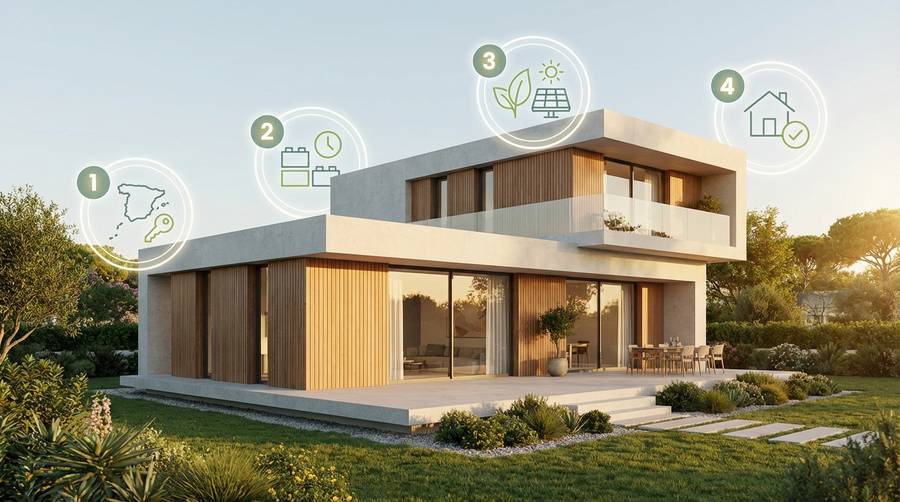
Image guidance for Findnido brand: High-quality real-estate photograph of a finished Mediterranean contemporary single-family home in Spain. Light-colored façade combining natural wood, soft exposed concrete and stone accents; large windows with warm golden-hour light; terrace and planted Mediterranean garden; human presence (family or couple) relaxed outdoors. Premium, magazine-style composition, natural colors and no visible module joints or construction equipment. Convey trust, comfort, sustainability and achievable modern living aligned with Findnido’s identity.
Artículos relacionados
Prefabricated House Guide: How to Build in Spain 2026
A practical, step-by-step guide for self-builders in Spain explaining why a prefabricated house is often faster, greener and more predictable than traditional builds — with materials guidance, financing options and two real case studies.
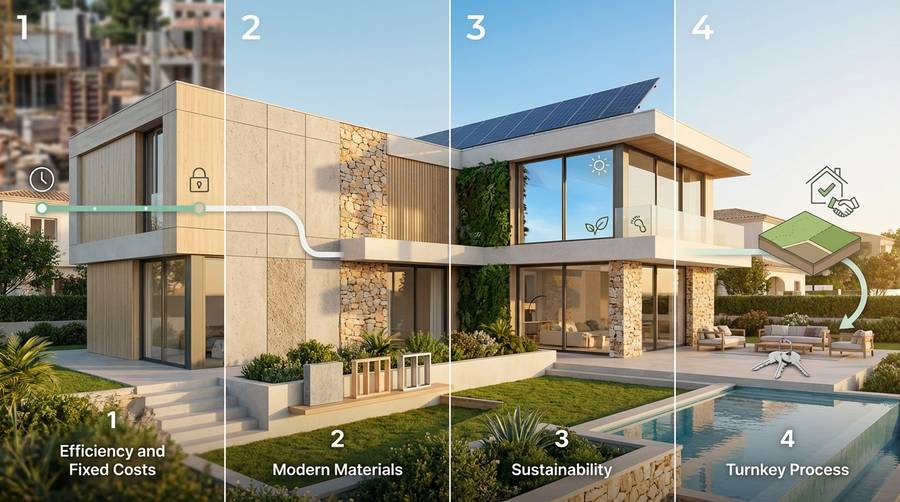
Top 4 Reasons to Choose a Prefabricated House in Spain
A concise, data-driven guide for self-builders in Spain: why prefabricated houses offer price certainty, shorter timelines, better energy performance and modern material choices — plus a practical turnkey roadmap and financing options.