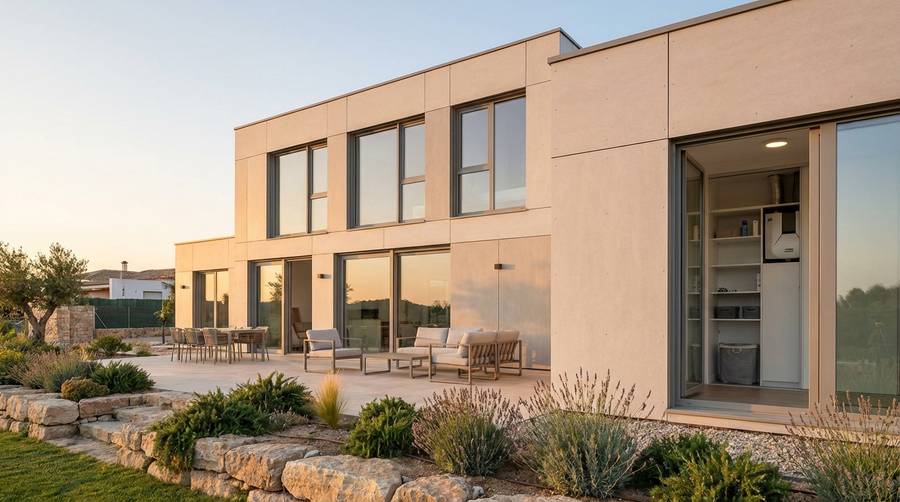
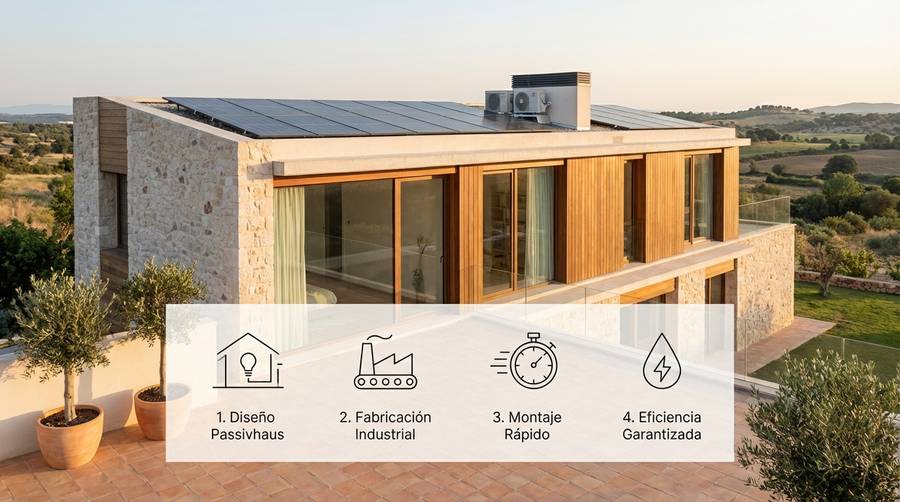
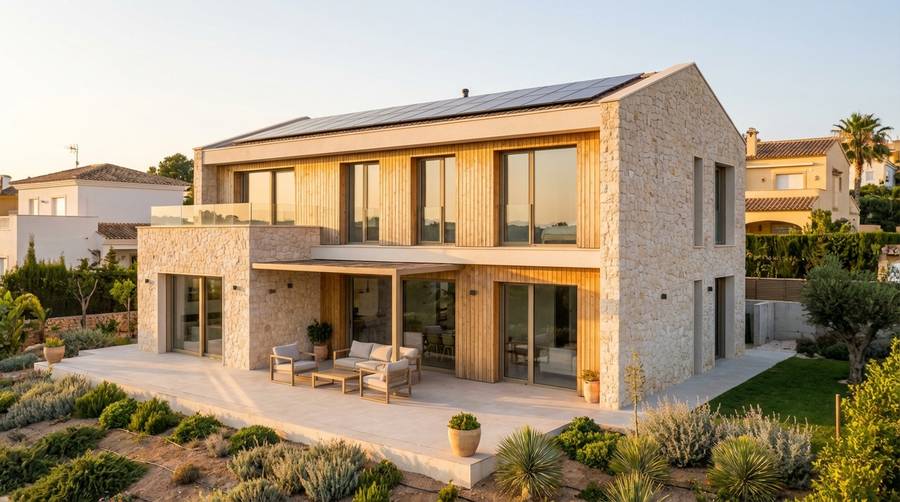
Industrialized Passivhaus Homes in Spain
Why choose an industrialized Passivhaus home in Spain: key advantages
Hook: If you want a high-performance home delivered on time, with predictable costs and low energy bills, an industrialized Passivhaus is the most pragmatic route in 2026 Spain.
Industrialized housing combines factory precision with field assembly. When designed to Passivhaus standards it adds demonstrable comfort and energy savings. Below are the core advantages:
- Energy efficiency and year-round comfort: fewer drafts, stable indoor temperatures and lower HVAC needs.
- Predictable schedules and fixed prices: factory workflows reduce weather delays and variation.
- Measurable carbon reductions: optimized assemblies and less construction waste.
- Quality control: repeatable factory checks lead to fewer defects on site.
Energy efficiency and comfort: what Passivhaus means in industrialized construction
Passivhaus in industrialized housing is not a marketing label. It has measurable targets: very low heating demand, strict airtightness and controlled ventilation. In practice this means:
- High-performance insulation: continuous layers designed and prefabricated to avoid thermal bridges.
- Tight envelopes: factory-made panel joints that are tested before assembly to ensure airtightness.
- Balanced mechanical ventilation (MVHR/VMC): with heat recovery sized to the home and commissioning protocols followed.
Delivery times and cost control: closed, fixed and predictable
Industrialized projects typically split into design/fabrication/assembly phases. Typical timelines (examples):
- Design + permitting: 2–4 months when a clear program exists.
- Factory production: 4–10 weeks depending on complexity.
- On-site assembly: 1–4 weeks for single-family homes excluding foundations.
These controlled steps translate into lower risk of cost overruns compared with traditional builds, because labour and time in the field are minimized.
Sustainability and carbon reduction: measurable benefits
Prefab processes reduce waste and enable optimized use of materials. Combined with Passivhaus performance, lifecycle carbon reductions are tangible:
- Lower operational carbon from reduced heating/cooling demand.
- Less construction waste and improved material yield in factories.
- Opportunity to choose low-carbon materials such as responsibly sourced timber or low-CO2 concrete mixes.
Real projects show operational energy savings of 70–90% versus a standard Spanish new build, while factory workflows cut waste by 30–50%.
How to design your industrialized home step by step (Practical guide 2026)
This section is a tactical roadmap you can follow with your project team. Each step includes what to decide, who should lead it and common pitfalls to avoid.
Define program and budget: needs, area and priorities
Start by creating a concise brief. Include:
- Number of bedrooms and principal uses (home office, storage, etc.).
- Net and gross square meters target.
- Priority list: energy performance, build time, upfront cost, aesthetics.
Tip: assign hard limits for budget and calendar before contacting manufacturers. This avoids scope creep.
Choose typologies and materials: industrialized concrete, timber frame and steel frame
Three common industrialized structural systems used in Spain:
- Industrialized concrete: robust, good acoustic mass, ideal for urban plots. Requires careful detailing for thermal breaks.
- Light timber frame (entracado ligero): fast, excellent thermal performance and low embodied carbon if timber is certified.
- Steel frame (steel frame): precise, slim floor-to-floor heights and fast assembly; requires thermal bridge control.
How to choose: balance site constraints, acoustic needs, budget and embodied carbon targets. For Passivhaus, timber and well-detailed steel systems often achieve design targets with less bulk.
From design to factory: drawings, models and factory coordination
Move from schematic to production-ready documentation swiftly:
- Produce a federated BIM or coordinated CAD package with clear interfaces.
- Agree factory tolerances early and incorporate factory feedback into the design stage.
- Define connection details and transport constraints (maximum panel width/height).
Common pitfall: late design changes during production increase cost and delay delivery. Freeze the scope at a clear milestone.
Passivhaus requirements for modular dwellings: techniques and checks
Passivhaus criteria apply equally to modular projects but require disciplined execution. Below are the technical focus areas.
Insulation, airtightness and thermal bridges: industrial solutions
Industrialized construction enables repeatable insulation layers. Key measures:
- Continuous external insulation or cavity solutions tailored to the structural system.
- Factory-installed airtight membranes with tested joints to reduce on-site sealing work.
- Detailing of junctions: window reveals, roof-to-wall and foundation interfaces documented and prefabricated when possible.
Mechanical ventilation with heat recovery and systems efficiency
MVHR (VMC) must be sized, commissioned and balanced. Practical advice:
- Choose units with >75% heat recovery and low electrical consumption.
- Provide clear duct routes in factory models to avoid site interventions.
- Include commissioning protocol: flow measurements, filter access and user instructions.
Certification and on-site tests: blower door, primary energy and verification
Key verifications:
- Blower door tests at completion and ideally post-assembly in the factory or on site.
- Energy models and primary energy checks aligned with Passivhaus tool outputs.
- Documentation pack including as-built drawings, component certificates and commissioning records for future owners.
Turnkey process: from plot search to handover
A turnkey industrialized build bundles design, manufacturing and assembly. The following outlines the practical stages and decision points.
Parcel search and valuation: orientation, access and local rules
Evaluate parcels for:
- Solar orientation and shading potential.
- Access for trucks and cranes used during assembly.
- Local planning constraints and buildability (setbacks, height limits).
Tip: request a quick site report from your provider before committing to purchase.
Permits, coordination and assembly logistics
Typical workflow:
- Submit local planning and building permit with industrialized documentation.
- Schedule factory slots early to avoid seasonal delays.
- Plan on-site sequence and utility connections well before module arrival to limit crane time.
Final quality control and handover: guarantees and owner documentation
Handover should include:
- As-built package and warranty certificates.
- Maintenance manual for MVHR, façade and finishes.
- Blower door and commissioning reports.
Financing and permits for self-builders of modular homes
Financing an industrialized home combines elements of construction loans and mortgage lending. Here’s what autopromoters should know.
Self-build mortgages and phased payment options
Common financing structures:
- Phase payment loans: funds released at design, production and completion milestones.
- Mortgage conversion: a bridge loan that converts to a mortgage once the home is finished and valued.
Key tip: negotiate payments linked to factory milestones to minimize on-site hold-ups.
Documentation lenders require and valuation of industrialized homes
Prepare these documents for banks:
- Detailed contract with manufacturer and turnkey scope.
- Work schedule and final valuation method.
- Permits and energy certificates where available.
Note: banks increasingly recognise certified high-performance homes. A Passivhaus rating can improve loan conditions or access to green finance.
Cost optimisation strategies: grants, efficiency and green finance
Ways to reduce net cost:
- Apply for local or national energy renovation/building grants.
- Design for compactness to lower envelope area per m².
- Consider green mortgages or preferential rates for low-energy buildings.
Case studies and technical comparisons: real data and practical lessons
Below are anonymised examples to illustrate real outcomes. Figures are rounded for clarity.
Case 1: Passivhaus home in industrialized concrete — timeline, cost and consumption
Overview: 140 m² single-family house with industrialized concrete panels, MVHR and solar PV.
- Design to handover: 7 months (2 months design/permits, 8 weeks factory, 3 weeks assembly).
- Budget: €1,650/m² turnkey (including foundations and landscaping).
- Energy: measured heating demand 11 kWh/m²·year; household electricity ~2,300 kWh/year offset by 4 kW PV.
- Client insight: owners reported improved thermal comfort and 60% lower heating bills vs neighbours.
Comparison: light timber frame vs steel frame — performance and cost
Summary of typical differences for similar designs:
- Insulation thickness: timber often needs slightly larger depths for the same U-value but has lower embodied carbon.
- Acoustics: steel requires additional mass or cladding for equivalent sound insulation.
- Cost: steel frame can be slightly more expensive but enables slimmer sections and faster spans.
- Assembly speed: both are fast; timber elements integrate well with MVHR and internal finishes.
Client satisfaction and post-occupancy metrics
Common feedback from industrialized Passivhaus occupants:
- Stable temperatures and negligible cold spots.
- Lower maintenance in the first five years due to quality-controlled finishes.
- High satisfaction rates related to delivery time and transparent contracts.
Practical conclusions for self-builders: how to start with confidence
Actionable checklist to take to your first supplier meeting:
- Program summary: rooms, area, target budget and timeline.
- Site brief: photos, topography, orientation and access constraints.
- Performance target: Passivhaus or a defined kWh/m²·year number.
- Finance plan: deposit, staged payments and expected lender conditions.
- Key contract clauses: fixed delivery window, penalties for delay, warranty scope.
Criteria to choose a manufacturer/developer
Favor partners that demonstrate:
- Transparent pricing and clear scope of supply.
- Factory visit options and documented QA processes.
- References and measurable post-occupancy results.
Next steps recommended
Start with a feasibility package: site report, schematic design and a factory quotation. Request a factory visit and ask for blower door targets and commissioning plans up front.
For technical guidance on factory-scale Passivhaus adoption see Vivienda industrializada Passivhaus: visión 2026–2035. For an in-depth Spanish case study, read Casa prefabricada Passivhaus: caso real en España.
Conclusion
Industrialized Passivhaus homes offer a clear path for autopromoters in Spain who value predictability, comfort and low running costs. Use the checklist and technical checkpoints above to reduce risk. Prioritize partners who willingly share factory data, testing reports and references.
If you are ready to explore options for your plot, consider starting with a feasibility package and a factory visit. Contact a specialist to get a tailored estimate and a timeline aligned with Passivhaus verification.
Call to action: Prepare your brief, book a consultation and see how an industrialized Passivhaus can become your next home.
Artículos relacionados