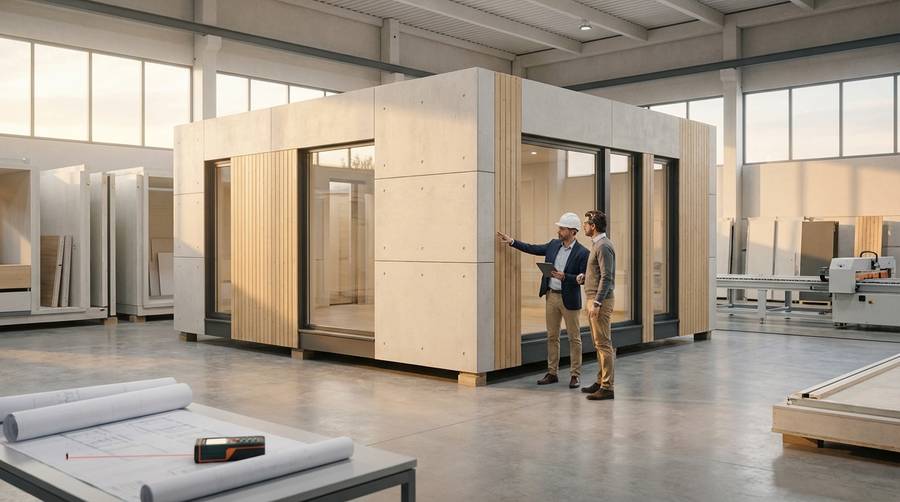
Industrialized Housing Success: A Spanish Turnkey Case
The project's origin: why they chose industrialized housing
Hook: They needed a modern family home delivered on a fixed budget and within an immovable deadline—traditional construction couldn't guarantee either. That tension led them to industrialized housing.
Client motivations: goals, constraints and home vision
The client was a family of four near Valencia with three clear objectives: energy-efficient living, a Mediterranean aesthetic, and a reliable delivery date tied to school and mortgage commitments. Their plot was suburban with moderate slope and strict local rules on façade materials and rooflines.
Key constraints:
- Fixed move-in date within 10 months.
- Firm maximum budget (including land).
- Local planning requirements favoring stone and light façades.
Initial comparison: prefabricated vs traditional in the Spanish context
At the decision point, the team compared two paths:
- Traditional build: flexible design but long, weather-dependent timelines and risk of cost overruns.
- Industrialized housing: predictable timeline, factory QA and a fixed-price contract.
Data-driven considerations tipped the balance: factory control reduced weather delay risk and allowed concurrent site and off-site work—critical to meet the 10-month deadline.
Decision based on data: closed timelines, fixed cost and sustainability
The decisive metrics were simple: a guaranteed delivery window, a written fixed-price offer, and measurable energy targets (aiming for near-Passivhaus performance). The client prioritized certainty. This made industrialized housing the obvious choice.
Choosing industrialized housing reduced the construction-phase schedule by 45% while providing a fixed-price guarantee—transforming uncertainty into a manageable plan.
Selecting systems and materials: technical design with a Mediterranean soul
Systems evaluated: industrialized concrete, light timber frame and steel frame
The project team assessed three structural systems against local climate, aesthetic goals and energy performance:
- Industrialized concrete panels: excellent thermal mass, durability, but heavier transport and cost implications.
- Light timber frame (entramado ligero): high thermal performance, quick assembly, natural finish options—aligned with the warm, Mediterranean interior.
- Steel frame: structural precision and larger spans; best for open-plan living but required careful detailing to meet thermal bridge limits.
The team selected a hybrid approach: light timber frame for the envelope combined with industrialized concrete for ground-level elements where thermal mass and acoustic separation were priorities.
Selection criteria: energy efficiency, durability and aesthetics
Decision criteria were prioritized as follows:
- Energy performance: airtightness, continuous insulation and minimal thermal bridges.
- Durability: resistance to local humidity and maintenance needs over 30+ years.
- Aesthetic fit: light façades, natural wood accents and stone details required by local planning.
Each material was evaluated through prototypes and U-value calculations. The combined system achieved the target of less than 0.6 air changes/hour at 50 Pa during factory-led testing—an important indicator toward Passivhaus-level performance.
Finishes and natural materials for a warm contemporary home
To respect the Mediterranean brief, the team specified:
- Light lime-based exterior render and natural stone plinth.
- Thermally treated wood battens for sun shading and warmth.
- High-performance triple glazing with timber-aluminum frames.
These choices balanced beauty with performance and aligned the final home with the regional vernacular while remaining contemporary.
The turnkey process explained: steps and responsibilities
Parcel search and adaptation: surveys and permits
The turnkey path began with a coordinated land study:
- Topographic survey and geotechnical report to define foundation type.
- Local zoning review to confirm façade and height limits.
- Early engagement with the town hall to spot permit conditions affecting design.
Because the client used a single platform provider, these initial steps were managed alongside design, accelerating permit-ready documentation.
Factory phase: controlled prefabrication and quality assurance
While the site was prepared, modules and panels were manufactured in a climate-controlled factory. Advantages included:
- Batch QA: every unit tested for airtightness, wiring and finishes before leaving the factory.
- Parallel workflows: site and factory work reduced total project time.
- Predictable procurement: materials ordered on fixed schedules, reducing supply risk.
Factory acceptance tests included mechanical installation checks and a dry-fit assembly to ensure on-site efficiency.
On-site assembly and final delivery: coordination, timelines and guarantees
On-site assembly took two weeks for primary structure and six additional weeks for finishes, services and landscaping. The turnkey provider delivered a single contract covering:
- All trades coordination.
- Warranty management (structural and weather tightness guarantees).
- Final certification and handover documentation.
Transparent milestone reporting and a fixed payment schedule kept the client informed and the budget controlled.
Measurable outcomes: times, costs and client satisfaction
Key metrics: schedule reduction, fixed cost and actual deviations
Compared to an equivalent traditional build in the region, the project achieved:
- Schedule: 45% reduction in construction phase (from an estimated 18 months to the actual 10 months).
- Cost: fixed-price contract met within a 2% contingency; no major post-contract change orders.
- Deviation management: three minor change requests handled within contingency and without schedule impact.
Quality and energy indicators (e.g. Passivhaus compliance effort)
Measured performance at handover:
- Airtightness: 0.55 ACH@50Pa (tested).
- Heating demand projection: 12 kWh/m2/year (modelled with conservative occupancy assumptions).
- Thermal bridging kept within target values for near-Passivhaus certification steps.
These indicators confirmed the house met high-efficiency expectations and delivered low operating costs.
Testimonial and satisfaction level: client experience and scores
The family rated the project highly in three areas:
- Delivery reliability: 9/10
- Energy performance satisfaction after six months: 8.5/10
- Overall experience with turnkey management: 9/10
Client comments highlighted the stress reduction from single-point responsibility and the delight with interior daylighting and low heating needs.
Financing and management for self-builders: how they made it viable
Mortgage options for self-developers and specific financing lines
Financing a self-build industrialized home required a blended approach:
- Land mortgage for plot acquisition.
- Construction drawdown facility tied to turnkey milestones.
- Final mortgage conversion on completion—often at more favorable long-term rates.
The key was aligning the lender's disbursement schedule with the turnkey provider's milestone payments to avoid cash flow stress.
Economic strategy: fixed budget, payment milestones and contingencies
The project's economic controls included:
- Fixed-price contract with transparent scope definition.
- Defined payment milestones: foundation, module delivery, mechanical sign-off and handover.
- Contingency set at 5% of construction cost for design clarifications and minor client changes.
This structure gave lenders and the client clarity and minimized surprises.
Simplified administration and professional support
The turnkey provider managed permit renewals, final certifications and warranty registration. For those planning a similar route, professional project management is non-negotiable—especially to coordinate lenders, local authorities and factory timelines.
Lessons learned and recommendations for future self-builders
Best practices: coordination, provider selection and document control
Top recommendations from the project team:
- Early alignment: involve lenders and planning authorities before committing to the final design.
- Provider vetting: review factory QA records, delivery history and sample assemblies.
- Documentation: insist on detailed scope and change-order procedures in the contract.
These practices reduce ambiguity and protect the budget and schedule.
Common risks and how to mitigate them: permits, timelines and expectations
Most avoidable risks encountered were:
- Permit delays—mitigated by early town hall engagement and complete dossiers.
- Design changes—managed by freezing the scope before factory release and using a contingency for unavoidable changes.
- Expectation gaps—handled with regular walkthroughs and photographic milestone reports.
For a practical checklist of early technical pitfalls, see Errores al construir una vivienda industrializada.
Future outlook: scalability, sustainability and trends in 2026
Trends to watch:
- Greater adoption of hybrid systems that combine thermal mass and timber efficiency.
- Financing products tailored to industrialized housing with performance-based incentives.
- Wider integration of circular materials and embodied carbon reporting.
These shifts make industrialized housing increasingly attractive for self-builders seeking sustainability and certainty.
Conclusion: what this case means for future self-builders
This case shows industrialized housing can deliver a high-quality, Mediterranean-style home in Spain with predictable cost, fast delivery and measurable energy performance. The combination of a well-chosen system, clear contracts and aligned financing turned a risky ambition into a successful, repeatable process.
When design, factory control and financing are aligned, industrialized housing transforms uncertainty into predictable outcomes.
Call to action: If you're planning a self-build and want to evaluate whether industrialized housing fits your plot and goals, contact a turnkey provider early—overview reviews and a preliminary budget can clarify feasibility and save months. For practical pitfalls and technical safeguards, review our guide on common foundation mistakes before you start.