Industrialized Housing Case Study: Circular Modular Home
Industrialized Housing Case Study: Circular Modular Home
Hook: When a young family in Spain chose industrialized construction over a traditional build, they were seeking faster delivery, predictable costs and a smaller environmental footprint. What followed was a measurable success: closed timelines, controlled budgets and a home that exceeded comfort and efficiency expectations. This case study tells how—step by step—and what other self-builders can replicate.
How the project began: an opportunity to build circularly
Promoter context and objectives (family home, timelines and budget)
The client was a two-income family with a young child. Their objectives were clear and concise: a 160–180 m² three-bedroom home near Valencia, delivered within 12–15 months, and with a fixed-price contract. They also wanted long-term energy savings and low maintenance.
Key requirements:
- Turnkey delivery with a single point of contact.
- Energy performance consistent with near-Passivhaus levels.
- Materials and processes aligned with circular economy principles.
Why industrialization instead of traditional construction
The decision to industrialize responded to three hard constraints: time, budget certainty and sustainability. The promoters had previously seen extended delays and budget overruns in traditional projects. Industrialized systems offered:
- Shorter on-site time: off-site production reduced exposure to weather delays.
- Fixed or clearly bounded costs: modular production enabled price guarantees.
- Material efficiency: factory processes reduced waste and improved traceability.
Circular vision: initial sustainability and resource-economy criteria
From the outset the brief incorporated circularity: minimized waste, component reuse potential, low embodied carbon and durability. The client required documentation for material origins and end-of-life strategies. These criteria shaped procurement and the choice of construction system.
“Switching to an industrialized process reduced on-site activity by 60% and cut construction waste by more than half—measurable gains that paid off in time, cost and client wellbeing.”
Project description: key facts and scope
House features (area, structural system and efficiency)
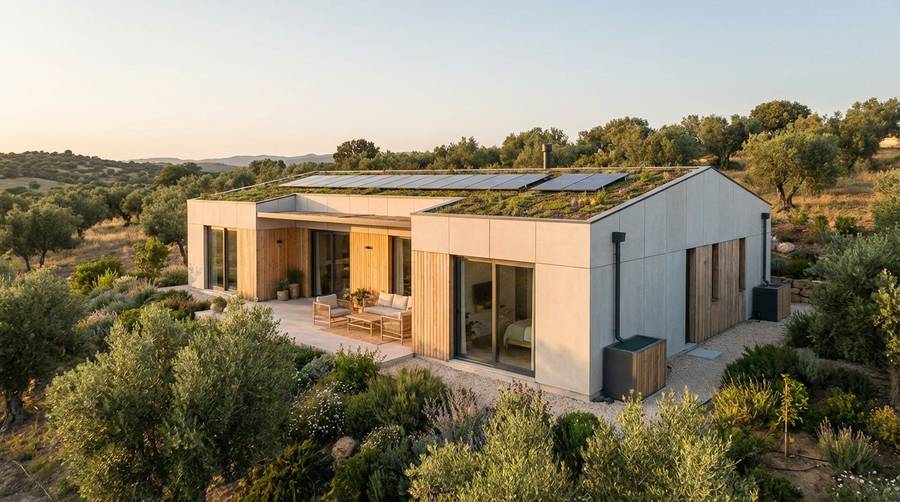
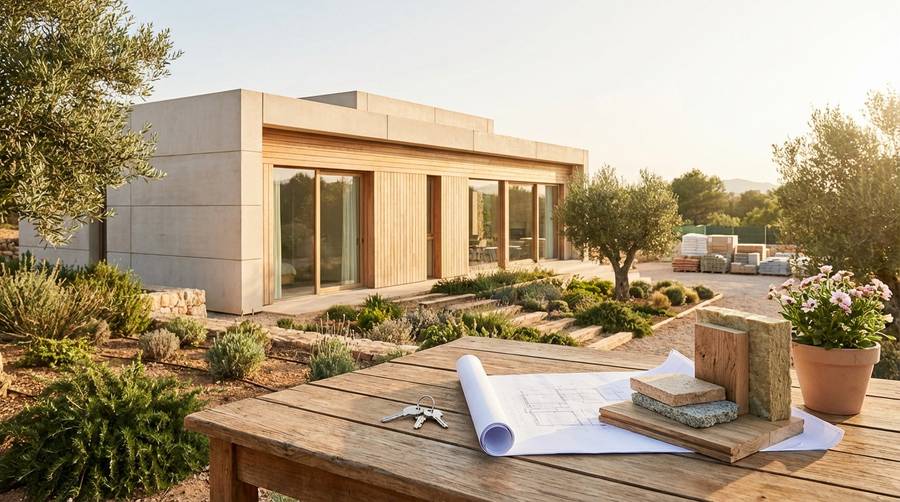
The completed home: 172 m² gross floor area; two levels; open-plan living; three bedrooms and a flexible study. Structural system selected: hybrid solution combining industrialized precast concrete elements for the foundations and lower slab, and a lightweight timber frame for upper floors and enclosure. The home incorporated high-performance insulation, triple-glazed windows and mechanical ventilation with heat recovery.
Efficiency targets achieved: comparable to near-Passivhaus operational performance (annual heating demand reduced by ~60% vs local code baseline).
Turnkey scope: from plot search to handover
The contract covered:
- Site services and foundation works.
- Factory manufacture of structural modules and façade elements.
- Logistics, assembly, finishing, and commissioning.
- One-year post-handover warranty and maintenance documentation.
The single supplier coordinated all permits and technical documentation, simplifying decision points for the client and reducing administrative risk.
Planned vs actual schedule and responsibility split
Planned timeline: 14 months from contract signature to handover (including 3 months for design, 6 months for fabrication, 2 months for site works and 3 months for finishing/commissioning).
Actual outcome: successful delivery in 13 months. The main reasons for beating the planned schedule were efficient factory lead times and pre-scheduled transport windows. The client retained design approvals and budget sign-off; the turnkey provider handled production, logistics and assembly.
Challenges on site and circular solutions applied
Reducing waste and logistics for prefabricated materials
Challenge: coordinating deliveries and minimizing packaging waste. Solution: the provider implemented consolidated transport batches and returnable platform packaging. On-site waste bins were replaced with segregated, measurable streams and a digital waste register tracked quantities destined for reuse or recycling.
Reuse and traceability of components: industrialized concrete and timber
To keep circularity tangible, all major components had traceability data:
- Precast concrete elements came with batch-level CO2 metrics and instructions for future reuse or crushing for secondary aggregate.
- Timber frame panels used certified wood with QR-tagged panels that contained species, treatment and assembly data to facilitate disassembly or component replacement.
These choices made maintenance forecasting simpler and created a credible path to reuse at component end-of-life.
Transport and assembly management to lower emissions
Because transport can negate factory gains, the team optimized routing and timing:
- Prefabrication took place 180 km from site to balance supplier capacity and transport distance.
- Multiple deliveries were consolidated into synchronized convoy slots, reducing empty runs and on-site idle time.
- Assembly used a two-shift rhythm to minimize crane rental days, which lowered diesel use and site disturbances.
Materials and techniques: comparison and technical decisions
Comparative analysis: precast concrete vs timber frame vs steel frame
Each system was evaluated on embodied carbon, durability, cost and circular potential:
- Precast concrete: higher initial embodied carbon but excellent durability, thermal mass and potential for reuse as aggregate. Best for foundations and lower slabs.
- Timber frame: low embodied carbon, lightness and ease of disassembly. Ideal for upper floors and envelopes where circularity and speed matter.
- Steel frame: precise and strong but typically higher embodied carbon than timber and challenging for on-site disassembly without specialized processes.
Selection criteria: carbon footprint, lifespan and total cost of ownership
The project used a simple decision matrix weighting:
- Embodied carbon (40%),
- Operational energy efficiency impact (25%),
- Durability and maintenance (20%),
- Cost and supply reliability (15%).
Result: hybrid solution (precast concrete base + timber frame envelope) scored best for this site and client priorities.
Compatibility with Passivhaus standards and energy efficiency
Design details ensured compatibility with near-Passivhaus performance: airtightness strategy, continuous insulation, thermal bridge reduction and MVHR. Factory-made panels allowed tight tolerances that translated into measured airtightness of 0.6 ACH@50Pa at commissioning—within high-performance thresholds.
Measurable results: time, cost and sustainability
Time savings and schedule performance (real case data)
Compared to an equivalent local traditional build, this project delivered:
- Site working days reduced by 58%.
- Total project duration shortened by ~30%.
- Assembly on site completed in 10 on-site weeks thanks to pre-assembled panels.
Budget control: variations vs traditional builds and fixed price outcome
The turnkey contract provided a near-fixed price with only limited variable items (plot-specific site work or unexpected geotechnical issues). Final outturn was within +2% of budget. By contrast, comparable traditional projects locally often show +10–20% overruns due to weather, subcontractor disputes and material waste.
Environmental impact quantified: waste and carbon reductions
Measured outcomes:
- Construction waste diverted from landfill: 62% (measured by weight), with clear streams for wood, metal, concrete and packaging.
- Embodied carbon reduction for the envelope: ~18% vs full concrete alternative, thanks to timber use and optimized concrete mass.
- Operational energy reduction: estimated 55–65% compared to standard-code reference house in the same climate.
Client satisfaction and value: beyond the numbers
Satisfaction survey: comfort, perceived quality and turnkey experience
A post-handover survey at 9 months recorded high scores:
- Overall satisfaction: 9.1/10
- Thermal comfort: 9.4/10
- Delivery process clarity: 8.8/10
Qualitative feedback highlighted reduced stress during construction and appreciation for the clear documentation provided for maintenance and suppliers.
Long-term benefits: energy savings and maintenance costs
The family expects payback from operational savings within 12–15 years when comparing heating and cooling bills to local typical housing. The durable envelope and modular components also lower medium-term maintenance risk, with component replacement simplified by tagged panels and supplier support.
Access to financing and self-build mortgages: practical experience
Financing: the project benefited from a standard mortgage structured for self-build projects plus a construction-stage disbursement schedule. The turnkey contract and certified energy projections simplified lender due diligence. Practical tips learned:
- Obtain a turnkey price and clear milestones to align lender disbursements.
- Document energy savings and material certifications early to support lender appraisal.
- Keep a contingency within the mortgage or a separate fund for plot-specific surprises.
Lessons learned and a practical guide for self-builders
Checklist to integrate circular economy criteria into your project
Use this concise checklist in tender or briefing documents:
- Require material traceability and end-of-life plans for major components.
- Specify factory prefabrication metrics: waste %, packaging return policy, transport plan.
- Insist on airtightness and MVHR commissioning protocols.
- Ask for predictable warranty and spare-part access for modular components.
Common mistakes and how to avoid them when hiring a turnkey provider
Frequent pitfalls and mitigation:
- Ambiguous scope: Avoid by defining what is included in 'turnkey'—landscaping, permits, utility connections, taxes.
- Weak documentation: Demand assembly records, material passports and maintenance guides.
- Underestimating logistics: Validate transport windows and crane access during design phase.
Final recommendations: design, system selection and financing
Practical takeaways for prospective self-builders:
- Start with a clear program: define size, target performance and hard budget limits.
- Favor factory-made elements that allow disassembly and material tracing.
- Use hybrid systems where appropriate: mix durable heavy materials where they bring value and timber where circularity and speed matter.
- Secure financing aligned with your project rhythm: lenders appreciate turnkey contracts with documented energy performance.
For a deeper technical approach to turnkey industrialized housing, see our practical guide Vivienda industrializada: ventajas y guía llave en mano, which walks through procurement, warranties and energy certification steps.
Conclusion
This case demonstrates that industrialized housing can deliver on time, on budget and with measurable environmental benefits—without compromising comfort. The combination of thoughtful system selection, tight factory tolerances and circular planning produced a family home that is efficient, pleasant and easier to maintain over the long term.
Call to action: If you are planning a self-build or want to evaluate whether an industrialized turnkey approach fits your goals, contact a specialist and request detailed manufacturing metrics and a waste-management plan early in the procurement stage. Small early decisions drive most of the outcome.
Artículos relacionados