Industrialized Housing: 7-Step Guide for Self-Builders 2026
1. Why this industrialized housing guide matters today
Hook: If you want a high-quality new home in Spain with predictable delivery, clearer budgets and lower environmental impact, industrialized housing is no longer niche — it is one of the fastest-growing, most reliable ways to self-build in 2026.
Quick sector snapshot in Spain (2026)
The industrialized housing sector in Spain has moved from pilot projects to scalable production lines. Key drivers in 2026 are: tighter energy regulations, rising labor costs for traditional builds, and lenders offering targeted mortgages for self-built modular homes. These forces make industrialized housing particularly attractive for autopromotores (self-builders).
What industrialization delivers to self-builders and families
- Predictability: fixed-price contracts and controlled factory schedules reduce scope for overruns.
- Speed: assembled modules and finished envelopes cut on-site time dramatically.
- Performance: repeatable quality control delivers better airtightness and thermal behavior.
How to use this checklist-style list
This article is a pragmatic, numbered guide. Use it to compare timelines, quantify cost risks, evaluate material choices, demand performance data, and plan a turnkey route from plot purchase to keys. Refer to linked resources like Vivienda industrializada: guía práctica para autopromotores for deeper practical checklists.
2. Time savings: sealed schedules and predictable delivery
Why time matters: construction delays cost money and stress. Industrial processes shift most work to the factory, where schedules are controlled and weather is not a variable.
Timeline comparison: industrialized vs traditional build
- Traditional build (single-family detached): design to keys often 12–30 months, with on-site works dominant.
- Industrialized build (factory-finished modules or panelized systems): typical total time 6–12 months; factory parallelization shortens calendar time.
Key differentiator: site works (foundations, connections) run in parallel with off-site production, reducing overall program length.
Impact on occupancy planning and project management
Shorter, fixed windows reduce interim accommodation costs and planning uncertainty. For autopromotores this means:
- clear handover dates for mortgage drawdowns;
- less risk of extended rental costs;
- fewer administrative extensions with local authorities.
Real example: median project metrics
Project (3-bed, 120 m²) — Spain, 2025:
- Design & permits: 10 weeks
- Factory production: 9 weeks
- Site works & assembly: 4 weeks
- Total: 23 weeks (5.5 months)
- User satisfaction (post-occupancy survey): 92% satisfied with schedule reliability
Shortening delivery time from 18 months to 6 months reduced interim housing costs by 60% in a representative self-build case.
3. Cost control: fixed price and reduced economic risk
Why cost control is a core advantage. A fixed-price contract backed by factory production reduces exposure to material price swings and labor delays that inflate traditional budgets.
Elements that stabilize the budget
- Standardized production: repeatable elements and bulk purchasing of materials lower unit costs.
- Defined scope: factory-finish options reduce onsite scope variability.
- Warranty frameworks: integrated warranties for airtightness, thermal and structural performance.
Financing options: mortgages for self-build and modular housing
Spanish banks and specialized lenders now offer specific products for autopromoción and modular homes. Typical features:
- drawdowns tied to milestones (plot purchase, factory completion, on-site assembly);
- interest reserves that account for shorter construction periods;
- loan-to-value ratios that consider turnkey valuations once modules are completed.
Ask your lender for examples of closed deals on similar industrialized projects to assess credit appetite and required documentation.
Case study: savings vs variable-budget project
Comparable 140 m² projects:
- Traditional: initial estimate €220,000; final cost €265,000 (+20%).
- Industrialized turnkey: contract price €235,000; final cost €235,000 (0% variance).
Net effect: although the turnkey price can be similar or slightly higher upfront, the eliminated overrun risk and faster delivery improve net-cost certainty and reduce holding costs.
4. Modern materials and performance: concrete, timber frame and steel
Selecting the right structural system depends on your priorities: thermal mass, speed, cost, finish flexibility and embodied carbon. Below is a concise functional comparison.
Technical and aesthetic strengths of each system
- Industrialized concrete (precast): high thermal mass, excellent acoustic performance, premium finish. Ideal for Mediterranean climates combining thermal inertia and modern façades.
- Light timber frame: fast, lightweight and renewable material. Offers excellent thermal performance when combined with high-quality insulation systems.
- Steel frame (steel frame/steel studs): precision, long spans and flexibility for open-plan interiors. Corrosion protection and thermal bridging details must be managed.
Durability, insulation and maintenance implications
Practical rules:
- Prioritize systems with factory-applied cladding and controlled junction details to limit site deviations.
- Ask for tested U-values and airtightness targets (eg. n50 ≤ 1.0 h-1 for high performance systems).
- Verify maintenance cycles: timber requires proper detailing and protective claddings; concrete and steel can offer lower lifecycle maintenance where properly protected.
Technical comparison with representative metrics
| Metric | Precast Concrete | Timber Frame | Steel Frame |
| Typical U-value (wall) | 0.20–0.30 W/m²K | 0.15–0.25 W/m²K | 0.18–0.28 W/m²K |
| Airtightness target | n50 ≤ 1.5 | n50 ≤ 1.0 | n50 ≤ 1.2 |
| Embodied carbon (kgCO2e/m²) | Higher | Lower | Moderate |
Use these numbers as a baseline. Ask suppliers for measured data on completed projects in similar climate zones.
5. Sustainability and energy efficiency: delivering real Passivhaus-class homes
Industrialized housing is well-suited to deliver high-efficiency performance because controlled production reduces thermal bridging and improves airtightness.
Key measures to reduce carbon footprint
- Optimize orientation and glazing strategy for solar gains in winter and shading in summer.
- High-performance insulation and continuous airtightness membranes applied in factory.
- Low-carbon materials selection: responsibly sourced timber, low-embodied-carbon concrete mixes and recycled steel.
Certifications and metrics: what to request and how to read them
Ask every supplier for:
- Measured airtightness (blower door test) results;
- PHPP or equivalent energy model outputs if claiming Passivhaus performance;
- Declared Embodied Carbon per ISO 14067 or EPDs for key components.
Energy case study: measured savings in an industrialized home
Example 110 m² home with timber frame and MVHR (mechanical ventilation with heat recovery):
- Heating demand: 15 kWh/m²·year (measured)
- Electricity consumption (household): 2,500 kWh/year
- Estimated CO2 reduction vs reference traditional build: 40% operational, embodied carbon reduced by 20% through timber and optimized detailing.
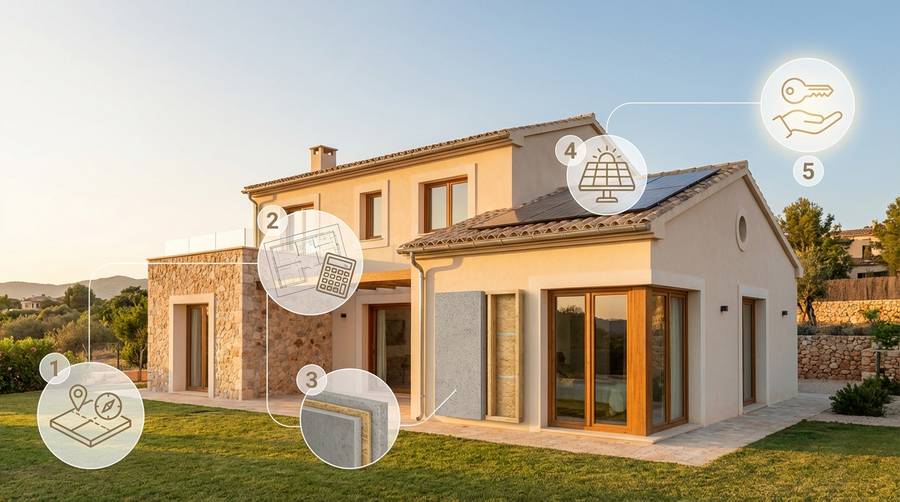
6. Turnkey process, step-by-step: from plot search to key handover
Turnkey delivery simplifies the self-build journey, but knowing each phase and required documents prevents surprises.
Turnkey service phases for self-builders
- Pre-purchase feasibility: plot assessment for access, topography, and utility connections.
- Design & permits: schematic design, technical project and building permit applications.
- Factory production: manufacturing of modules/panels, QA tests and finishes.
- Site works & assembly: foundations, utility connections and module assembly.
- Commissioning & handover: systems testing, snagging and final keys.
Common administrative steps and how to expedite them
- Early contact with town hall to confirm plot development rules and required documentation.
- Prepare geological report and utility connection requests before finalizing contracts.
- Use an experienced local architect to avoid iterative corrections during the approval process.
Practical final-handover checklist
- As-built drawings and manuals for systems.
- Warranty certificates for structure, envelope and installations.
- Airtightness and commissioning reports.
- Checklist of snags and an agreed rectification timeline.
For a practical walkthrough of steps and documents, see Vivienda industrializada: ventajas, materiales y financiación.
7. Real cases and decision criteria: choosing the right supplier
Choosing a supplier is both technical and personal. Use data and references to validate claims.
Summary of case studies with KPIs
- Case A — 120 m² timber: delivery 20 weeks, budget variance 0%, post-occupancy comfort score 4.6/5.
- Case B — 140 m² precast concrete: delivery 28 weeks, reduced acoustic complaints, client rated finish 4.8/5.
- Case C — 100 m² steel frame: delivery 18 weeks, high flexibility for interior changes, client satisfaction 4.5/5.
Checklist of personal and technical requirements
- Personal: desired delivery date, budget certainty, aesthetic priorities, sustainability targets.
- Technical: airtightness targets, U-values, maintenance expectations, supplier track record.
Recommended next steps for self-builders
1) Define your top three priorities (time, budget, sustainability). 2) Request measured performance data and references from at least three suppliers. 3) Visit a delivered house or staged visit where possible. 4) Confirm financing milestones with your bank and align them with the turnkey contract.
For additional practical tips on avoiding common mistakes, consult Vivienda industrializada: errores comunes y soluciones and design-focused guidance in Bienestar residencial industrializado: diseño sostenible y humano.
Conclusion: is industrialized housing right for your self-build project?
Bottom line: industrialized housing offers predictable delivery, stronger cost control, high energy performance and appealing material options. It is especially compelling if you value schedule certainty and energy efficiency without compromising on architectural quality.
Choose industrialized housing when your priority is predictable results: fixed budgets, shorter programs and measurable energy performance.
If you want a tailored assessment for your plot, budget and timeline, contact a specialist early to compare systems and finance options — a short feasibility review will save time and money later. For practical next steps, start with a feasibility check and request measured performance data from vendors.
Call to action: If you are planning a self-build in Spain, consider commissioning a 4–6 week feasibility study to compare materials, schedule and financing — it’s the most effective way to convert ambition into a predictable delivery plan.
Artículos relacionados