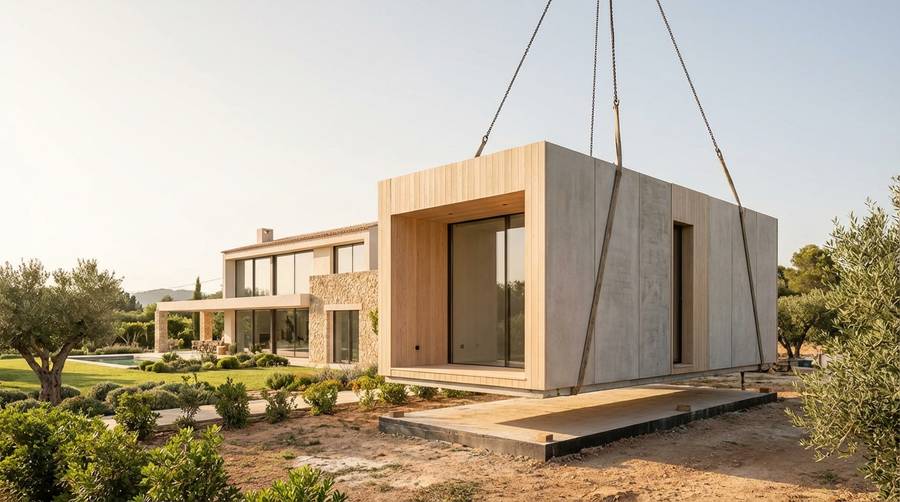
Top 6 Benefits of Rapid Assembly for Industrialized Homes
1. What rapid assembly is and why it matters for your industrialized home
Hook: If you want a predictable schedule, controlled budget, and a home built to high energy standards, rapid assembly changes the rules of the game.
Clear definition and how it differs from traditional construction
Rapid assembly refers to a production-led process where major building elements are manufactured off-site and installed on-site in a compressed schedule. Unlike incremental, on-site traditional builds, industrialized housing shifts repetitive, weather-sensitive, and quality-controlled work to a factory environment. This reduces exposure to delays and improves repeatable quality.
Immediate benefits: predictable timelines, cost control and consistent quality
- Predictable timelines: Factory production runs to a fixed cadence. On-site assembly then follows planned modules or panels with minimal weather impact.
- Cost control: Fewer on-site surprises and standardized components reduce variation in labor and materials.
- Quality consistency: Factory QA/QC, traceable materials and repeatable processes yield consistent performance.
How rapid assembly fits into the turnkey model for self-builders
In a turnkey (llave en mano) offering, the provider manages land evaluation, design adaptation, permits, factory production and final delivery. Rapid assembly shortens the on-site phase of a turnkey project, enabling self-builders to concentrate on choices like finishes and energy targets instead of construction logistics.
Rapid assembly turns the most uncertain housebuilding stages—weather, labor coordination and on-site sequencing—into a predictable, factory-controlled process.
2. Advantage 1: Delivery within fixed, predictable timelines
Typical schedule: factory and on-site phases with metric examples
A representative rapid-assembly schedule for a 150–180 m² detached home:
- Design & permits: 8–12 weeks (parallel permit acceleration possible)
- Factory production of modules/panels: 6–10 weeks
- Site preparation and foundations: 2–4 weeks (overlaps with factory work)
- On-site assembly and finishing: 2–6 weeks
- Commissioning and handover: 1–2 weeks
Total average time from contract to handover: 4–6 months, depending on permits and finishes. For larger or bespoke homes, add 4–8 weeks.
Time comparison vs traditional build (real-world cases)
Case study A: A 160 m² home in Valencia
- Traditional build: 14 months (permits + on-site delays due to weather and subcontractor scheduling)
- Rapid assembly turnkey: 5 months (permits in 10 weeks, factory 8 weeks, on-site 4 weeks)
Case study B: A 120 m² Passivhaus-oriented house in Málaga
- Traditional: 12–16 months, extensive rework to meet airtightness targets
- Rapid assembly: 4.5 months, airtightness verified at factory and site with minimal remediation
Impact on financial planning and decision-making
- Lower carrying costs: Shorter construction duration reduces interest and temporary housing costs.
- Loan predictability: Banks can better stage disbursements when milestones are firm.
- Faster occupancy: Earlier rental income or avoidance of double housing costs improves cashflow for self-builders.
3. Advantage 2: Fixed price and reduced economic uncertainty
What a turnkey fixed-price quote usually covers and which risks it mitigates
A robust turnkey quote should itemize:
- Design, engineering and permit support
- Factory-manufactured building elements and QA records
- Foundations and on-site assembly
- Standard finishes, MEP installation and commissioning
- Handover and performance testing (airtightness, thermal balance)
When properly defined, a fixed-price contract transfers most material and labor price volatility and many coordination risks to the provider. What remains with the client are choices that change scope (extra finishes, plot remediation, or permit-driven changes).
Numeric example of savings versus typical overruns
Average cost overrun on traditional builds in Spain can range from 10–25% due to unforeseen site issues, material price swings and schedule delays. Example: on a 250,000 EUR budget, a 15% overrun equals 37,500 EUR. With a carefully vetted turnkey rapid-assembly contract, documented case studies show clients limiting extra costs to <5% for change orders, saving tens of thousands of euros.
Tips to validate offers and avoid ambiguous clauses
- Require a detailed scope matrix: what is included, optional upgrades, and allowances for provisional items.
- Insist on factory QA documentation for critical components (insulation, envelope, structure).
- Set clear change-order procedures with fixed per-item pricing or a transparent actual-cost mechanism.
- Confirm who bears risk for permits, site remediation or contract-approval delays.
4. Advantage 3: Modern materials and performance (concrete, light timber frame, steel frame)
Technical comparison: industrialized concrete vs light timber vs steel frame
Each system has predictable performance when produced in a factory:
- Industrialized concrete: High thermal mass, fire resistance, excellent durability; suited to coastal or windy sites. Factory-produced panels improve tolerances and reduce on-site wet works.
- Light timber frame (entramado ligero): Fast to assemble, excellent thermal bridging control when properly detailed, lower embodied energy compared with conventional concrete.
- Steel frame (steel frame): High precision, long spans and slim profiles; effective when combined with insulation layers to control thermal bridging.
Impact on energy efficiency and durability
Performance depends on the whole envelope and installation quality. Factory-fitted insulation, pre-installed membranes and controlled junctions reduce onsite errors, improving airtightness and lowering operational energy. For example, factory-assembled envelopes commonly achieve airtightness values that simplify meeting Passivhaus targets.
Selecting materials by climate, plot and aesthetic preferences
- Warm Mediterranean climates: prioritize shading, thermal mass and ventilation—concrete or hybrid systems perform well.
- Inland or cooler zones: timber frames with high-insulation values and heat-recovery ventilation are efficient.
- Aesthetic choice: façades in stone, wood cladding or stucco can be combined with any structural system—decisions should be driven by maintenance expectations and local regulations.
5. Advantage 4: Sustainability and energy efficiency embedded from design
Passivhaus strategies applied to industrialized homes
Passivhaus principles—high insulation, airtightness, thermal bridge control and balanced mechanical ventilation—align well with industrialized construction. Factory production allows precise assembly of layers, pre‑cut insulation, and factory-installed window units tested for performance.
Reducing carbon footprint through industrialized processes
Key carbon advantages:
- Less onsite waste and better material yield from factory cutting.
- Controlled logistics reducing repeated deliveries.
- Optimized material selection (low-embodied-energy timber or optimized concrete mixes) and efficient integration of renewables.
Practical measures to increase certification and occupant comfort
- Specify triple-glazed windows with certified U-values and solar control as needed.
- Integrate mechanical ventilation with heat recovery (MVHR) sized by certified airflow calculations.
- Design continuous insulation and pre-detailed thermal-bridge solutions in factory panels.
- Plan for photovoltaic-ready roofs and electric heating to match future decarbonization strategies.
6. How to start: turnkey process, financing and next steps
Step-by-step summary: from plot search to final handover
- Plot assessment: soil, orientation, access, local regs. Early geotechnical and hydraulic checks avoid surprises.
- Concept & budget: program, rough budget and target performance (e.g., Passivhaus).
- Design & permits: adapt standard modules to the plot, secure building permits.
- Factory production: components manufactured with QA records and on-site sequencing plan.
- Foundations & assembly: site prep, foundation, fast on-site assembly of modules or panels.
- Systems commissioning: airtightness test, mechanical commissioning and final inspections.
- Handover: user manual, warranties and performance verification.
Financing options and mortgages for self-build modular housing in Spain
Self-build and modular projects typically use one of these financing paths:
- Construction loan for self-build (hipoteca para autopromoción): staged disbursements linked to milestones. Rapid assembly can reduce the number of stages and therefore financing risk.
- Turnkey mortgage: Some lenders offer loans tailored to turnkey providers with a fixed final appraisal once the project is complete.
- Green mortgage or preferential loans: If aiming for Passivhaus or A-rated EPC, explore lenders with preferential terms for energy-efficient homes.
Tip: Provide lenders with factory QA documents, energy models and a clear schedule to speed credit approval.
Practical checklist to choose a provider and set a decision calendar
- Request a full scope matrix and sample contract with fixed-price elements.
- Ask for completed project references with measured performance (times, airtightness, final costs).
- Verify factory processes: quality control, material traceability and pre-installation tests.
- Plan your decision milestones: plot purchase, contract signature, permit submission, factory order—align personal financing with these dates.
- Read Vivienda industrializada: errores comunes y soluciones to avoid common pitfalls during rapid assembly and turnkey delivery.
Conclusion: Is rapid assembly the right path for your industrialized home?
Rapid assembly is not a one-size-fits-all answer, but it offers measurable advantages for self-builders seeking predictability, cost control, modern material performance and higher energy standards. When paired with a transparent turnkey process and the right financing, it shortens timelines, lowers uncertainty and often delivers better in-use performance.
Final practical advice: prioritize verified factory QA, a clear fixed-price scope, and an energy strategy (e.g., Passivhaus targets) from the start. These three decisions capture most of the upside from rapid assembly.
Want tailored guidance for your plot and budget? Contact an expert to run a feasibility and financing plan aligned with your goals.