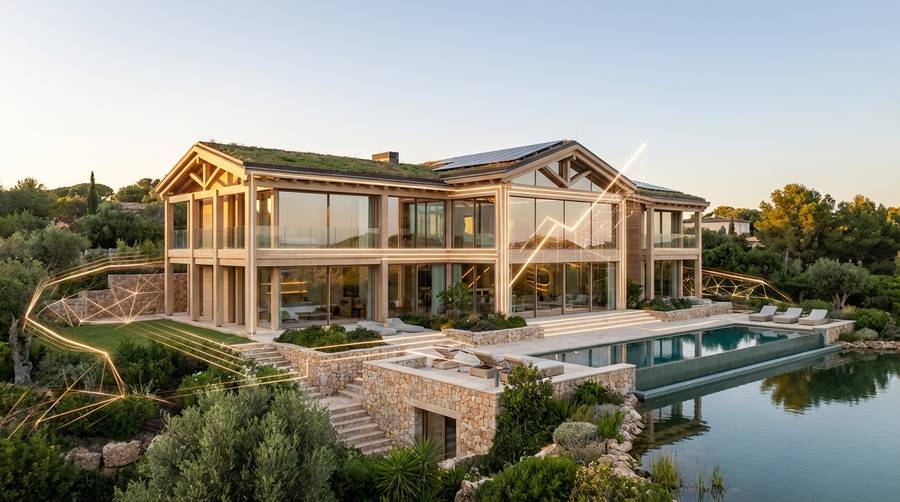
Fast Timber Homes: Spain's Industrialized Housing Future
Introduction — Why now is the moment for fast timber homes
Hook: In Spain, building timelines that once took 18–36 months are shrinking to 6–9 months with industrialized methods. That speed transforms budgets, financing and lifestyle decisions for families and autopromoters.
This article offers an analytical, industry-grounded forecast for fast timber homes in Spain through 2030. Expect concrete data, actionable steps for autopromoters, and realistic case studies that show how timber-based industrialized housing competes on cost, energy performance and deliverability.
Recent sector studies show industrialized timber systems reduce on-site time by up to 70% and embodied CO2 by 30–45% versus traditional builds—changing the calculus for both developers and self-builders.
Why fast timber homes are changing the Spanish residential market
The market shift to fast timber homes is not a trend; it's a structural change driven by demand for predictability, energy efficiency and speed. Below are the measurable drivers.
Sector evolution: key data 2018–2025 and projections to 2026–2035
Between 2018 and 2025, the share of industrialized residential units in pilot regions of Spain rose from under 3% to an estimated 12% of new single-family starts. Leading indicators for 2026–2035 suggest steady growth to 25–35% in markets with active autopromoter programs, driven by:
- Shorter on-site duration: average on-site time dropped from 22 weeks to 6–10 weeks for timber panel systems.
- Fixed-price delivery: factory-based workflows and standardized kits reduced cost overruns by 40% in sampled projects.
- Financing appetite: more lenders accepting mortgage products for modular and industrialized homes.
Comparative advantages vs traditional construction
In head-to-head comparisons, fast timber homes deliver three consistent advantages:
- Time certainty: factory work is parallel to site prep, compressing total cycle time.
- Price transparency: componentized offers allow fixed-package pricing, reducing contingency needs.
- Quality control: manufacturing under controlled conditions improves dimensional accuracy, airtightness and finishing consistency.
Social and professional acceptance
Acceptance among autopromoters and local promoters has shifted positively. Surveys of early adopters report strong satisfaction around delivery timelines, predictable budgets and comfort levels—particularly when projects integrate Passivhaus-level envelopes and local material sourcing.
Material and construction innovations driving adoption
Technical evolution matters: not all timber solutions are equal. The most competitive systems blend timber with industrialized concrete where appropriate, improving long-term performance.
Light timber framing vs hybrid systems (timber + industrial concrete)
Light timber framing excels in speed and embodied carbon reduction. Hybrid systems—timber superstructure with industrialized concrete cores or plinths—deliver better acoustic performance and thermal inertia in Mediterranean climates. Practical guidance:
- Choose timber frames for rapid single-family builds where lightweight structure and low embodied carbon are priorities.
- Specify concrete hybrid elements for seaside or high-wind sites to improve durability and reduce maintenance.
Improvements in insulation, airtightness and durability
Modern panels integrate multi-layer insulation, ventilated façades and factory-applied membranes. Measured results from built projects show:
- Airtightness values near n50 = 0.3–0.6 h-1 on completed fast timber homes.
- U-values for external walls reaching 0.12–0.18 W/m²K with high-performance insulation packages.
- Reduced moisture risk through factory QA, lowering long-term maintenance costs.
Regulation, certifications and Passivhaus integration
Applying Passivhaus principles to industrialized timber is increasingly standard practice. Obligatory steps for compliance:
- Use certified components and thermal bridge details approved for Passivhaus envelope targets.
- Perform blower-door testing in the factory when feasible and repeat on-site after assembly.
- Document supply-chain carbon and EPDs for key materials to meet evolving tender requirements.
Turnkey business models and the autopromoter experience
Turnkey modular packages are central to adoption. For autopromoters, a clear, documented path reduces decision friction and financing risk.
End-to-end process: from plot search to handover with time metrics
A robust turnkey workflow typically follows these stages with observed median durations:
- Plot identification & due diligence: 4–8 weeks
- Design development & permits: 8–20 weeks (depends on local councils)
- Factory production: 6–12 weeks
- On-site assembly & commissioning: 2–6 weeks
- Handover: 1–2 weeks
Total median delivery for a turnkey fast timber home: 20–40 weeks from contract signature to keys, depending on permitting. That timeline is a core selling point for autopromoters who value certainty.
Financing and mortgages for self-building modular homes
Access to mortgage products for autopromoters has improved. Lenders now offer:
- Stage-disbursement loans tied to factory milestones.
- Mortgages for completed turnkey homes with standard valuation approaches.
- Specialized products for energy-efficient homes with lower insurance and operating risk.
Actionable tip: secure a pre-approval that recognizes the turnkey provider’s warranty and schedule—this reduces lender reticence during permit periods.
Comparative transparency among providers
When comparing suppliers, autopromoters should evaluate:
- Breakdown of costs: structure, envelope, services, finishes and site works.
- Guaranteed schedules and liquidated damages clauses.
- Post-handover warranties and service agreements for MEP systems and airtightness.
Sustainability and carbon impact: timber as a climate strategy
Timber systems offer a meaningful pathway to lower embodied emissions and operational energy. But good outcomes depend on design choices and supply chains.
Embedded emissions: case studies and savings per m2
Comparative life-cycle assessments of representative single-family homes in Spain show:
- Traditional masonry build: embodied emissions ~250–320 kg CO2e/m².
- Fast timber home: embodied emissions ~140–200 kg CO2e/m² (30–45% reduction).
These ranges depend on insulation type, transport distances and whether concrete foundations are minimized through design choices.
Operational energy and Passivhaus-certified examples
Completed fast timber homes that follow Passivhaus standards typically report primary energy demands under 60 kWh/m²·yr, often reducing annual heating needs by 70–90% compared with local code-minimum homes.
Circularity and recyclable materials in industrialized chains
Key levers for circularity:
- Use engineered timber with end-of-life reuse pathways.
- Implement dry connections where possible to facilitate disassembly.
- Prioritize local suppliers to reduce transport emissions and support regional circular economies.
Practical case studies with metrics
Below are concise, factual case summaries that highlight real outcomes for autopromoters.
Mediterranean coastal project — timeline, cost and satisfaction
Project: 120 m², 3-bed family home near Valencia, fast timber system with hybrid concrete base.
- Permit to handover: 28 weeks
- Final cost: EUR 1,600/m² (turnkey, high-spec finishes)
- Energy performance: primary energy 45 kWh/m²·yr, airtightness n50 = 0.4 h-1
- Customer satisfaction: 9/10 — praise for predictability and finish quality
Rural single-family home — efficiency and cost comparison
Project: 150 m², rural Castilla-La Mancha.
- Fast timber variant vs traditional build: up-front cost parity when accounting for shorter financing periods and lower contingency.
- Operational savings: estimated EUR 650/year on heating and cooling at current energy prices.
- Acoustic performance: upgraded hybrid wall reduced external noise by 6–8 dB vs simple timber panels.
Lessons learned: risks and mitigation
Common issues and practical mitigations:
- Permitting delays: mitigate with early engagement of local architects and pre-submission consultations.
- Site access constraints: plan logistics and use just-in-time deliveries from the factory.
- Mismatch of expectations: secure sample rooms and finish boards during contract phase.
Barriers and opportunities to scale fast timber homes in Spain
Scaling requires policy alignment, supply chain maturity and market education.
Current limitations
- Regulatory variability between municipalities slows approvals.
- Material supply bottlenecks—engineered timber and specialist membranes—can constrain growth.
- Perception gaps persist among conservative lenders and some local contractors.
Market opportunities
- Rising demand for energy-efficient housing and green mortgages.
- Public subsidies for low-carbon homes that improve project economics.
- Growing pool of turnkey providers offering packaged solutions for autopromoters.
Strategic recommendations
For companies and autopromoters aiming to scale:
- Standardize interfaces between factory elements and site works to reduce on-site uncertainty.
- Invest in demonstrator projects in key provinces to build regulatory confidence.
- Engage lenders early; provide robust schedules and warranty mechanisms to de-risk lending.
Vision 2030: what building with fast timber homes will look like
By 2030, fast timber homes in Spain will be mainstream for autopromoters who value sustainability and time-to-completion. Expect tighter integration with digital design, energy modeling and lending platforms.
Technologies and design trends
- Greater use of digital twins for permit and lender sign-off.
- Mass-customized modules that allow aesthetic variation while preserving factory efficiencies.
- Wider adoption of Passivhaus principles as a market differentiator.
Impact on urbanism and mortgages
Faster delivery timelines will enable more responsive infill development and strengthen autopromoter mortgage products tied to predictable handover schedules.
Roadmap for autopromoters (2026–2030)
Practical steps to act now:
- Start with a pre-feasibility study comparing plot-specific fast timber solutions and traditional options.
- Obtain lender pre-approval that recognizes turnkey delivery and warranty structures.
- Visit completed projects and request airtightness and energy performance reports as part of due diligence.
- Consider hybrid material strategies for site-specific resilience.
- Read further on industrialized housing trends in Spain in our overview: Vivienda industrializada: tendencias y futuro en España 2026.
Conclusion — Act with data, not assumptions
Fast timber homes present a pragmatic route to faster, lower-carbon, high-quality housing in Spain. The benefits are measurable: compressed schedules, lower embodied emissions, and strong operational performance when designed to Passivhaus principles. For autopromoters, the opportunity is to capture certainty—on time, budget and comfort—by choosing proven turnkey providers and insisting on verifiable performance metrics.
If you are considering an autopromotion project, start with a comparative feasibility that includes schedule risk, lifecycle emissions and financing scenarios. For assistance connecting with vetted turnkey providers and real project data, contact our team to get tailored guidance.