Industrialized Housing: Common Mistakes & Fixes
Why Choose Industrialized Housing: Brief Context and Key Advantages
Hook: If you plan to self-build in Spain, choosing industrialized housing can cut timelines, fix costs and deliver higher energy performance—if you avoid the common pitfalls.
Industrialized housing—also called modular or prefabricated housing—moves much of the work off-site. Panels, modules or systemized components are produced in controlled environments. That reduces weather delays and variability. For autopromoters this means faster delivery and predictable budgets.
Key advantages at a glance:
- Faster delivery: parallel onsite and factory work reduces overall calendar time.
- Price control: fixed-scope manufacturing cuts scope creep and surprises.
- Higher quality and performance: factory conditions improve finishing and quality control.
- Sustainability: reduced waste, better airtightness and easier renewable integration.
This article focuses on the common errors autopromoters make when they choose industrialized housing in Spain—and practical, immediate fixes.
Data point: factory-built processes commonly reduce on-site time by 40–60% versus traditional builds, making schedule risk a controllable variable.
Error 1: Underestimating the Importance of Choosing the Right Construction System
Risks of Choosing Without Comparison: Concrete Systems vs Timber vs Steel Frame
Each structural system has strengths and limits. Selecting the wrong one leads to maintenance issues, poor thermal comfort, or higher lifecycle costs.
- Industrialized concrete: excellent thermal mass and durability. Heavier logistics and foundation needs. Good for acoustic performance.
- Light timber frame: fast and lightweight. High thermal efficiency when well detailed. Requires strict moisture control.
- Steel frame: precise, flexible and strong. Needs careful thermal break detailing to avoid cold bridges.
How to Evaluate Criteria: Durability, Insulation and Ease of Execution
Use measurable criteria, not marketing claims. Compare systems across the same variables.
- Thermal resistance (R-value): ask for lab-tested U-values for walls, roofs and windows.
- Service life estimates: projected maintenance intervals for finishes and critical systems.
- Logistics footprint: transport and crane needs for modules or panels.
- Acoustic performance: measured dB reductions for walls and floors.
Practical Fix: Comparative Checklist and Certified Supplier Consultation
Create a short, scored checklist to compare suppliers. Score each on the same scale.
- Structural type and pros/cons (score 1–5)
- U-values and airtightness targets (score)
- Factory QA processes and certificates (ISO, EN standards)
- Logistics complexity and costs
- Warranty and post-delivery support
Then book a certified technical consultation. Request references and on-site visits to completed homes.
Error 2: Failing to Prioritize Energy Efficiency and Certifications from the Start
Consequences: High Operating Costs and Re-sale Difficulty
Skipping energy strategy early inflates lifetime costs. Buyers and lenders increasingly value certified performance. A non-certified home may sell slower or at a discount.
Steps to Integrate Passivhaus and Efficiency Measures into the Project
Passivhaus-level thinking doesn’t always mean full certification. Use the principles:
- Airtightness: plan continuity at junctions and test early with a blower door.
- Thermal envelope: target high-performance insulation in walls and roofs.
- Thermal bridges: detail connections to avoid cold spots.
- Ventilation: balanced mechanical ventilation with heat recovery (MVHR).
- Solar gains and shading: model orientation to balance gains and overheating.
Practical Fix: Early Energy Audit and Material Shortlist
Commission a preliminary energy audit before signing the final supplier contract. Use its output to create a material shortlist with tested products:
- External wall panel system with certified U-values
- High-performance windows (Uw, g-values documented)
- MVHR units sized for actual occupancy
- Renewables: PV sizing and battery options
This reduces retrofit risk and improves financing options.
Error 3: Poor Planning of the 'Turnkey' Process and Timelines
Common Problems: Delays with Plots, Permits and Partial Deliveries
Many delays are not in manufacturing. They are in land, permits and utility connections. Relying on verbal timelines creates false expectations.
How to Structure a Realistic Schedule and Key Contract Clauses
Use a phased contract aligned with permits and procurement milestones.
- Milestone-driven payments: tie payments to achieved deliverables.
- Permits contingency: include extra time for urban planning checks.
- Penalties and incentives: define liquidated damages for critical delays and bonuses for early delivery.
- Acceptance criteria: list tests and documentation required at handover.
Practical Fix: Clear Phases, Milestones and Real Cronogram Examples
A workable turnkey timeline example for a 120–180 m² home:
- Weeks 0–8: Parcel purchase, site survey and licenses
- Weeks 6–12: Final design, energy audit and factory order
- Weeks 12–20: Foundation and site preparation
- Weeks 20–28: Factory production of modules/panels
- Weeks 28–34: Transport, craning and installation
- Weeks 34–40: Finishes, systems commissioning and handover
This sample compresses onsite time. Adjust for local permit speed and site complexity.
Error 4: Not Planning Specific Financing for Self-Build and Modular Homes
Common Mortgage Mistakes for Self-Build Projects
Traditional mortgages often assume finished construction. Self-build requires staged financing. Many autopromoters apply too late or with incomplete documentation.
Alternatives and Financial Products for Industrialized Housing
Consider these options:
- Self-build mortgage (hipoteca autopromoción): staged disbursements keyed to construction milestones.
- Construction credit lines: short-term drawing facilities that convert to mortgage on completion.
- Hybrid products: lender partners that understand modular delivery and accept factory documentation as evidence.
Practical Fix: Required Documentation and Negotiation Steps
Prepare this folder before applying:
- Detailed turnkey contract with milestones and penalties
- Factory production schedule and QA certificates
- Energy audit or performance prediction
- Cost breakdown and contingency buffer (at least 5–10%)
Negotiate for payments aligned to handover, not to calendar months. Present certified references of completed projects to lenders.
Error 5: Associating Prefabricated Homes with Low Quality or Limited Aesthetics
Common Myths and How to Counter Them with Data and Case Studies
Myth: prefabricated equals low quality. Reality: modern industrialized homes achieve equal or better performance. Use metrics to show results.
- Time metric: projects often complete 40–60% faster than traditional builds.
- Cost certainty metric: fixed-price contracts reduce budget overruns by a measurable margin.
- Energy performance: many factory-built homes meet or exceed NZEB and near-Passivhaus standards.
Mediterranean Contemporary Materials and Premium Aesthetics
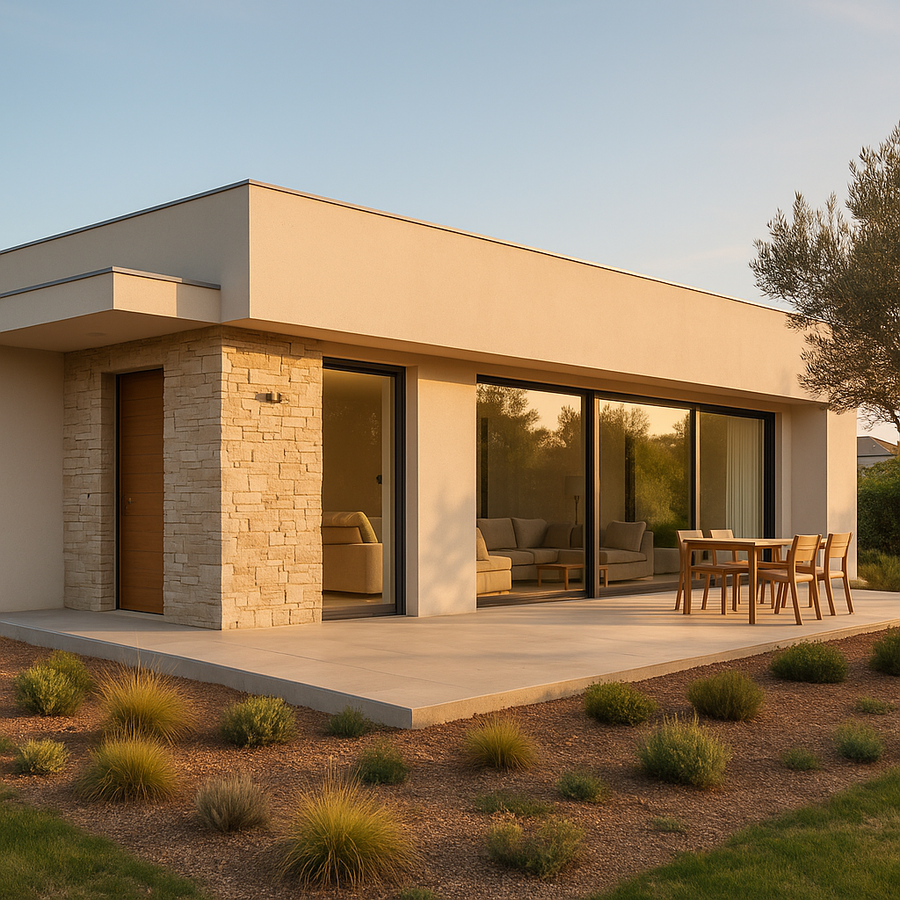
Quality depends on design intent and material choices. Use contemporary Mediterranean vocabulary:
- Light façades with smooth render or pale microcement
- Natural wood accents for warmth
- Stone plinths or planters as contextual elements
- Large glazed openings with slim frames
These choices make modular homes look premium and site-appropriate.
Practical Fix: Real Examples with Metrics
Ask suppliers for case studies that include:
- Production time vs bid schedule
- Final cost vs budget
- Energy use (kWh/m²·year) and airtightness (ACH50)
- Post-occupancy satisfaction scores
These figures prove performance and counter prejudice.
Practical Advice to Avoid Problems During the Project
Step-by-Step Guide: From Plot Search to Turnkey Delivery
A compact roadmap for autopromoters:
- Plot due diligence: check access, utilities, topography and urban rules.
- Preliminary energy audit: align design with performance targets.
- Design freeze: lock the scope before factory ordering.
- Contract with milestones: include penalties and acceptance tests.
- Factory QA visits: inspect at panel/module production stages.
- Onsite preparation: foundations, drains and temporary services ready before modules arrive.
- Commissioning: systems handed over with manuals and certificates.
Key Contract and Communication Points with Manufacturer
Keep communication formal and documented. Include:
- Weekly progress reports during production
- Approved change order process and pricing
- Defined acceptance tests and documentation list
Final Handover Checklist: Quality, Tests and Paperwork
- As-built drawings and warranties
- Blower door and thermal imaging reports
- Appliance and system manuals
- Certificate of completion and energy label
Inspiring Close: How to Ensure a Successful and Sustainable Modular Home
Quick Solutions and Priorities for Autopromoters
Prioritize three things:
- Performance-first decisions: energy and airtightness early.
- System comparison: score and select the right structural approach.
- Contract discipline: milestones, tests and documented communication.
Mid- and Long-term Benefits: Savings, Comfort and Value
Industrialized homes can deliver lower operational costs, improved comfort, and better resale value. Over time, energy savings and reduced maintenance often offset slightly higher early costs.
Next Steps: Resources, Case Studies and Expert Consultations
If you want practical guidance, read our detailed guide Vivienda industrializada: guía para autopromotores for step-by-step instructions. For sales and delivery insights, see Comprar vivienda nueva con empresa de construcción. To understand closing processes, consult Comprar vivienda retail: guía completa paso a paso.
Final thought: Industrialized housing is not a shortcut. It is a process that rewards planning and discipline. Get the right system, secure energy targets and structure your turnkey contract. The result is a faster, greener and more predictable home.
Call to Action: If you are planning an autopromoted home, contact our team for a project review and a practical checklist tailored to your plot and budget.
Main Image for the Article (AI Generator Description in Findnido Style)
Scene description: Mediterranean contemporary finished home in Spain. Light-colored façade with natural materials: pale rendered walls, warm wood cladding accents and a subtle polished concrete base. Large, slim-frame windows open to a sunlit living area. A well-kept garden and a terrace with outdoor furniture sit in the foreground. Soft golden-hour light warms the scene. Include a small family enjoying the terrace—one person pouring coffee, another child with a toy—conveying livability and warmth. The background shows gentle Mediterranean landscape and nearby trees. Photographic style: architectural magazine quality, realistic, natural colors, balanced composition. Mood: trust, comfort, modern sustainability. Avoid any exposed construction, container-like forms or industrial settings. The image should read as a premium, finished Spanish home aligned with Findnido brand identity.