


Prefabricated House: Smart Guide for Self-Builders in Spain
1. Quick summary: why choose a prefabricated house today
Hook: If you want a high-quality home built faster, with predictable cost and modern sustainability, a prefabricated house can be the efficient route to achieve it.
This section gives a rapid decision framework for the self-builder (autopromotor) in Spain. Read on for facts, timelines and the exact steps you should expect when choosing industrialized housing.
Key advantages vs traditional construction (time, cost control, quality)
- Faster delivery: Many projects close within months, not years.
- Price predictability: Fixed-price contracts reduce budget overruns.
- Controlled quality: Factory production with calibrated processes lowers variability.
- Less on-site disruption: Shorter on-site schedules and cleaner worksites.
What 'industrialized housing' means in Spain, 2026
Industrialized housing refers to buildings where a significant portion of design, component manufacturing and assembly happens off-site in controlled factory conditions. In Spain today this includes modular volumetric, panelized systems and hybrid approaches combining factory-cast concrete panels, light timber frames and steel frames.
Profile of the ideal self-builder
- Values schedule certainty and transparency in cost.
- Wants modern performance (thermal comfort, low energy bills).
- Prefers professional turnkey services rather than DIY management.
Companies that combine factory precision with a clear turnkey process reduce average project delivery uncertainty by over 40% compared with traditional site-driven builds.
2. Time savings and fixed schedules: your home ready earlier
Time is one of the most measurable benefits of prefabrication. This section breaks down how parallelization and factory workflows compress delivery schedules.
Parallel phases: factory manufacturing and site preparation
Unlike traditional builds, prefabricated projects run two major threads at once:
- Off-site manufacturing: Structural modules, facades and interior panels are made in controlled conditions.
- On-site preparation: Groundworks, foundations and utilities are completed in parallel.
This parallel approach eliminates many idle periods and reduces weather-related delays.
Real timelines: comparative examples
Typical timelines (Spain, mid-2020s):
- Prefabricated turnkey home (single family, 120–180 m²): 6–9 months from contract to handover.
- Traditional build with project management: 12–20 months, often with contingency extensions.
These averages depend on project complexity, local permitting times and accessibility of the plot.
How delays are minimized and milestones controlled
Successful modular projects use:
- Fixed milestone plans: Weekly production reports and predefined assembly windows.
- Factory QA/QC: Inspections and tests before shipping modules to site.
- Integrated logistics: Just-in-time delivery schedules to avoid site congestion.
3. Fixed price and financial predictability
Budget control is a central selling point. Here we cover budgeting models, typical costs per square metre and financing options.
Budget models and closed-price guarantees
Common contractual options:
- Fixed-price turnkey contract: The supplier defines scope, price and deliverables.
- Design-and-build with allowances: Contract includes allowance budgets for client choices.
Tip: Request a clear exclusion list. That reduces later claims and scope creep.
Real metrics: cost per m² and typical deviations
Indicative figures (2024–2026 market context):
- Basic high-quality prefabricated family home: €1,300–€1,700/m² (turnkey).
- High-spec or Passivhaus-ready models: €1,700–€2,400/m².
Actual prices vary by location, plot complexity and finishes. Compared to traditional builds, average cost deviations are commonly lower for prefabrication because most variables are resolved pre-contract.
Financing and mortgages for modular self-builds
Options include:
- Self-build mortgages: Staged drawdowns aligned to factory and on-site milestones.
- Developer-backed mortgages: When the provider offers turnkey financing or partnerships with banks.
- Construction-to-mortgage conversion: Some lenders convert construction loans to standard mortgages at handover.
Practical step: Before signing, ask lenders for an outline of required documentation, timing of drawdowns and permitted contractors.
4. Modern materials and durability: concrete, light wood frame and steel frame
Choosing the right structural system impacts cost, timeline, thermal performance and long-term maintenance. Below is a concise technical comparison to help decision-making.
System comparison: industrialized concrete vs light wood frame vs steel frame
- Industrialized concrete: Excellent durability and acoustic performance; often used for ground floors, basements or hybrid façades. Heavier logistics and foundation needs can extend site works.
- Light timber frame (entradado ligero): Fast assembly, excellent thermal performance, lower embodied energy if sourced responsibly. Skilled factory joinery is essential.
- Steel frame: High structural strength, long spans and design flexibility. Corrosion protection and thermal bridging strategies must be planned.
Thermal performance and long-term maintenance
All three systems can meet strict energy targets when combined with proper insulation, airtightness and mechanical ventilation with heat recovery (MVHR). Maintenance profiles differ:
- Concrete: low maintenance, more resilient to moisture.
- Timber: requires attention to moisture management and quality of protective layers.
- Steel: minimal deformation, but surface protection and thermal break detailing are critical.
Impact on costs and schedule by structural choice
Choosing timber or steel often reduces assembly time and foundation loads. Concrete options may raise foundation and transport costs but deliver superior mass and acoustic comfort. Evaluate trade-offs with the manufacturer early: structural decisions shift both capex and lifecycle costs.
5. Sustainability and energy efficiency: building towards Passivhaus
Industrialized methods enable repeatable high-performance details, which helps reach stringent certifications such as Passivhaus more efficiently than one-off traditional builds.
Industrialized strategies to cut embodied carbon
- Optimized material usage: Factory fabrication reduces waste ratios significantly.
- Local sourcing: Use locally produced panels and finishes to reduce transport emissions.
- Design for disassembly: Modular elements that can be reused or recycled at end-of-life.
Energy certification and moving towards Passivhaus
To approach Passivhaus standards, focus on:
- High insulation levels and continuous thermal envelope.
- Meticulous airtightness and staged blower-door testing during factory assembly.
- Mechanical ventilation with heat recovery sized to the building.
Industrialized production reduces the risk of on-site workmanship errors that commonly compromise airtightness.
Benefits for energy bills and indoor comfort
High-performance prefabricated houses typically show:
- Lower heating/cooling demand by 60–90% compared with poorly insulated stock.
- More stable indoor temperatures and improved acoustic comfort.
6. How to start a turnkey project: practical steps and conclusion
The final section is a practical checklist and recommended next steps for self-builders planning a turnkey prefabricated home in Spain.
Turnkey path: from plot to final delivery
- Confirm the plot: Check urban planning, buildability and access for modular delivery.
- Preliminary feasibility: Ask for a feasibility study that includes budget, plot constraints and timeline.
- Design phase: Agree layouts, materials and performance targets (e.g., Passivhaus-ready).
- Permitting and groundworks: Start licenses and prepare foundations while factory production begins.
- Factory production and QC: Factory builds modules with staged QA, reducing surprises on site.
- Assembly and commissioning: Modules are installed, services connected and commissioning completed.
- Handover: Final checks, warranties, and client walkthrough.
Checklist for choosing a supplier and required documents
- Detailed scope and exclusions in the contract.
- Factory visit or documented production evidence.
- Proof of insurance, structural calculations and warranty terms.
- Required documents: urban planning license, geotechnical study, connection permits and construction insurance.
Recommended next steps for self-builders
Practical roadmap:
- Request a tailored estimate with a breakdown of costs by phase.
- Arrange a factory visit and ask for client references and case studies.
- Compare financing alternatives and obtain pre-approval for the expected loan structure.
- Review turnkey contract and confirm delivery milestones and penalties for delays.
For further reading on market positioning and detailed decision factors, see our comparative article Casa prefabricada: futuro de la vivienda industrializada 2026 and practical benefits in Top 4 razones para elegir una casa prefabricada en España.
Conclusion
Bottom line: Prefabricated houses offer measurable gains in schedule certainty, budget control and consistent quality. When paired with modern materials and a careful turnkey process, they also enable competitive energy performance and a lower carbon footprint.
If you're an autopromotor in Spain, start by verifying plot constraints, requesting factory evidence and comparing fixed-price turnkey proposals. A focused feasibility study and a factory visit will tell you more than pages of promises.
Ready to evaluate your plot? Contact a trusted industrialized housing provider, request a feasibility report, and plan a factory visit to compare real metrics before signing.
Artículos relacionados
Prefabricated House Guide: How to Build in Spain 2026
A practical, step-by-step guide for self-builders in Spain explaining why a prefabricated house is often faster, greener and more predictable than traditional builds — with materials guidance, financing options and two real case studies.
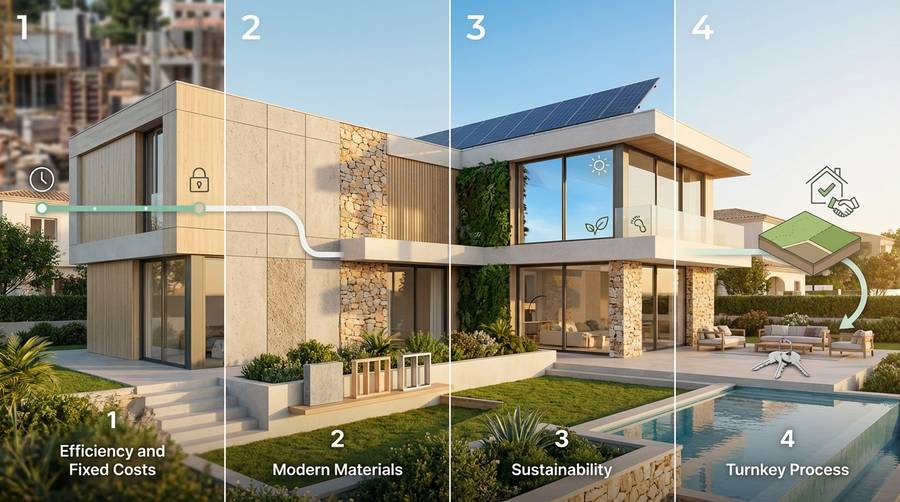
Top 4 Reasons to Choose a Prefabricated House in Spain
A concise, data-driven guide for self-builders in Spain: why prefabricated houses offer price certainty, shorter timelines, better energy performance and modern material choices — plus a practical turnkey roadmap and financing options.
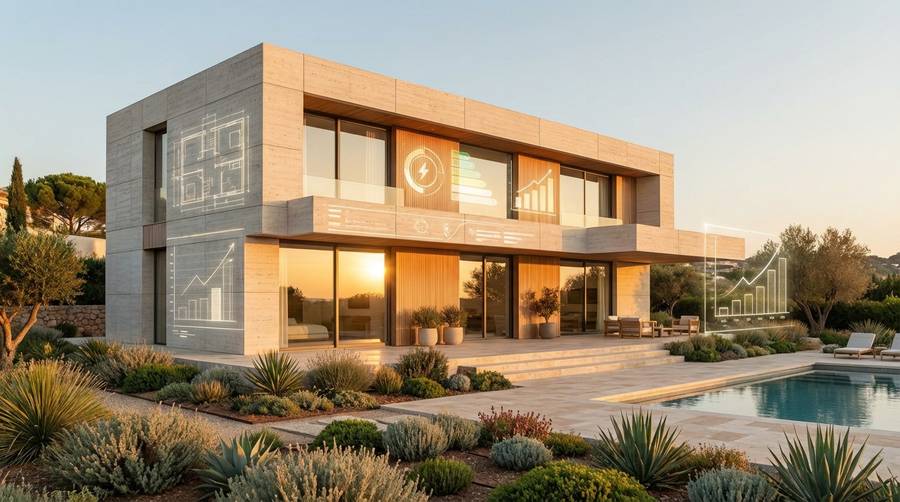
Prefabricated Houses Spain: Market Outlook 2026–2035
A forward-looking, data-driven analysis of how prefabricated houses will reshape Spain’s residential market from 2026 to 2035 — with technical comparisons, financing pathways, turnkey workflows and practical checklists for self-builders.