Modular Housing Emissions: 6 Ways Industrialized Homes Cut Carbon
Modular Housing Emissions: 6 Ways Industrialized Homes Cut Carbon
Hook: If you are planning a self-build or autopromotion in Spain, choosing an industrialized modular approach can reduce project uncertainty and significantly cut lifecycle emissions — when managed correctly. This guide gives you six concrete mechanisms where modular housing reduces carbon footprint, with metrics, practical checks and a realistic starter plan.
Lo esencial: what to expect from modular housing and its impact on emissions
Quick summary: key differences vs traditional construction
Industrialized housing centralizes production in factories, applies repeatable quality controls and compresses on-site work. Traditional builds rely on bespoke on-site assembly with variable workmanship, longer site activity and more logistics. For emissions, the differences matter in three areas:
- Process emissions: factory vs site waste and energy use.
- Operational performance: airtightness and insulation determine long-term energy use.
- Transport and logistics: fewer site deliveries, predictable schedules.
How industrialization reduces uncertainty (time, cost, quality)
Factories enable fixed production times, standardized quality control, and predictable costs. That predictability reduces the risk of rework — a key source of excess emissions in traditional builds. Use contractual milestones tied to measurable outcomes (air tightness, insulation R-value, window Uw) to convert construction certainty into quantifiable emissions savings.
Which emissions and efficiency metrics this list covers
This article focuses on actionable metrics you can measure or request from suppliers:
- Embodied emissions: kgCO2e per m2 for structure and envelope.
- Construction-phase emissions: tonnes CO2e from machinery, transport, and rework.
- Operational energy: kWh/m2/year, heating and cooling loads, and expected payback.
Industrial processes + early design integration = the most immediate CO2 reductions available to autopromoters without changing lifestyle.
1. Lower carbon footprint through factory control
Material control and waste reduction: factory vs site
Factories cut waste by optimizing cuts, batching material orders and reusing offcuts. On-site cutting generates variable waste rates (often 8–15%), while factory rates typically fall below 2–4%. That translates to lower embodied emissions because less material is produced and transported per finished square metre.
Modern materials: industrialized concrete, steel frame, light timber frame
Choose systems matched to project priorities:
- Industrialized concrete: high thermal mass, durable; use mix optimization (partial SCMs like fly ash or slag) to lower cement-related emissions.
- Steel frame: efficient for spans, recyclable; prefer high-recycled-content steel and design for disassembly.
- Light timber frame: low embodied carbon and renewable; specify certified sources (FSC/PEFC) and engineered timber for stability.
Typical metrics: estimated emissions reductions per m2
Representative numbers (project dependent):
- Modular timber-framed home: ~20–35% lower embodied CO2e per m2 vs conventional masonry.
- Steel-frame modular with recycled content: ~10–25% lower embodied emissions vs traditional steel-heavy solutions.
- Optimized industrialized concrete with SCMs: 5–20% lower cement emissions vs standard concrete mixes.
Tip: Request supplier LCA sheets or EPDs (Environmental Product Declarations) for the exact kgCO2e/m2 so you can compare systems apples-to-apples.
2. Superior energy efficiency by design and execution
Airtight envelopes and insulation in modular systems
Modular components are produced with consistent seals, pre-installed insulation and factory-checked junctions. Achieving air leakage values below 1.0 m3/h·m2@50Pa is common for well-executed modular homes, which reduces heating demand and associated emissions.
Compatibility with Passivhaus and passive measures
Industrialized methods simplify meeting Passivhaus-level criteria: precise window installation, continuous insulation layers, and factory-applied vapour control. Even if you don't pursue full Passivhaus certification, aim for elements of the standard — especially airtightness and thermal bridge control.
Real energy savings: consumption and payback
Example data points to use in your feasibility:
- Typical modular home (well-sealed): 40–60 kWh/m2·year heating demand — often 30–50% lower than a standard new traditional build in similar climate zones.
- Simple measures such as optimized glazing and mechanical ventilation with heat recovery (MVHR) can reduce operational energy further, with payback often under 10 years when combined with energy prices and incentives.
3. Shorter, closed schedules that lower indirect emissions
Fewer site visits, less machinery time
Condensed on-site installation means fewer trucks, less diesel machinery time and fewer worker commutes. These indirect emissions add up: a prolonged site can double transport-related CO2e compared to a well-coordinated modular installation.
Logistics: how fixed schedules reduce transport emissions
With factory production slots and scheduled deliveries, logistics can be optimized to avoid partial loads and repeat trips. Consolidated deliveries reduce empty running and improve load factors — a measurable cut in transport emissions.
Case comparison: calendars and emissions
Illustrative example (indicative figures):
- Traditional 150 m2 house: 9–12 months on site, 120–180 truck movements, higher rework potential.
- Modular 150 m2 house: 8–12 weeks on site for installation, 40–60 truck movements, lower rework.
Result: modular approach can cut site-phase transport emissions by 30–60% depending on distance to factory and logistics planning.
4. Sustainable materials and optimized life-cycle
Choosing low-impact materials: certified timber, optimized concrete
Prioritize materials with low embodied carbon and clear provenance. For timber, use certified suppliers. For concrete, require >20% SCM replacement where structural codes permit.
Durability, maintenance and long-term emissions
Durability reduces lifetime replacement demand. A slightly higher initial embodied carbon for longer-lasting cladding can out-perform a low-quality finish over 30–50 years. Ask manufacturers for maintenance schedules and expected lifespans to include in LCA modelling.
LCA indicators applied to modular homes
Request cradle-to-gate or cradle-to-site LCA outputs from suppliers covering:
- kgCO2e per m2 for core structure and envelope.
- Maintenance and replacement cycles (kgCO2e over 30–50 years).
- End-of-life considerations: recyclability or re-use potential.
5. Sustainable turnkey: integrated management that avoids overconsumption
How turnkey delivery reduces wasteful decisions
Turnkey projects transfer coordination to a single provider, which reduces fragmented procurement and last-minute substitutions that often increase carbon. A clear scope combined with design-for-manufacture reduces on-site improvisation and waste.
From plot search to handover: integrating energy and low-carbon solutions
Good turnkey processes integrate site analysis, orientation, passive solar strategy and PV-ready roofs from the start. Aligning these elements early reduces the need for retrofit add-ons that typically have worse carbon payback.
Financing: mortgages for autopromotion and green lines
Autopromoters can access dedicated mortgages and green loans that reward energy performance. When budgeting, include possible incentives and lower interest lines that improve payback for higher-efficiency choices. Speak with lenders who understand modular projects to avoid financing surprises.
6. How to start: practical steps for a low-carbon modular project
Choose the construction system and material for your climate and plot
Match system to site:
- Mediterranean, mild climates: timber frame with high insulation and solar shading.
- Coastal or high-humidity zones: optimized concrete or hybrid systems with vapour control.
- Urban parcels: tight-footprint steel frames for design flexibility.
Typical schedule, reference budget and environmental checkpoints
Starter plan:
- Design & permits: 2–4 months (include energy model and brief LCA targets).
- Factory slot & production: 6–12 weeks.
- On-site installation: 2–8 weeks depending on scope.
- Handover & commissioning: 2–4 weeks (air-tightness and MVHR balancing).
Budget reference: modular premiums are reducing — for many projects price parity with traditional approaches is achievable when you include reduced site costs, shorter financing periods and lower rework. Always request a breakdown: structure, envelope, services, finishes and commissioning.
Key questions to ask your team: certifications, emissions metrics and warranties
- Do you provide EPDs or LCA outputs for the shell and main materials?
- What airtightness value and U/W/SHGC figures will you guarantee?
- Which third-party certifications or testing do you use (e.g., Passivhaus, local energy ratings)?
- What is included in the turnkey scope and what are change-order costs?
Practical checklist for procurement: include specific CO2 or LCA clauses in contracts, require factory QA reports, and set completion air-tightness tests as contractual milestones.
Conclusion: integrate industrialized processes for measurable carbon wins
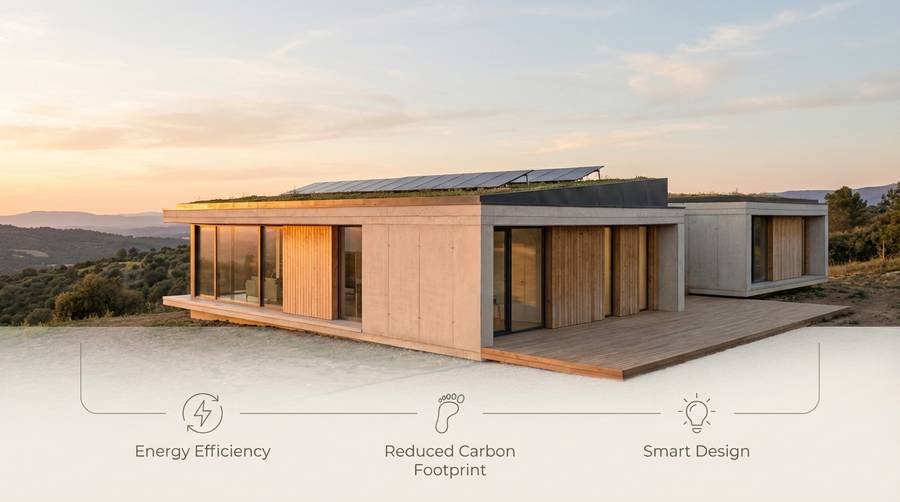
Industrialized modular housing offers distinct, measurable ways to reduce carbon: better material control, higher energy performance, shorter site activity, and integrated turnkey management. The benefits materialize when autopromoters demand transparency (EPDs, airtightness tests) and choose systems suited to their plot and climate.
If you want a practical next step, start by requesting comparative LCA sheets and a production schedule from two modular providers, and run a simple energy model for your plot. For further guidance on avoiding common pitfalls and ensuring Passivhaus-level efficiency in modular homes, see Vivienda industrializada: errores comunes y soluciones and our comprehensive autopromoter guide Vivienda industrializada: guía completa para autopromotores 2026.
Call to action: If you are planning an autopromotion and want a tailored checklist and sample LCA request template, contact our team to convert those carbon-saving mechanisms into a realistic project plan.