Prefabricated House: Common Errors and Practical Fixes
Why choose a premium affordable prefabricated house: realistic expectations
Hook: Many self-builders expect a faster, cheaper and greener home with a prefabricated house—but unclear assumptions can turn savings into delays and extra costs. This guide exposes the most common mistakes and gives precise solutions so your modular project delivers what it promises.
Advantages versus traditional housing: speed, cost certainty and project control
What you actually get: predictable schedules, fixed-price packages and factory-quality elements that reduce weather risk. A well-managed prefabricated house project typically shortens on-site work by 50–70% and reduces unexpected cost overruns seen in traditional builds.
Practical takeaway: Require a timeline with factory and on-site milestones, and a fixed-price clause for defined scope to capture those advantages.
Common warnings when comparing offers: spotting unrealistic promises
Watch for these red flags from any provider:
- Open-ended delivery dates without liquidated damages.
- Vague scope—"turnkey" with many exclusions (utilities, retaining walls, access).
- Claims of "Passivhaus" without certification or U-values provided.
Action: Ask for a sample contract with explicit exclusions and a certified thermal report.
Practical checklist to validate turnkey proposals
- Clear milestone schedule (factory, transport, assembly, finishes).
- Liquidated damages per week of delay.
- Detailed list of included finishes and brands.
- Warranties with duration and coverage.
Frequent errors when choosing a plot and how to fix them
Error: choosing land without checking municipal rules — Solution: urban checks guide
Problem: Buying a plot without confirming use, buildable area, or maximum height can invalidate your project or add large costs.
Fix: Before signing, obtain a written certificate of urban planning constraints (cédula urbanística or nota simple and consulta urbanística). Confirm:
- Permitted use and maximum buildable ratio.
- Setbacks, height limits and protected views.
- Required parking spaces and septic or drainage rules.
If the vendor resists providing documentation, walk away or use a conditional purchase contract.
Error: ignoring orientation and climate — Solution: simple orientation criteria for energy efficiency
Why it matters: Orientation affects solar gains, passive comfort and mechanical system sizing.
Rules of thumb:
- Maximize glazing to the south, limit glazing to the west.
- Favor natural shading (trees, pergolas) for hot summers.
- Consider prevailing winds for natural ventilation.
Request a solar study or simple sun path sketch from your architect to validate the plot before purchase.
Practical: what to ask the seller (services, access, hidden costs)
- Is the plot connected to municipal water, sewer, electricity and fiber?
- Who pays for connection works, meters and road access?
- Are there easements, right-of-way or flood risks?
Require written estimates for connection costs; include them in your budget contingency.
Design pitfalls and how to correct them
Error: standard designs not adapted to your lifestyle — Solution: key questions to personalize the project
Problem: Buying a repeated plan can leave you with poorly used space.
Fix: Before finalizing design, answer these 6 questions with your architect:
- How many hours a day and activities occur in each room?
- Which spaces must be flexible (home office, guest room)?
- Storage needs: seasonal, bulky items, daily access?
- Indoor-outdoor flow: terraces, privacy and level access?
- Future-proofing: accessibility, aging in place?
- Desired thermal comfort and ventilation strategy?
Document answers and convert them into measurable design requirements (m2 per function, daylight hours, window sizes).
Error: over- or undersizing technical spaces — Solution: practical metrics for kitchen, storage and ventilation
Common traps: Too-small plant rooms that complicate maintenance; oversized corridors that waste budget.
Practical metrics:
- Kitchen: plan circulation triangle and allow 1.2–1.5 m clearance in primary work aisles.
- Storage: minimum 3–5 m3 per person for household storage; add 4–6 m2 for bulk storage in single-family homes.
- Plant room: at least 1.2 m clear service front and 0.6 m side access for equipment; size per HVAC and hot water kit documented by supplier.
Practical: integrate Passivhaus and sustainable solutions without inflating cost
Approach: Use targeted measures with highest ROI:
- High-performance thermal envelope (insulation, airtightness).
- Right-sized mechanical ventilation with heat recovery.
- Solar shading and optimized glazing ratios.
Cost-control tip: prioritize envelope and ventilation first; photovoltaic systems and battery storage come after energy demand is minimized.
Material and construction system mistakes and reliable alternatives
Error: choosing by price alone — Solution: compare industrialized concrete, timber frame and steel frame
Reality check: Lowest-price materials can cost more over the lifetime due to maintenance, thermal performance or moisture problems.
Comparative summary:
- Industrialized concrete: excellent thermal mass, fire resistance and durability; higher initial cost but lower maintenance.
- Timber/light frame: fast, sustainable when certified wood is used, good thermal performance and high design flexibility.
- Steel frame: precision, large spans and reduced thickness; needs careful thermal bridge treatment.
How to compare: Request life-cycle cost estimates, not only initial price. Ask for sample details showing connections, U-values and maintenance guidance.
Error: confusing marketing with thermal performance — Solution: practical indicators to evaluate energy efficiency
Do not accept vague claims. Ask for:
- Declared U-values for walls, roof and glazing.
- Airtightness target (n50 value) and whether a blower-door test is included.
- Thermal bridging details at junctions and balconies.
Insist on real test reports or third-party certifications when possible.
Practical checklist for materials quality and warranties
- Material brand and model per major element (windows, insulation, cladding).
- Warranty length and what it covers (water ingress, structural, finishes).
- Maintenance recommendations and replacement costs.
Financing, contracts and permits: avoid these mistakes
Error: accepting unsuitable mortgage terms — Solution: keys for self-build and modular financing
Typical problems: Short disbursement windows, variable rates without caps, and insufficient coverage for construction phases.
What to demand:
- Clear disbursement schedule aligned to construction milestones.
- Ability to convert a construction loan into a long-term mortgage with known fees.
- Interest rate caps or fixed-rate options for stability.
Work with a broker experienced in autopromotion mortgages and modular housing. They can compare offers and spot hidden commissions.
Error: vague turnkey contracts — Solution: essential clauses that must appear
Make sure contracts include:
- Detailed scope list and drawings referenced as contract appendices.
- Penalties for delay and malfunctioning work.
- Acceptance criteria and final inspection checklist.
- Warranty terms and dispute-resolution mechanism.
Never sign a contract that leaves finish specifications or guarantees to a later "agreement"—put them in the main contract.
Practical: permit calendar and administrative milestones to avoid delays
Create a permit calendar with responsible parties and target dates for:
- Municipal building license (licencia de obra).
- Environmental approvals if required.
- Utility connection permits and inspections.
Assign one person (your project manager or architect) to own follow-ups with the town hall and utility companies.
Risks during execution and delivery: control measures and practical solutions
Error: lacking quality controls during factory assembly and on-site work — Solution: phase inspection checklist
Quality is built in when checked early. Use this inspection checklist by phase:
- Factory: module tolerances, core connections, airtightness panels, labeled components.
- Transport: protection of finishes, fixation points, insurance for damages.
- On-site assembly: foundation tolerances, alignment, waterproofing at junctions, mechanical commissioning.
- Handover: systems tests, walkthrough with checklist and documented defects list with deadlines.
Bring a third-party inspector for key milestones or perform video inspections if travel is constrained.
Error: accepting open-ended timelines — Solution: real metrics and a short case study
Reality: A typical 140–180 m2 prefabricated house in Spain with a turnkey supplier can follow this schedule:
- Design finalization and permits: 3–6 months.
- Factory production: 6–10 weeks.
- Transport and assembly: 2–4 weeks.
- Finishes and commissioning: 4–8 weeks.
Example case: A 150 m2 family home using timber frame finished in 18 weeks from factory start to client handover; total project from contract signature to keys: 6 months. Customer-reported satisfaction: 9/10 (comfort, delivery time, transparent costs).
Use such metrics in negotiations and require the supplier to commit to similar milestone guarantees.
Image description for AI generator
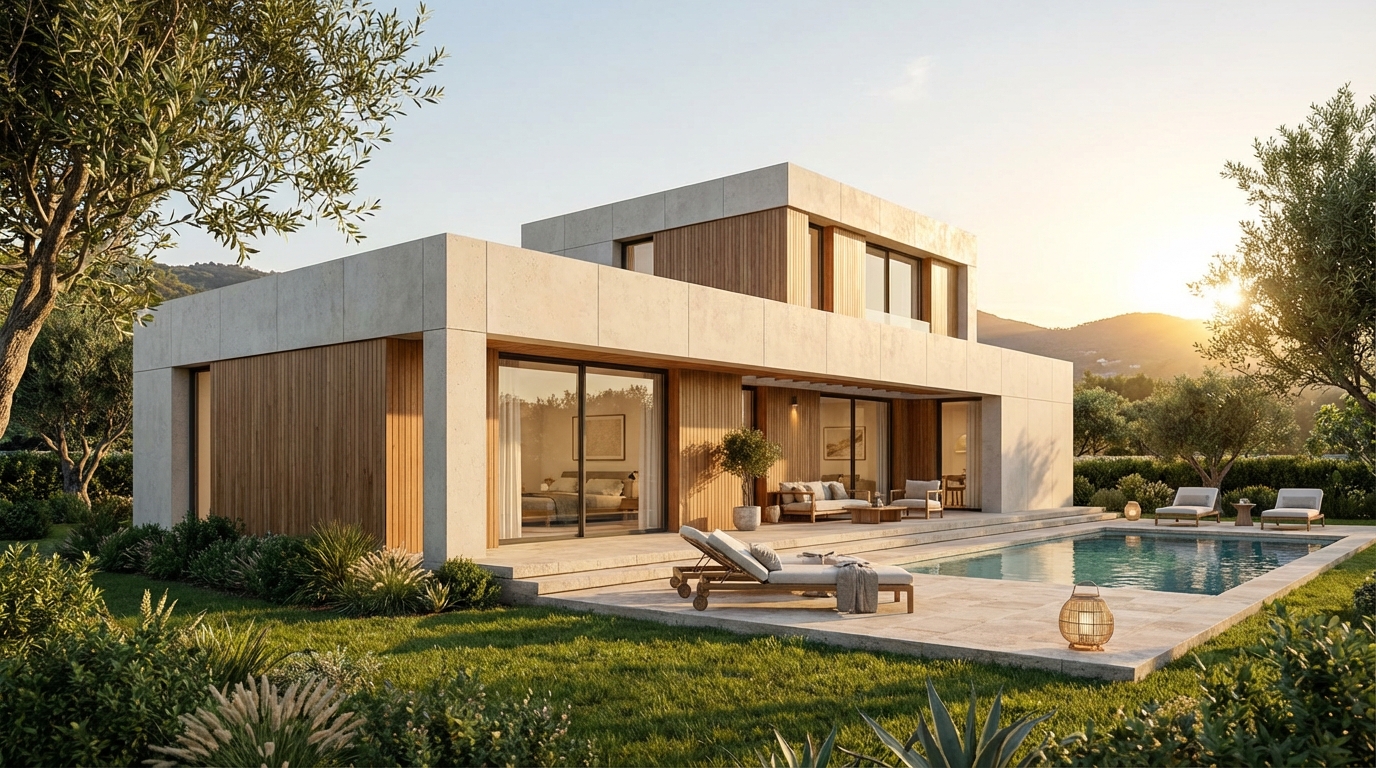
Photograph in Findnido style of a finished premium Mediterranean prefabricated house in a residential Spanish setting. The home is real and contemporary: light façade combining natural stone, warm wood accents and smooth concrete. Large windows and a terrace with planted Mediterranean garden. Golden hour lighting, warm natural tones, editorial real-estate quality. A family relaxed on the terrace in the foreground to convey lifestyle and trust. No container-like shapes, no exposed construction systems, no factory or industrial backdrop. The scene should feel lived-in, sustainable and aspirational yet achievable.
Conclusion: practical next steps and subtle CTA
Bottom line: Prefabricated houses deliver speed, cost control and sustainability—if you avoid the common mistakes above. Verify land regulations, demand measurable design requirements, compare life-cycle costs of materials, secure suitable financing and insist on phased inspections.
If you are planning a self-build prefabricated house, start by gathering the documents and answers from the checklists in this article. That short upfront diligence prevents the majority of delays and budget surprises.
Call to action: If you want a tailored checklist for your plot or a review of a turnkey proposal, contact a qualified project manager or architect to convert these steps into an executable plan.
Artículos relacionados