Prefabricated Housing vs Traditional: Pros & Cons
Prefabricated housing in Spain: why it matters now
Hook: If you're planning to build a home in Spain, the choice between prefabricated (modular) and traditional construction will determine your timeline, budget predictability and long-term comfort. This article gives a clear, balanced comparison to help you decide.
Prefabricated housing—also called industrialized housing or modular building—has moved from niche to mainstream in Spain. Driven by housing demand, stricter energy rules, and a push for lower delivery times, modern prefabrication now competes on quality, not only on speed. Below you'll find concise, actionable analysis focused on costs, timelines, materials, sustainability, the turnkey process for self-builders, financing options and real case metrics.
Prefabricated homes can cut on-site time by 40–70% while offering predictable final prices—trade-offs depend on systems and site complexity.
Comparative snapshot: prefabricated vs traditional
Before deep-diving, here are the main differences at a glance:
- Cost predictability: Prefabrication typically delivers a fixed-price contract; traditional projects often face on-site variations.
- Schedule: Factory production shortens on-site work significantly; traditional builds require longer curing, weather-dependent phases.
- Quality control: Industrial processes improve repeatability; craftsmanship in traditional builds varies with teams and supervision.
Costs: fixed price vs potential overruns
Prefabricated housing
- Most modular providers offer a near-fixed price from design freeze to delivery. This reduces risk for self-builders.
- Real-world example: a 120 m² three-bedroom modular home delivered turnkey in 2024 in Spain reported a contracted price variance of ±3% due to site-specific foundations and connections.
- Common additional costs: plot preparation, utility hookups, terraces and landscaping, urbanization fees.
Traditional construction
- Initial budgets often rise 10–30% due to unforeseen groundworks, weather delays, and contract change orders.
- Longer schedules increase financing costs (interest during build) and can push final delivery beyond planned dates.
Times and schedules: factory control vs site variability
Prefabricated approach
- Typical timeline: 4–6 months factory + 2–6 weeks on-site assembly for standard single-family homes.
- Predictability improves when the design is fixed prior to production; changes during manufacture are costly.
Traditional approach
- Typical timeline: 12–24 months depending on size and approvals.
- Weather, material deliveries and subcontractor scheduling introduce variability.
Quality, durability and maintenance
Prefabricated homes
- Manufacturing in controlled conditions reduces moisture-related defects and improves finish consistency.
- Warranties and factory QA protocols offer traceability; inspect warranty scope (structure, envelope, mechanical systems).
- Potential downside: transport limits component dimensions; complex custom features can raise cost.
Traditional homes
- Proven long-term durability if built to code and well supervised.
- Variability in workmanship can mean inconsistent envelope performance unless rigorous site QA is enforced.
Materials and systems: strengths, limits and best-fit uses
Modern prefabrication in Spain uses three primary systems: industrialized precast concrete, light timber framing, and steel frame (steel stud). Each has clear trade-offs.
Industrialized precast concrete
Advantages: robustness, excellent acoustic and thermal inertia, longevity. Good for social housing or urban infill where fire resistance and low maintenance are priorities.
Limitations: higher transport weight and cost; architectural expression needs careful detailing to avoid monolithic aesthetics.
Light timber frame (Entramado ligero de madera)
Advantages: lightweight, fast assembly, low embodied carbon when sourced responsibly, excellent thermal performance when insulated correctly.
Limitations: requires strict moisture protection and detailing in Spanish coastal climates; maintenance of external claddings is essential.
Steel frame (Steel frame)
Advantages: precision, long-span flexibility, high reproducibility. Ideal where design flexibility and large glazed openings are desired.
Limitations: thermal bridging must be mitigated; embodied carbon is higher than timber but lower than some concrete solutions if optimized.
Sustainability and energy efficiency: beyond marketing claims
Evaluating sustainability means assessing operational energy, embodied carbon and life-cycle costs. Industrialized housing can excel if design choices are intentional.
Passivhaus strategies that work in industrialized homes
- Continuous thermal envelope produced in factory reduces on-site errors.
- High-performance windows and mechanical ventilation with heat recovery (MVHR) are easier to integrate into a controlled assembly process.
- Orientation, shading and simple thermal mass strategies still matter and must be considered at design stage.
Reducing carbon footprint: realistic balances
Key levers: choose low-carbon materials (certified timber, optimized concrete mixes), reduce waste via factory precision, and integrate renewable energy (PV, heat pumps).
Example metric: a timber-frame modular house optimized for low emboded carbon can cut construction-stage CO2 by up to 30% vs a similar concrete traditional build, depending on foundation and transport distances.
Long-term operating savings
- Energy-efficient modular homes often achieve 30–60% lower heating and cooling costs versus poorly insulated traditional homes.
- Lower operating costs improve total cost of ownership and can justify a modest premium at purchase.
The turnkey process for self-builders: practical steps
Turnkey modular solutions simplify many coordination tasks, but self-builders must still manage key decisions. Below is a practical roadmap with responsibilities.
1) Plot selection and urban viability
- Check basic constraints: permitted build area, maximum height, set-backs and local architectural requirements.
- Do a geotechnical study early—foundation type affects cost significantly.
- Checklist: utilities availability, access for transport cranes, protected zones or landscape constraints.
2) Design freeze, permits and factory production
- Lock design before factory production. Late changes increase cost and delay delivery.
- Coordinate with the modular supplier on interfaces: plumbing stacks, mechanical systems and electrical routing.
- Permits: provide the certified plans required by the local town hall; most turnkey providers assist with documentation.
3) On-site assembly, quality control and handover
- Typical on-site activities: foundations, craning and assembly, final connections and finishes.
- Demand clear quality control checkpoints and as-built documentation, including commissioning reports for mechanical systems.
- At handover verify warranties, manuals and spare parts for installed systems.
Deciding with data: financing, case studies and a decision checklist
Financing options and mortgages for self-build modular homes
Financing modular homes is similar to financing traditional builds but requires clarity in contracts and delivery milestones.
- Self-build mortgages and construction loans are available; some lenders now have specific products for turnkey modular homes.
- Key lender requirements: fixed-price contract, clear timeline, and a certified completion certificate. Factor in bridge financing if you sell an existing home.
- Tip: compare interest during construction and ask lenders about valuation of factory-built components.
Real case studies (2024–2026): metrics that matter
Case A — Social family home, timber frame, Seville area (2024)
- Gross floor area: 110 m²; turnkey delivery time: 5.5 months total (4 months factory, 6 weeks on-site)
- Contracted price variance: +2% for additional foundation works; client satisfaction: 9/10 (post-occupancy survey)
- Key takeaway: fast delivery and predictable costs made the project feasible within a constrained budget.
Case B — Prefabricated concrete social units, Valencia (2025)
- Ten units delivered in 9 months; industrialized precast reduced site noise and allowed simultaneous finishes of interiors in factory.
- Operational energy reduction: ~35% compared to local baseline multi-family stock.
Decision checklist for autopromoters
- Confirm plot constraints and crane access.
- Obtain a fixed-price turnkey offer with scope and exclusions clearly listed.
- Require factory QA reports and warranty conditions in the contract.
- Plan financing with lender requirements for modular delivery.
- Consider lifecycle costs (energy, maintenance) not only upfront price.
Practical recommendations: when to choose prefabricated housing
- Choose prefabrication if you value a predictable schedule and budget, want high indoor comfort quickly, or face tight site constraints with sensitive neighbors.
- Prefer traditional construction when the site requires highly bespoke, complex on-site geometry or when you need phased, incremental expansion not suitable for factory modules.
Further resources
For a deeper technical comparison and practical guidance, see our related guides: Vivienda prefabricada: ventajas, materiales y financiación, Vivienda prefabricada: caso real de transformación familiar and Vivienda prefabricada: errores comunes y soluciones.
Image concept (Findnido brand brief)
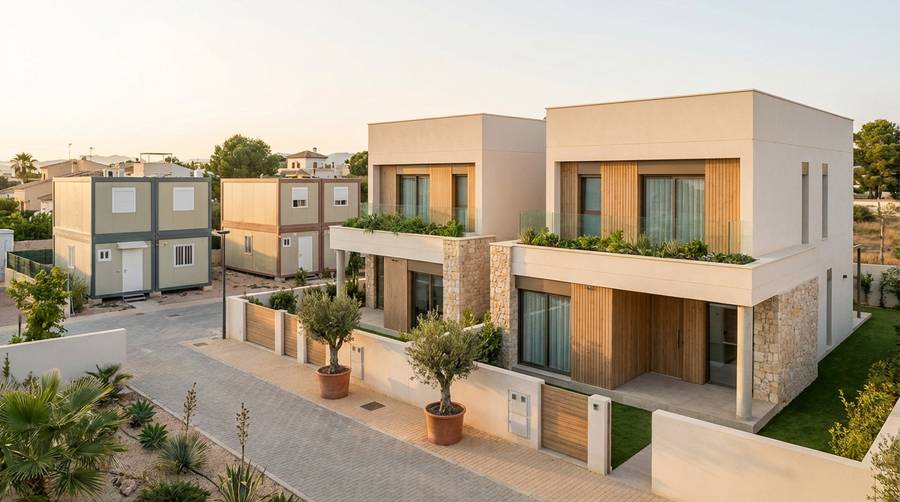
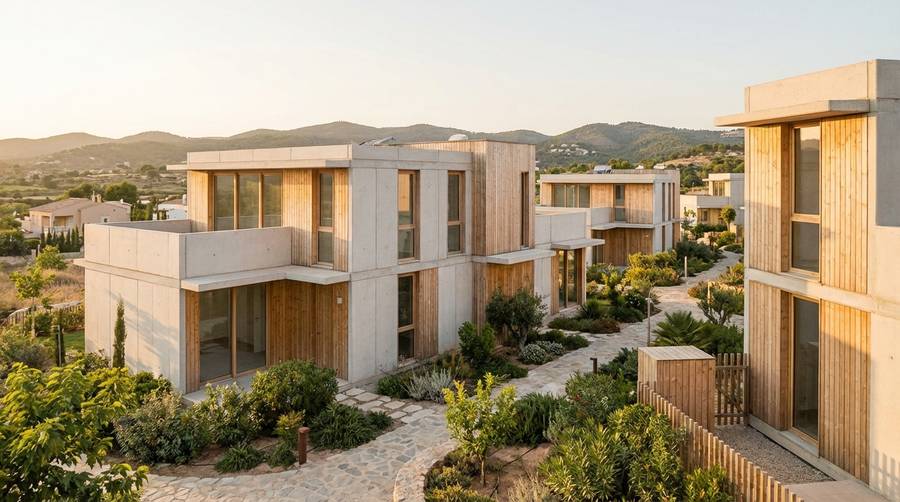
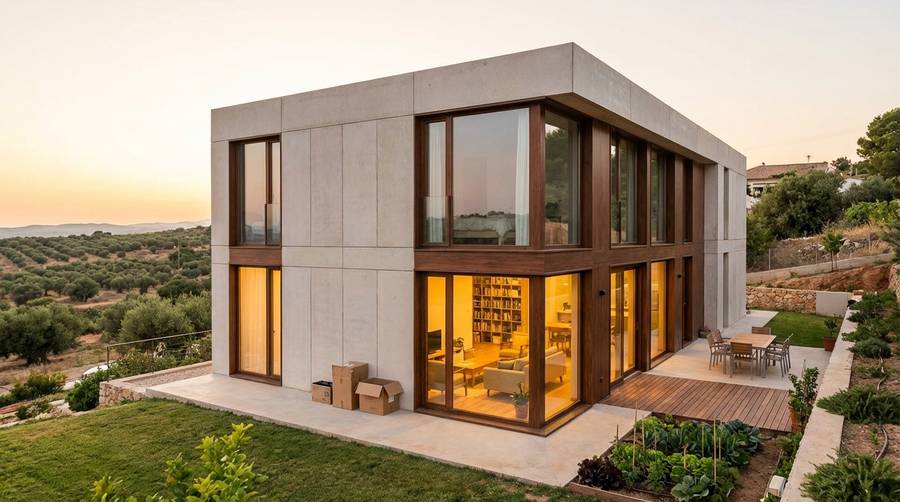
Image description for AI generator: A finished Mediterranean-contemporary detached home in Spain built using industrialized methods. Light-colored rendered façade with warm wood and stone accents, large floor-to-ceiling windows glowing with golden-hour light. A family of four relaxes on a terrace with potted native plants and a small lawn; the scene feels lived-in and aspirational. Framing resembles premium real estate photography at golden hour: soft shadows, natural colors, balanced composition. Emphasize sustainable cues (solar panels discreet on roof, native landscaping) but avoid any exposed construction or modular boxes. The house should read as a high-quality, finished Spanish home — modern, comfortable and trustworthy, consistent with Findnido’s brand identity.
Conclusion
Summary: Prefabricated (modular) housing in Spain offers clear advantages in schedule control, budget predictability and factory-level quality. Material choice—concrete, timber frame or steel—should match your site, climate and lifecycle goals. Turnkey modular solutions reduce coordination for self-builders, but due diligence on plot viability, financing and warranty scope is essential.
If your priorities are speed, energy efficiency and predictable costs, prefabricated housing is often the better route. If you need extreme bespoke design or phased on-site customization, traditional construction may fit better.
Next step (CTA): If you want a tailored feasibility check for your plot or a side-by-side cost and timeline estimate, contact a modular provider or request a turnkey quote — informed decisions start with clear numbers.