Industrialized Housing Success Story: Faster, Greener Homes
Industrialized Housing Success Story: Faster, Greener Homes
Hook: Imagine moving into a newly built Mediterranean home in under six months from the moment the foundation was poured—finished, certified and on budget. This is the story of one family in Spain who chose industrialized housing and achieved exactly that. Below you will find concrete metrics, the decisions that mattered, and a practical roadmap for autopromoters who want speed, quality and sustainability.
How this project began: from idea to choosing industrialized construction
Promoter context: needs, plot and family vision
The clients were a young family relocating from the city to a coastal town near Valencia. Key requirements: a bright, low-maintenance home; large living spaces connected to an outdoor terrace; strict energy-efficiency targets; and a predictable schedule to match a school year. The plot was suburban, slightly sloped, with easy access but a narrow build footprint—conditions that favored a modular, factory-built solution.
Why they chose industrialized housing over traditional build
They weighed three critical factors: time certainty, cost predictability, and thermal performance. Traditional on-site construction introduced variability on all three. Industrialized housing promised closed timelines (short on-site assembly), a fixed-price contract, and factory-controlled quality—all highly valuable for the family's schedule and budget constraints.
Initial expectations: schedules, budgets and sustainability criteria
Initial KPIs established with the project team:
- Turnkey delivery within 9 months from contract signature.
- Total cost within a ±5% band of the fixed price.
- Design to meet at least EnerPHit/Passivhaus EnerPH standard targets for airtightness and primary energy.
Project description: Mediterranean design and modern materials
Architecture and style: Mediterranean contemporary adapted to the Spanish climate
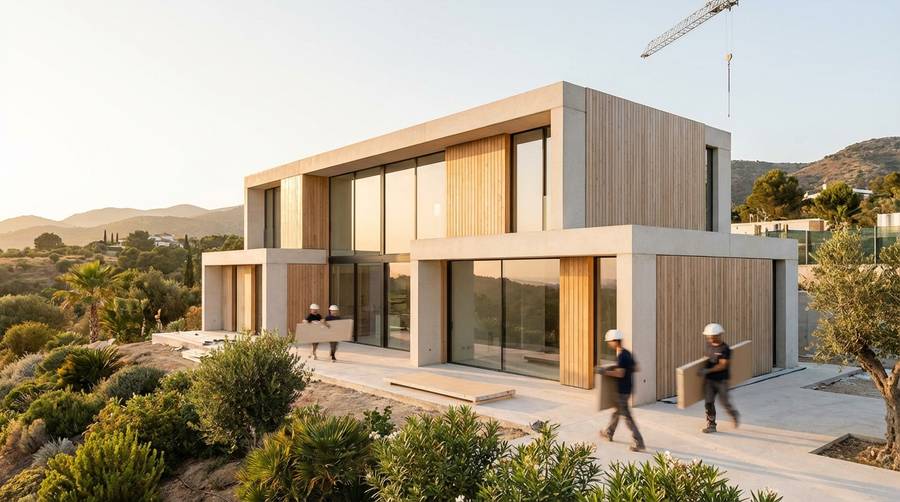
The design language married clean Mediterranean volumes with warm natural materials. Large windows oriented to the south capture winter sun while deep overhangs shade in summer. Interior layouts prioritize cross-ventilation and indoor-outdoor living: an open-plan kitchen-living-dining area flows to a covered terrace with native landscaping.
Choice of structure: industrialized concrete, light timber frame and steel frame — reasons and benefits
The project used a hybrid approach:
- Industrialized concrete elements for the basement slab and key structural load paths—offering durability, thermal mass and high fire resistance.
- Light timber frame for external walls and internal partitions—fast assembly, high insulation capacity, and low embodied energy.
- Steel frame for large-span roof and terrace canopies—thin sections that allowed open interiors and prefabricated precision.
These choices balanced speed, thermal performance and local construction customs. Timber reduced onsite weight and assembly time; concrete provided long-term robustness; steel enabled architectural freedom.
Energy efficiency and Passivhaus objectives from design phase
From schematic design the team prioritized:
- Continuous insulation with minimal thermal bridges.
- Airtightness targeting n50 ≤ 0.6 h-1.
- Mechanical ventilation with heat recovery sized for actual occupancy patterns.
- Renewable systems: photovoltaic array sized for net consumption, and an efficient heat pump for DHW and space heating.
The challenge: express assembly and micro-schedules without compromising quality
Planning and coordination for tight deadlines (detailed timeline)
A rigorous Gantt schedule broke the program into factory and on-site sequences. Key milestones:
- Design freeze and production package: week 0–6.
- Factory production of modules and elements: week 7–14.
- Foundation, utilities trenches and slab readiness: week 10–14 (overlapped).
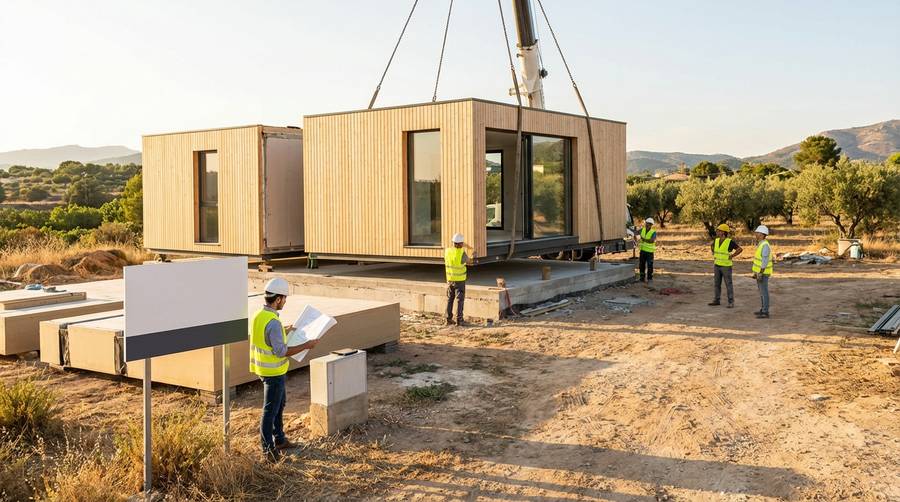
- Transport and on-site assembly: week 15–18.
- Envelope closure, systems commissioning and finishes: week 19–24.
Overlap between factory and civil works reduced the total calendar time by 30% compared to traditional sequencing.
Factory-to-plot logistics: prefabrication, transport and record-speed assembly
Elements were delivered in protective packaging and installed with a 10-person site crew over three intensive days for the main modules, followed by specialist crews for airtightness and services. The controlled factory environment eliminated weather delays and quality variation common to in-situ builds.
Handling surprises and quality control during rapid assembly
Two practical measures preserved quality:
- Daily cross-disciplinary stand-ups during the on-site phase focused on interface details between modules and services.
- A third-party airtightness and thermal commissioning team tested envelope continuity immediately after enclosure to catch issues while access was easy.
"Factory conditions and early commissioning allowed us to detect and fix 90% of potential defects before landscaping—an outcome impossible with traditional build schedules."
Turnkey process: clear steps and responsibilities
From plot search to delivery: turnkey contract milestones
The turnkey approach defined responsibilities clearly. Milestones included:
- Site validation and geotechnical study.
- Design development and permit package.
- Factory production and QA checks.
- On-site assembly, systems integration and commissioning.
- Final inspection, certifications and handover with an operation manual.
This contract model reduced negotiation overhead for the family and placed warranty responsibility largely with the industrialized provider.
Permits, paperwork and synchronization with utilities under tight schedules
Key administrative actions that avoided delays:
- Early submission of permit documents while production drawings were finalized.
- Pre-booking utility connections (electricity, water) with conditional start dates tied to assembly milestones.
- Using a local project manager to coordinate municipal inspections around the tight assembly window.
Financing options: self-build mortgages and staged payment solutions
The family used a hybrid financing route: a self-build mortgage that released funds based on milestones, combined with a small bridge loan to cover early factory production. This approach aligned cash flow with the fixed-price contract and reduced the need for a high initial down payment.
Measurable results: time, cost and client satisfaction
Concrete metrics: time saved and final cost vs initial budget
Outcomes compared to initial KPIs:
- Turnkey delivery in 24 weeks from contract signature (target was 36 weeks for a similar traditional build).
- Final cost came in +3% above the fixed price due to an upgraded solar array requested mid-construction—well within the ±5% band.
- On-site assembly time reduced by 70% compared to a typical two-story on-site build of similar size.
Energy performance and carbon footprint: predicted vs achieved
Measured first-year performance:
- Airtightness: n50 = 0.5 h-1 (below the 0.6 target).
- Primary energy consumption: 35 kWh/m2/year (consistent with EnerPH targets for the climate zone).
- Operational CO2 emissions were reduced by an estimated 60% compared to a conventional Spanish house of the same size, thanks to the envelope and PV production.
Client testimony: satisfaction, living use and perception of the process
The family reported high satisfaction with:
- Living comfort: stable indoor temperatures and low heating/cooling bills.
- On-time moving: no temporary accommodation costs.
- Communication: clear milestones and a single point of responsibility reduced stress compared to their experience with previous renovations.
Technical and competitive comparison: what made the difference
Objective comparison with traditional construction: closed timelines, fixed price and risk mitigation
Industrialized delivery shifted several risks away from the client:
- Weather delays largely eliminated.
- Quality variance reduced by factory QA processes.
- Cost overruns minimized through a fixed-price turnkey contract.
Technical advantages of each material and their impact on schedule
Material impact summary:
- Concrete: allowed immediate load-bearing capacity and quick service connections to slab-embedded conduits.
- Timber frame: cut production time and improved thermal performance with high prefab insulation panels.
- Steel frame: enabled clear spans for the living area without time-consuming onsite fabrication.
Why this hybrid solution outperformed other industrialized alternatives
Many off-the-shelf modular vendors offer quick modules but compromise on long-term thermal performance or architectural integration. This project used a hybrid method to maintain a Mediterranean aesthetic while achieving Passivhaus-level performance—combining the best attributes of several systems rather than relying on a single, one-size-fits-all product.
Lessons learned and a practical guide for future self-builders
Five key recommendations for hiring express assembly and managing tight schedules
- Lock design decisions early: late changes drive factory rework and delays.
- Parallelize tasks: overlap site works and factory production where safe and contractually clear.
- Choose a turnkey provider with in-house QA and third-party commissioning experience.
- Pre-book utilities and inspections to match assembly windows.
- Plan contracts with staged payments tied to verifiable milestones.
Common mistakes to avoid and communication best practices
Avoid vague scope descriptions that leave finish decisions until late. Maintain weekly visual progress reports and a shared document repository. Assign a single client contact to reduce mixed messages and accelerate approvals.
Final checklist: documents, critical dates and supplier selection criteria
- Validated permit and structural calculation pack before factory starts.
- Airtightness and thermal bridging strategy sealed in contract documents.
- Delivery windows and crane scheduling confirmed at least 6 weeks before assembly.
- Service coordination plan (electric, water, sewer) with draw-down schedule.
Closing inspiration: results that encourage building differently
Summary of impact: delivered home, happy family, achieved sustainability goals
This case proves that speed, quality and sustainability can coexist when planning is precise and construction is industrialized thoughtfully. The family moved in on schedule, energy goals were met, and the house blends with the Mediterranean context while performing beyond typical expectations.
How this case demonstrates that speed, quality and sustainability can align
Success factors were: early integration of energy goals, hybrid material strategy, factory QA, and a turnkey contract model that defined responsibilities and mitigated client risk. These elements allowed the project to hit tight deadlines without compromising comfort or certification targets.
Invitation: next steps for readers considering industrialized housing
If you are exploring a self-built home in Spain, start by clarifying your non-negotiables: timeline, budget tolerance and energy targets. Use those to screen turnkey providers and demand evidence of factory QA, airtightness testing and real-case metrics.
Call to Action: Reflect on your priorities and request a documented timeline and sample performance data from any provider you consider. If you want, contact our platform to compare verified industrialized housing options and real case metrics tailored to your plot and goals.