Industrialized Housing in Spain: 7 Practical Advantages
Industrialized Housing in Spain: 7 Practical Advantages
Hook: If you plan to build your own home in Spain, industrialized housing gives you predictable costs, shorter delivery times and better energy performance than conventional on‑site builds — when executed with the right process.
1) Why choose industrialized housing in Spain: core advantages
Industrialized housing is not a single product but a delivery model: components and assemblies produced under factory conditions and assembled on site. For autopromoters this model brings three decisive advantages.
Efficiency and fixed, shorter timelines
What to expect: typical project timelines for a turnkey industrialized single‑family house fall between 4 and 8 months from factory start to handover, depending on size and finishes. That compresses overall delivery by 30–60% versus traditional builds.
- Parallelization: design, permitting and fabrication can overlap.
- Controlled assembly: on‑site time focuses on foundations and installation — less weather risk.
- Predictable milestones: factory schedules reduce late surprises.
Fixed price and budget control
Why it matters: industrialized delivery often offers clearer fixed‑price contracts because much of the work is predefined and produced in controlled conditions. For autopromoters this reduces financial risk and makes mortgage underwriting simpler.
- Manufacturing allows bulk procurement and fewer subcontractor variations.
- Change orders are still possible but are easier to price because of repeatable assemblies.
- Tip: require clear scope, a payment schedule linked to factory milestones and a retention to protect against defects.
Consistent build quality and reduced execution uncertainty
Factory processes deliver repeatable quality: consistent insulation installation, tighter joints and documented QC checks. That translates into fewer site defects and faster commissioning.
Real gains from industrialization come from process control: when you standardize production, you convert uncertainty into predictable outcomes.
2) Energy efficiency and certifications: Passivhaus and carbon reduction
Energy performance matters for living comfort and long‑term value. Industrialized homes are particularly well suited to meet high efficiency targets.
What Passivhaus means for daily consumption and comfort
Passivhaus is a performance standard that reduces heating and cooling demand by prioritizing insulation, airtightness and heat‑recovery ventilation. In Spain, a Passivhaus‑level industrialized house can cut space‑heating energy by 70–90% compared to a conventional build.
Passive and active measures: insulation, airtightness and efficient systems
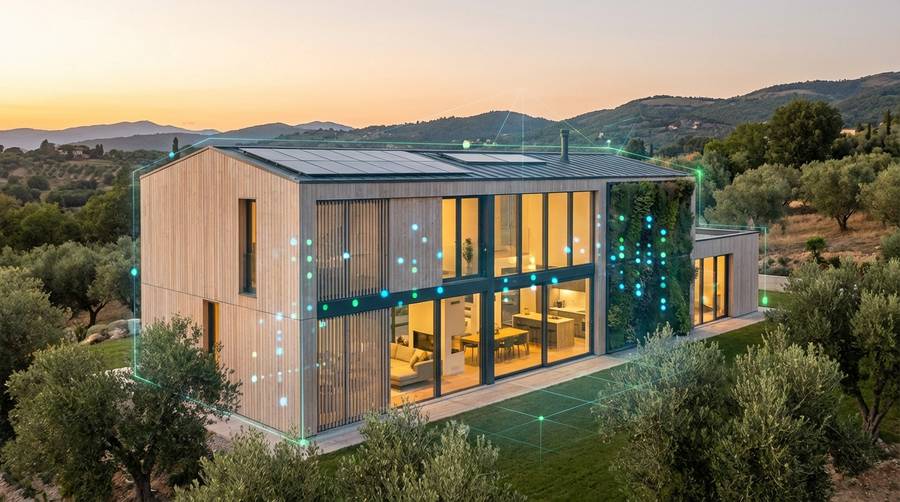
Passive measures: continuous external insulation layers, thermally broken frames, optimized window placement and compact envelope geometry. In factory fabrication, these elements are easier to install consistently.
Active measures: mechanical ventilation with heat recovery (MVHR), high‑efficiency heat pumps and solar PV with smart controls. Combine passive and active systems and you reduce both operational cost and maintenance risk.
Impact on emissions and long‑term home value
Lower operational energy reduces lifetime CO2 and improves marketability. Buyers increasingly look for certified energy performance; a documented Passivhaus or A rating supports resale and can ease financing terms.
3) Modern materials and structural systems: choosing what fits your project
Material selection should follow project priorities: durability, sustainability, thermal performance and design flexibility. Below are common systems used in Spain for industrialized housing.
Industrialized concrete: structural performance and longevity
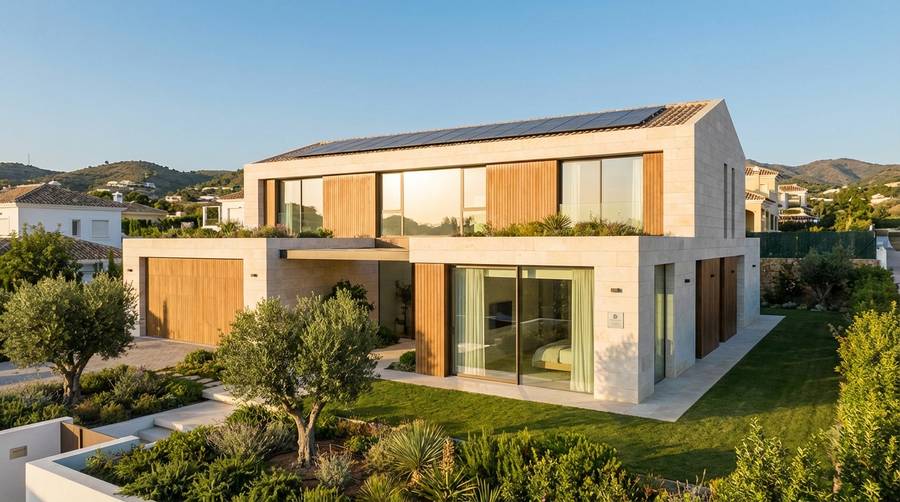
Precast and industrialized concrete elements offer exceptional structural capacity, fire resistance and acoustic performance. They are ideal for sloped sites, basements or when thermal mass is desired.
- Best for: projects where durability and low maintenance are priorities.
- Consider: transport costs and heavier foundations.
Light timber frame: speed, comfort and sustainability
Entramado ligero de madera (light timber frame) balances rapid assembly, low embodied carbon and excellent thermal performance. Factory‑cut panels reduce waste, and timber is a renewable resource when sourced responsibly.
- Best for: low‑rise single‑family homes prioritizing sustainability and speed.
- Key detail: airtightness strategy and moisture control must be specified and tested.
Steel frame: flexibility and design freedom
Steel frame systems (steel‑stud, cold formed) are light, dimensionally stable and allow large spans. They suit contemporary architectures and fast delivery, but require careful detailing for thermal breaks and fire protection.
- Best for: open‑plan designs and façades with large openings.
- Consider: acoustic treatment and corrosion protection in coastal zones.
4) Costs and financing: autopromotion mortgages and payment models
Cost transparency and financing are decisive. Industrialized housing changes the cost profile — more predictable manufacturing costs, but different cashflow timing.
Typical cost breakdown for a turnkey industrialized house
Example allocations for a high‑quality turnkey single‑family home (numbers illustrative):
- Land acquisition: 20–35%
- Design, permits and engineering: 6–10%
- Factory fabrication and materials: 30–45%
- Foundations and on‑site works: 8–15%
- Systems, finishes and commissioning: 10–20%
These ratios vary with plot constraints, finishes and systems. Always request a costed Bill of Quantities tied to defined finishes.
Financing options in Spain: autopromoter mortgages and specialised lines
Autopromotion mortgages in Spain finance land purchase and construction. For industrialized homes banks may require:
- Detailed project documentation and schedule.
- Fixed‑price turnkey contract with an accredited builder/manufacturer.
- Milestone‑based drawdowns aligned to factory and assembly progress.
Some lenders offer specific products for modular or prefabricated homes; compare conditions and insist on lender familiarity with off‑site construction.
Negotiation tips: guarantees, penalties and payment terms
- Link payments to objective milestones (e.g., foundation completion, module delivery, watertight status).
- Require performance guarantees and defined remedies for delays.
- Hold a retention (5–10%) until final commissioning and defects period expires.
5) Turnkey process: from plot search to handover, step by step
A clear process reduces surprises. Below is a practical step plan with decisions autopromoters must resolve early.
Plot search and technical feasibility
Evaluate these items before purchase:
- Zoning and permitted build ratio (edificabilidad).
- Topography and geotechnical constraints (slope, rock, groundwater).
- Access for transport and crane operations; this affects module size and logistics.
- Local connection capacity for water, electricity and sewer.
Ask the manufacturer to review site photos and a preliminary topo to confirm feasibility before you sign an option on the plot.
Design, factory production and on‑site assembly
Key coordination points:
- Freeze finishes and technical scope early to avoid costly factory changes.
- Schedule factory production and route logistics; deliveries often require traffic permits.
- On‑site works: foundations, utility connections, crane days and waterproofing.
- Commissioning: airtightness tests, MVHR balancing and final systems checks.
Handover, guarantees and aftercare
At delivery insist on:
- As‑built documentation, warranties and maintenance manuals.
- Clear defects list and response timelines.
- Contact for post‑warranty service and spare parts supply.
6) Practical case studies and measurable outcomes
Below are anonymised, realistic metrics to ground expectations for autopromoters considering an industrialized route.
Case study A — 140 m² single‑family home (timber frame, turnkey)
- Project timeline: 18 months total; 3 months design/permitting, 6 months factory + 2 months site works and commissioning; total on‑site installation: 2 weeks.
- Total turnkey cost: ~1,600 €/m² (including foundations, MEP and finishes).
- Energy: predicted heating demand ~15 kWh/m²·yr (near‑Passivhaus performance).
- Customer satisfaction: high — fewer site visits, fixed price and transparent schedule.
Case study B — 200 m² home with precast concrete elements
- Project timeline: 20 months total; factory phase 5 months; on‑site assembly 4 weeks.
- Total cost: ~1,900 €/m² due to structural elements and higher finishes.
- Acoustic performance: superior for multi‑storey plans and sloped site solutions.
Technical comparison vs conventional construction
Direct comparisons show:
- Time: industrialized projects typically deliver 30–60% faster.
- Quality: fewer site defects and more consistent insulation/airtightness.
- Cost volatility: less exposure to inflation in labour and material price swings due to fixed factory procurement.
7) How to start your autopromotion project today: an immediate checklist
A short, practical checklist to move from idea to action:
- Assess budget ranges per m² for the finish level you expect.
- Shortlist 3 manufacturers with portfolio and references; request standardized specifications.
- Verify lender familiarity with industrialized mortgages and obtain pre‑approval.
- Carry out a plot feasibility check (zoning, topography, utilities, access).
- Ask for a staged contract: design deposit, factory start, delivery, retention.
- Plan for commissioning tests: airtightness (Blower Door) and MVHR balancing.
For more on energy certification and practical compliance, see our piece Certificación energética: clave para la eficiencia and for an in‑depth turnkey guide consult Casa prefabricada: ventajas y guía llave en mano.
Conclusion
Industrialized housing in Spain offers autopromoters a compelling combination of faster delivery, predictable costs and improved energy performance. Success depends on early technical checks, selecting the right materials for your priorities, and insisting on transparent contracts and commissioning tests.
Start with feasibility: validate the plot and contractor before committing funds — that single step reduces risk more than any later negotiation.
If you are planning a self‑build or turnkey project, use the checklist above as your first roadmap. Contact a specialist early to align financing and technical scope — a brief consultation can save months. If you'd like, we can help review your plot and shortlist suitable industrialized solutions tailored to your needs.